 look news india

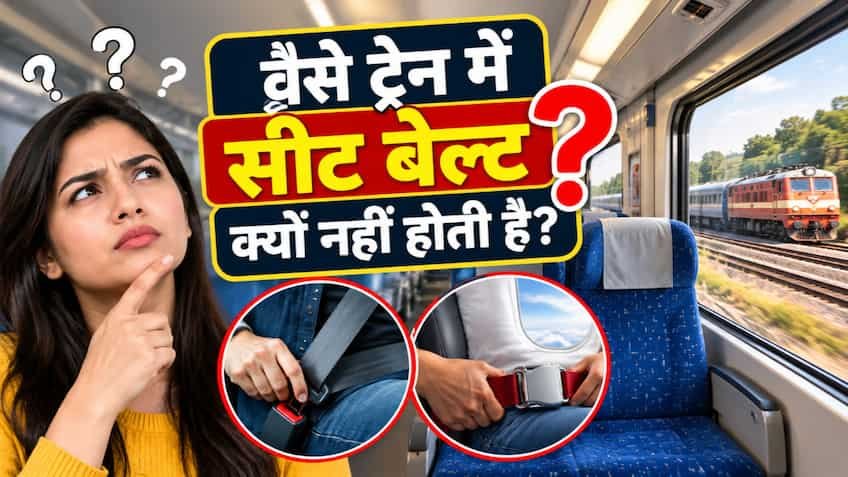
If you do not wear seat belt while driving on the road, you will be immediately fined a heavy fine. At the same time, it is mandatory for every passenger to fasten to his seat in the airplane during take-off, landing and turbulence amidst clouds as soon as the ‘Fasten Seat Belt’ sign turns on. When this basic rule of safety is so important both on the road and in the sky, then why is there no provision of seat belts in trains running at a speed of 100 to 130 km per hour carrying hundreds of passengers on the ground? Is the Railways careless about the safety of passengers or is there some deep scientific, technical and human reason behind it? When you deeply understand the basic principles of railway engineering and physics, it will become clear that the absence of seat belts in trains is not carelessness, but a well-thought-out scientific decision taken to keep passengers safe.
There is a world of difference in the way a train and a car move and stop. A normal car weighs around 1 to 1.5 tonnes. If there is suddenly an obstacle in front of a car running at a speed of 80 km per hour, then as soon as the driver presses the emergency brake, the car stops abruptly within a few seconds and within a few meters. Due to this sudden deceleration, a terrible force of ‘inertia’ is applied on the passengers sitting in the car, due to which they can collide with the windshield. To prevent this life-threatening shock, the seat belt becomes a lifesaver. In contrast, a complete train weighs about 1,000 to 1,500 tonnes, with 20 to 24 bogies and a huge locomotive engine. Due to such huge mass and huge momentum, a train can never stop suddenly in a second like a car. Even when the loco pilot applies the emergency brakes with full force, the heavy train still has to cover a distance of 800 to 1,000 meters i.e. about 1 kilometer to stop completely. This reduction in speed is so slow and gradual that the passengers are not subjected to any dangerous forward jerk, eliminating the need for seat belts.
The biggest reason for wearing seat belts in airplanes is unexpected air pressure and turbulence in the sky. While flying, the aircraft sometimes suddenly falls hundreds of feet downwards or starts wavering due to gusts of wind. If the passenger is not wearing the seat belt at that time, he may jump and hit the cabin roof and suffer serious injury. No such situation arises with trains. The train runs on a fixed track, perfectly balanced on strong steel tracks. The designing of the tracks, super-elevation of the curves and the suspension system of the coach are designed in such a way that the center of gravity inside the train always remains stable, due to which the risk of any passenger jumping from his seat in the air is negligible.
Studies by safety experts and railway research agencies have proven that if seat belts are installed in a train, instead of protecting the passengers in the event of a major accident, it can lead to their death. Car accidents usually occur due to head-on collision, but in train accidents, derailment i.e. falling off the tracks, bogies running over each other or overturning are most common. When a train meets with an accident, there is a risk of the coach catching fire, falling into water or the coach being crushed. In such critical moments, passengers have to run out through emergency windows or doors within a few seconds to save their lives. If the passengers are fastened with seat belts, then due to the belt not locking in the dark, smoke, water or panic environment, they will get trapped in the debris of the bogie and will not be able to get out quickly.
The biggest feature and attraction of train travel is that passengers are not forced to sit tied to the same chair for hours. On long-haul journeys, passengers lie down on their berths, stroll through the galleries, visit washrooms or go to the dining and pantry areas. In sleeper and 3-tier AC coaches, the berths are made up and down. It is extremely impractical to technically implement a seat belt system in such an open and multi-purpose environment. If a passenger is sleeping on an upper berth or standing in the aisle, then it may not be possible to enforce the belt requirement there under any circumstances.
Instead of seat belts, modern railways around the world focus on ‘passive safety’ and ‘active crashworthy’ design. Indian Railways is now replacing the old ICF coaches with modern LHB (Linke Hofmann Busch) coaches. These LHB coaches have ‘anti-climbing’ technology, which means that even after a severe collision, the bogies do not climb over each other nor do the coaches deflate like toys. Additionally, the interior of the coach is designed with ‘compartmentalization’ technology, with the seats and walls made of shock-absorbing cushion material. Besides, state-of-the-art automatic train protection systems like ‘Kavach’ are being installed, which prevent head-on collisions in advance. It is clear that the absence of seat belts in trains is not a lack of technology, but a tried and tested standard of providing freedom of safe evacuation to passengers and scientific balance of rail motion.