 look news india

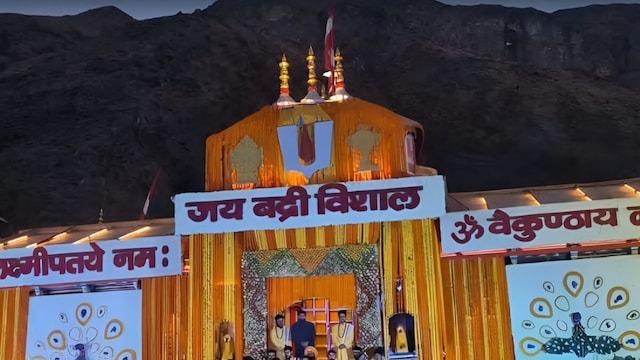
According to mythological beliefs and Sanatan Hindu scriptures, Vaikuntha Lok is considered to be the supreme abode of Lord Shri Hari Vishnu, where he resides with Mother Lakshmi. But Badrinath Dham located on earth has been termed as ‘Bhu-Vaikuntha’ because it is believed that in Satyayuga, Lord Vishnu had performed rigorous penance for thousands of years at this place. According to the legend, when Lord Vishnu was engaged in severe penance in this serene and snowy region situated on the banks of river Alaknanda, he was attacked by heavy snowfall and stormy winds. To save Lord Vishnu from this terrible weather, Goddess Lakshmi herself took the form of a huge ‘Badri’ i.e. wild plum tree and provided shelter to Lord Vishnu, bearing the snow, wind and sun. When Lord Vishnu’s penance was completed and he saw that Goddess Lakshmi was covered with snow, he became happy and said that from today at this place he will be known as ‘Nath of Badri’ i.e. ‘Badrinath’ and this place will be called Bhu-Vaikuntha.
Being located in the highly snow covered areas of Uttarakhand, Badrinath Dham receives excessive snowfall during winters, leaving the entire area covered in minus temperatures and a thick blanket of snow. For this reason, every year in the winter of Kartik month (around October-November) the doors of the temple are closed for the devotees for the next 6 months with special Vedic rituals. Before the doors are closed, a unique and extremely sacred tradition is performed. The movable idol (Utsav idol) of Lord Badrinath is brought down from the temple to Joshimath with full respect and chanting of mantras. During the entire 6 months of winter, Lord Badri Vishal resides in the famous Shri Nrisimha Temple of Joshimath, and there his worship and offering is done as per daily routine.
The most miraculous and mysterious belief regarding Badrinath Dham is that even when the main doors of the temple are closed to humans, the worship there does not stop. According to mythological beliefs, when humans are not present in the Dham during the 6 months of winter, then Devarshi Narad himself and other gods and goddesses come there and worship Lord Badri Vishal. While closing the doors, the chief priest (Rawal ji) goes inside the temple after lighting an unbroken lamp (Akhand Jyoti). The surprising thing is that after 6 months, when the doors are opened again in the month of Vaishakh (April-May), that eternal flame is found burning the same and the Tulsi leaves offered to God are found to be as fresh. Thousands of devotees reach Badrinath on the day of opening of doors to see this amazing scene.
Badrinath Dham is not just a temple but it is a great center of spiritual knowledge, yoga and peace. This divine abode is situated between two huge mountain ranges named ‘Nar’ and ‘Narayan’. In mythological texts, Nar and Narayan are considered to be two parts or incarnations of Lord Vishnu, who performed penance here for public welfare and establishment of religion. It is believed that in the Dwapar Yuga, this ‘Nara’ had incarnated in the form of Arjun and ‘Narayan’ had incarnated in the form of Lord Shri Krishna. Apart from this, the ‘Tapt Kund’ (natural source of hot water) located near the Badrinath temple complex is also a great scientific and religious miracle in itself, where boiling hot water comes out even in the harsh winter. Devotees bathe in it to wash away their sins and feel pure.