 look news india

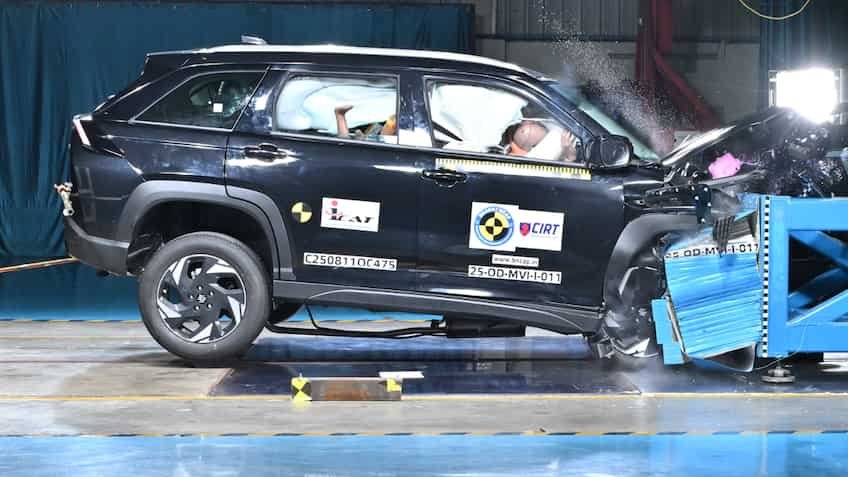
A major policy and technical change has been decided in the Indian automobile sector regarding the strength of vehicles and safety of passengers. Every new car running on the roads in the country will now have to go through more stringent safety standards than ever before. The Union Ministry of Road Transport and Highways has made it clear that the next phase of the Bharat New Car Assessment Program i.e. ‘Bharat NCAP 2.0’ (BNCAP 2.0) will be fully implemented from October 2027. Under this new protocol, the crash test rules will not be limited to just saving the lives of adults sitting in the cabin, but pedestrians walking on the road, active safety features working just before the accident and post-accident relief management are also being made a mandatory part of the safety star rating.
Currently, under India NCAP, vehicles have to undergo mainly three tests – offset frontal impact, side impact and side pole impact test. But two new stringent tests are being added to the new rules to be implemented from 2027, after which the total number of tests will increase to 5. The first new test will be the ‘Full Frontal Impact Test’, in which the entire car will be directly collided with a wall or barrier 100 percent of the time, so that the strength of the entire structure of the car and the deployment of airbags can be accurately assessed. The second major change is the ‘Rear Impact Test’, in which the vehicle will be hit from behind. This test is often considered very important to check the severe whiplash injury to the neck and spine of passengers in rear-end collisions on the highway and the crumple zone of the boot space. Along with this, the speed limit for side-pole test is also being increased from 29 km per hour to 32 km per hour.
Till now, mainly dummy models of average male height have been used in crash tests, but in BNCAP 2.0 this difference is being completely eliminated. The new rules will mandate the use of specially designed state-of-the-art female dummies, so that accurate data can be obtained on the pressure exerted on various body parts of women during collision. Apart from this, child occupant protection is also being given a new level, in which seat belt and child lock safety on the back seat will be actually evaluated through dummies of 6 year and 10 year old children. For side impact and pole tests, dummies with next-generation sensors are being procured, which will accurately record the strain on the ribs, head and hip bones within milliseconds of the collision.
It will no longer be possible for car companies to get a 5-star rating just by installing stronger metal sheets. In the new protocol, separate weightage has been given to the techniques used to save the vehicle before a crash i.e. ‘Accident Avoidance’. Under the new rules, to achieve a 5-star safety rating, electronic stability control (ESC) and curtain airbags will need to be standard. Apart from this, only the car which has the features of key tools of Advanced Driver Assistance System (ADAS) like Autonomous Emergency Braking (AEB), Lane Departure Warning, Driver Drowning Detection (alert when falling asleep) and Forward Collision Warning will be given the top rating in safety. That is, how capable the car itself is of sensing an accident and applying brakes and alerting the driver, this star will play a big role in deciding.
In view of the increasing number of electric vehicles on the roads, a special safety chapter for EVs has been added in India NCAP 2.0. Thermal runaway of the battery pack after a collision, risk of fire, current leakage from high-voltage wires and emergency systems like automatic door unlock will be closely tested. If a car meets with an accident, its doors should unlock automatically so that passengers and the rescue team can easily get out. Apart from this, Multi-Collision Braking (MCB)—which immediately applies automatic brakes after the first collision to protect the vehicle from a second collision—and Emergency SOS Call (E-Call) feature are also being included in the rating system.
In Bharat NCAP 2.0, not only the safety of the passengers sitting inside the car, but also the safety of ‘vulnerable road users’ i.e. pedestrians and cyclists has been made the main pillar of the rating. It will be mandatory for the bonnet, grill and front bumper of the car to be designed in such a way that the impact of injury on the head and knees of a pedestrian can be minimized if it collides with a pedestrian. With the advent of these stringent safety standards, the prices of new car models launched after 2027 may see a slight increase of 2 to 4 percent at the initial level, because auto companies will have to install body structural reinforcement and advanced sensors. However, according to the Road Transport Ministry, the testing cost of vehicles in India is only around Rs 60 lakh compared to Global NCAP (about Rs 2.5 crore), due to which there will be no additional burden of testing on domestic manufacturers and customers will be able to get global level safe cars at affordable prices.