 look news india

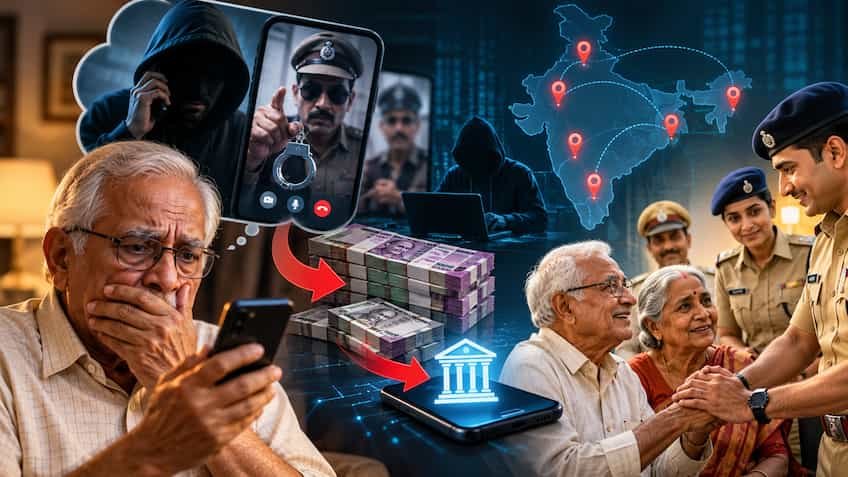
As rapidly as the reach of internet and smartphones has increased across the country, at the same speed, vicious cyber fraudsters have invented new and extremely scary ways of cheating common citizens. ‘Digital Arrest’, which has become the subject of most discussion and fear in recent months, is no longer limited to just a few metros, but has taken the form of a big organized interstate syndicate. Against this threat, the Special Cyber Cell (IFSO) of Delhi Police took a big and well-planned action and conducted rapid raids in 5 different states and saved Rs 1.53 crore of hard-earned money of innocent citizens from being transferred to the accounts of swindlers by freezing them at the last moment. In this joint operation, the police has also achieved great success in arresting many key masterminds of the gang and agents running the network of Mule Bank accounts.
The most shocking and disturbing fact that has emerged in the investigation is that the targets of this cyber network were mainly retired elders above 60 years of age, retired government officials and women living alone. Taking psychological advantage of these senior citizens’ lack of technical understanding and natural fear of the law, the fraudsters used to keep them digital hostage for several hours and get them to transfer crores of rupees of life savings, gratuity and pension fund to their fake bank accounts.
Digital arrest is not a legal process, rather it is completely a game of organized fraud and mental blackmailing. No provision like ‘digital arrest’ exists in Indian law, Indian Civil Defense Code (BNSS) or any other constitutional system. Any investigating agency of the country—be it CBI, Enforcement Directorate (ED), Narcotics Control Bureau (NCB), National Investigation Agency (NIA) or the local police of any state—can never arrest a person or give a legal order to sit in front of the camera over WhatsApp, Skype or video call.
Despite this, cyber fraudsters misuse technological resources to create such a virtual environment that the victim panics and loses the ability to distinguish between right and wrong. The fraudsters make video calls using the backdrops of fake police stations, court rooms and CBI offices, making everything appear completely real and authentic to ordinary citizens at first glance.
Investigation by Delhi Police revealed that this gang used to work on a very sophisticated and pre-planned script to trap its victims. The fraud usually started with an automated IVR call or a normal phone call. The caller claimed to be a representative of a well-known international courier company (like FedEx or DHL), the Customs Department or the Department of Telecommunications.
The victim was suddenly informed over the phone that an illegal parcel was being sent to Taiwan, Cambodia or Dubai using his Aadhaar card and mobile number, which was seized by the customs officials at the Mumbai or Delhi airport. The panicked old man was told that 5 fake passports, 150 grams of MDMA (drugs) and several banned SIM cards were recovered in that parcel. As soon as the victim would say that he had not sent any such parcel, the thugs would show sympathy in a very vicious manner and say, “It seems that some big terrorist or drug syndicate has done this by stealing your identity, hence we are transferring your call directly to the police headquarters.”
As soon as the call was transferred, a fake police inspector or DCP would appear on the screen, wearing police uniform, carrying a name plate and a walkie-talkie. He used to cite non-bailable sections like money laundering, terror funding and human trafficking to scare the victim. After this, PDF files of ‘Arrest Warrant’ and ‘Property Confiscation Order’ with fake seals of Supreme Court, Reserve Bank of India (RBI) and CBI were sent to the victim’s phone. The victim was threatened not to talk to anyone, close the door of the room and remain in front of the camera for 24 to 48 hours, which they called ‘digital custody’. Finally, in the name of “checking the legality of your money”, all the money was transferred to fake accounts in the name of Government Escrow Account.
When the Special Cell started a technical investigation on the complaint of a retired senior citizen of Delhi, the money trail was found spread across several states. Cyber cell teams conducted simultaneous planned raids in Delhi-NCR, Uttar Pradesh, Rajasthan, Gujarat and West Bengal. Police quickly coordinated with financial intelligence units and nodal officers of banks.
At the same time when the thugs were trying to withdraw Rs 1.53 crore snatched from an elderly person from the ATM and send it out of the country through crypto currency and hawala, at the same time the police team digitally froze dozens of ‘mule accounts’ (fake bank accounts opened in the name of others). The investigation also revealed that the masterminds of this gang were in direct contact with foreign syndicates based in cyber scam hubs of South-East Asian countries like Myanmar and Cambodia and agents operating in India were tasked with providing accounts only on commission basis.
Cyber security experts and law enforcement agencies have appealed to citizens to use normal legal procedure and discretion instead of panicking over any unknown call:
-
Understand the law, there is no arrest on video call: Always remember that no police officer, custom officer or judge in India records statement over video call nor arrests anyone digitally. To make an arrest the police have to come in person with a warrant.
-
Flatly refuse to sit in front of the camera: If someone tries to threaten you by showing your uniform on a video call, disconnect the call immediately. Do not under any circumstances sit in front of the camera or close your room.
-
Never send money in the name of ‘verification’: No government department, RBI or CBI ever asks you to transfer money to your accounts to ‘verify’ your assets or bank balance. If someone demands to send money to the account, then it is 100% fraud.
-
Share instantly with family and acquaintances: The first move of the fraudsters is to isolate the victim socially so that he cannot seek advice from anyone. If you receive any such call, immediately tell the whole story to your family members, children or close friends.
-
Take helpline 1930 and local police station: If you receive any suspicious call, without wasting a moment contact the National Cyber Crime Portal of the Government of India. cybercrime.gov.in Register complaint on or 24×7 cyber helpline number 1930 Call immediately. You can also immediately go to your nearest police station and confirm the situation. Awareness and immediate bold action are the strongest defense against this digital terror.