 look news india

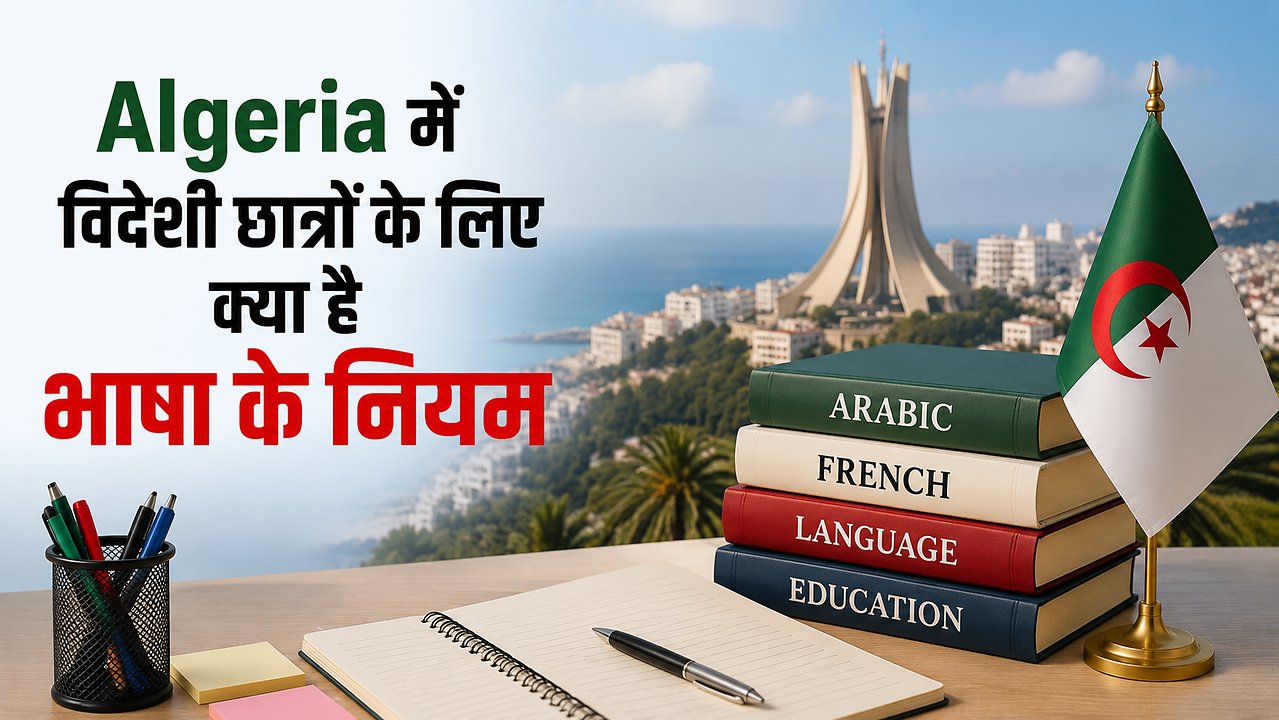
Algeria, the largest country in North Africa, is now making its mark as an emerging higher education hub for international students. Students from Asia, Africa and the Middle East, including India, are flocking to Algerian universities due to its rich historical heritage, Mediterranean climate and globally affordable tuition fees. However, the most important step for foreign students planning to take admission here is to understand the rules and medium of the language. Algeria’s higher education system is based on a multilingual framework, where the medium of instruction is determined by individual faculty. If you are also planning to pursue a degree from prestigious institutions in Algeria, it is essential to closely understand the official language rules and proficiency requirements before applying.
The Algerian Ministry of Higher Education and Scientific Research has launched a digital platform (‘Study in Algeria’) to facilitate the admission of foreign students. Students applying through this portal have to prove language proficiency as per their preferred course. Mainly three languages—Arabic, French, and increasingly in recent years, English—form the basis of the academic curriculum of higher education institutions in the country. Based on the selection of the subject, it is decided in which language the student will have to appear for the examination or in which language the proficiency certificate will have to be submitted.
The classification of languages in Algerian universities is kept quite clear based on faculty. All studies and examinations in subjects such as humanities, social sciences, law, Islamic studies, political science and literature are officially conducted in the Arabic language. If a foreign student wants to pursue a bachelor’s, master’s or doctoral degree in these subjects, then a strong command of Modern Standard Arabic is the first and mandatory condition. For admission to Arabic medium courses, students have to provide evidence of communication, writing and research in the respective language.
On the other hand, the French language has been a major influence for decades in technical courses such as medicine, pharmacy, dentistry, engineering, architecture, computer science and natural sciences. Even though the national languages of Algeria are Arabic and Tamazight, French continues to be the medium of lectures, research papers and practicals in most technical and medical colleges. In addition, as part of the Algerian government’s policy of rapid internationalization of its higher education system, courses in Artificial Intelligence (AI), Data Science and Advanced Technology are now being offered entirely in English medium in many leading universities, National Centers of Excellence and technical institutes.
To gain direct admission to degree programs at Algerian universities, foreign students are required to provide official proof of their language proficiency. If you are applying to a course whose medium of instruction is French, you are required to submit a scorecard of at least B2 level of DELF (Diplôme d’Etudes en Langue Française) or DALF or TCF (Test de Connaissance du Français). This certificate ensures that students can easily understand the complex scientific discussions and theories taking place in the classroom.
Degree programs conducted through English medium require students to have internationally recognized test scores such as IELTS or TOEFL scores. Generally, a minimum score of 6.0 to 6.5 band is acceptable for most engineering and research programs. At the same time, students whose previous education has been completed in English medium can also get conditional exemption on the basis of ‘Medium of Instruction’ (MOI) certificate issued by the concerned institution. For Arabic language courses, the university’s admission board may conduct a direct online interview or language test of the student.
It often happens that bright students from India or non-Arabic/non-French speaking countries have excellent academic records but are not proficient in the instructional languages of Algeria. For such students, special provision has been made in the Algerian higher education system for ‘Preparatory/Intensive Language Year’. Under this, the student has to complete a one-year intensive language training course before starting the main degree course.
During this one year, students are enrolled in the university’s Center for Intensive Language Teaching (CEIL), where they receive intensive practice in Arabic or French grammar, vocabulary and academic writing for several hours a day. After passing the standardized assessment held at the end of the year, the student is automatically allowed to begin regular classes in his/her main degree program (such as Medicine, Engineering or Arts). This system gives an excellent opportunity to foreign students to adapt to the local culture and completely eliminate the fear of language.
Language preparation also plays an important role during student visa application for Algeria. At the time of visa interview at the embassy, the student may be asked questions by the officers regarding his/her medium of study and his/her preparation. Language proficiency is also considered an important measure of merit in various bilateral scholarships offered by the Algerian government.
In terms of everyday life outside the campus, there is a widespread influence of the local colloquial language ‘Darija’ (Algerian Arabic) and French in Algeria. Knowing basic French or everyday Arabic sentences to converse in hostels, supermarkets, public transport and local markets makes life much easier for foreign students. Therefore, students planning to go to Algeria are advised to start basic language training well before their departure so that they can enjoy a safe, enriching and stress-free academic journey.