 look news india

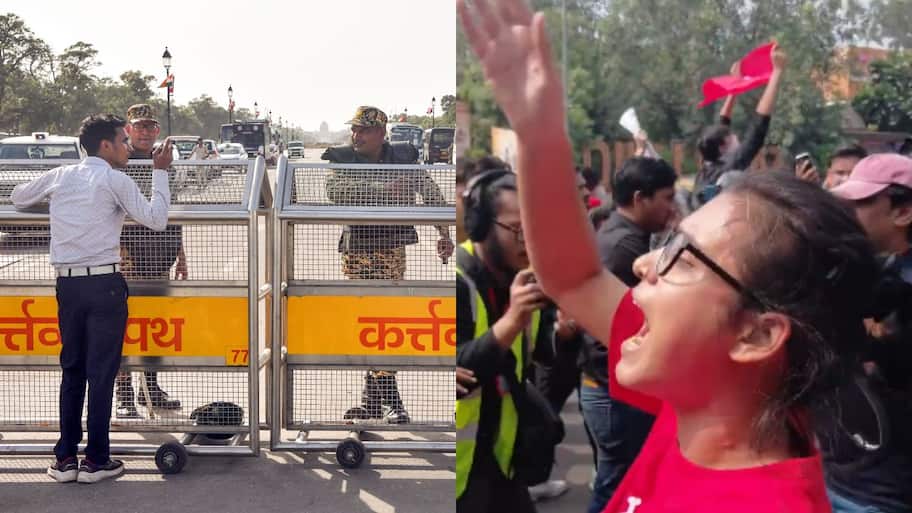
The controversy arising out of the Election Commission and SIR policies in the country’s capital Delhi has now taken the form of a big political and social conflict. Protests by student organizations, social workers and opposition party workers have become fierce on the streets regarding the recent decisions of the Election Commission and the issues of electoral transparency. To control the situation, the administration has temporarily suspended mobile internet services in New Delhi and surrounding sensitive areas. Security forces took action and detained more than 1,500 protesters, while All India Students Association (AISA) national president Neha Bora was also detained by the police from the protest site.
The controversy began following allegations of lack of transparency in the electoral processes and the alleged SIR process being implemented by the Election Commission. Students and civil rights groups allege that this policy of the Commission is disenfranchising many eligible voters. Regarding this issue, hundreds of student organizations, civil society members and youth activists gathered at Jantar Mantar and started raising slogans demanding the resignation of the Chief Election Commissioner. The protesters completely blocked the roads leading to Parliament Street and Connaught Place, causing complete disruption of traffic in Lutyens’ Delhi.
The administration took immediate steps to control the ever-increasing pressure of the crowd and the rapidly spreading rumors on social media. In coordination with the Home Ministry and Delhi Police, mobile internet services were suspended with immediate effect in major parts of Jantar Mantar, New Delhi district and surrounding areas. Police officials say that this decision has been taken as a precautionary measure to maintain law and order and thwart attempts by anti-social elements to gather crowd. Section 144 has been imposed in the entire area and a complete ban has been imposed on the gathering of four or more people at one place.
As soon as the protesters tried to march towards Parliament, the police stopped them by erecting several layers of barricades. When the crowd tried to move forward, the police had to resort to water cannon and then a large-scale crackdown began. According to eyewitnesses, the police detained more than 1,500 protesters one by one and packed them in dozens of buses and sent them to various outskirts of the city like Narela, Bawana and Mandir Marg. Those detained include student leaders from several prominent universities, social workers and office-bearers of various organisations.
AISA’s national president Neha Bora, who was leading this entire movement, was taken into custody by Delhi Police during the march. When Neha Bora was addressing the supporters and calling for carrying forward the march, the female policemen surrounded her, took her into custody and made her sit in the police vehicle. During this period, heated arguments and scuffles were also seen between students and policemen. As soon as the news of Neha Bora’s detention was received, students started protesting in many campuses including JNU, Delhi University and Jamia Millia Islamia and demanded the immediate unconditional release of their leader.
On the other hand, the Election Commission and the administration say that the procedures being adopted regarding electoral processes and purification of voter list are completely legal, transparent and fair. Sources in the Commission say that the name of any eligible citizen is not being struck off unfairly and all the objections are being investigated at the ground level through BLOs. The authorities have appealed to the protesters to express their views democratically and not to take law and order into their own hands. At present, heavy police force and companies of paramilitary forces are deployed in sensitive areas of New Delhi and the situation is being continuously monitored through drone cameras.