 look news india

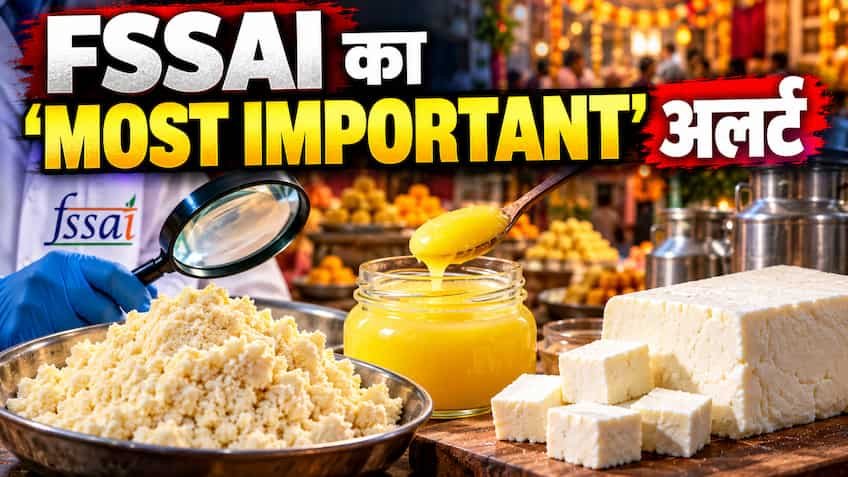
With the onset of big festivals like Dussehra, Karva Chauth, Dhanteras and Diwali, there is a huge surge in the demand for milk, mawa (khoya), paneer, sweets and desi ghee in the market. Under the guise of this increased demand, in order to earn more profits, adulterators become active and launch synthetic food products prepared with detergent, urea, refined oil, starch and dangerous chemicals in the market. To deal with this serious problem that directly threatens the health of the general public, the Food Safety and Standards Authority of India (FSSAI) has issued an official alert of ‘Most Important’ category. The regulator has ordered food safety commissioners of all states and union territories in the country to be on high-alert. Under this nationwide campaign, strict instructions have been given to keep 24-hour surveillance at dairy plants, wholesale markets, cold storages, interstate transport check-posts and local sweet shops and immediately seize suspicious samples.
During festivals, the production of natural milk in the country remains limited, but the demand for mawa and paneer increases by four to five times. To bridge this huge gap, adulterators play chemical games in an organized manner. According to investigation reports, substandard milk powder, potatoes, sweet potatoes, arrowroot, starch and stale bread are used to prepare fake mawa, while cheap palm oil or vegetable ghee is added to make it smooth. To make fake and synthetic cheese, poisonous chemicals like caustic soda, detergent powder, urea and hydrogen peroxide are mixed in synthetic milk. Not only this, in the name of pure desi ghee, a poisonous mixture prepared by mixing animal fat, paraffin wax and artificial butter flavor is sold in the market. Continuous consumption of such contaminated and adulterated food items increases the risk of life-threatening diseases like liver and kidney damage, food poisoning, intestinal ulcers and cancer in the long run.
FSSAI has clarified in its instructions that to detect adulteration, instead of limiting itself to traditional paperwork, state-of-the-art ‘Food Safety on Wheels’ (FSW) i.e. mobile lab vans will be deployed directly at markets, railway stations and highway toll plazas. These vans are capable of doing primary detection of starch, urea, detergent and artificial colors in milk, khoya and ghee within just 15 to 20 minutes on the spot. Along with this, a joint task force of police and food safety officials has been formed to thoroughly investigate the consignments of mawa and paneer supplied through trucks and passenger buses from one state to another. Instructions have been given to seal the illegal dairies and illegal manufacturing units operating without a valid food license (FSSAI License/Registration) on the spot and impose heavy fines.
To keep consumers on their toes to avoid adulterated goods, FSSAI has suggested some simple home testing methods (DART – Detect Adulteration with Rapid Tests) that anyone can try in their kitchen in a few minutes:
-
Testing of Starch in Mawa (Khoya): Boil a small piece of mawa brought from the market in water and cool it. After this add 2-3 drops of tincture iodine on it. If the color of mawa changes to blue or dark purple, then adulterated starch or boiled potatoes are mixed in it. The color of pure mawa does not change when iodine is added. Apart from this, rubbing real mawa on the palm gives off the fragrance of ghee and slight smoothness, whereas fake mawa feels grainy and sticky.
-
Cheese texture and iodine test: Boil a piece of cheese in water and when it cools down, add drops of iodine on it. Blue color is a clear sign of adulteration. Apart from this, real cheese is very soft and tastes like it dissolves in the mouth, whereas synthetic or rubbery cheese feels hard to chew and stretches like rubber when pulled.
-
Hydrochloric Acid Test of Pure Desi Ghee: Mix equal quantity of hydrochloric acid (HCl) and a pinch of sugar in one spoon of melted ghee. Shake it well and leave it for 5 minutes. If the bottom part turns dark red or pink, the ghee is adulterated with vegetable (dalda). Additionally, add one teaspoon ghee to the hot pan; If it melts immediately and turns dark brown then it is pure, but if it takes time to melt and looks yellow then it may be adulterated.
Manufacturing, storing or selling adulterated and unsafe food items is a non-bailable and serious cognizable offense under the provisions of the Food Safety and Standards Act, 2006 (FSS Act). According to FSSAI guidelines, if adulteration of any food item poses a threat to a person’s life or causes serious illness, a case under Section 59 will be registered against the guilty trader or manufacturer. Under this, there is a strict legal provision for punishing the culprit ranging from minimum 7 years imprisonment to life imprisonment and a financial fine of up to ₹ 10 lakh. Apart from this, food licenses of shopkeepers who repeatedly violate the rules will be canceled forever with immediate effect.
FSSAI has appealed to consumers not to hesitate in reporting any suspicious shop or adulterated product. If you suspect adulterated mawa, paneer or ghee being sold at any sweet shop, dairy or grocery store, you can directly contact the Central Government’s National Food Security Portal. ‘FoSCoS’ (Food Safety Compliance System) You can lodge a complaint online by visiting. Apart from this, FSSAI’s national toll-free helpline number 1800112100 Complaints can be lodged by calling Food Safety Connect or by uploading photos and bills through the ‘Food Safety Connect’ mobile app. The identity of the consumer will be kept completely confidential and a team of local food inspectors will reach the spot within 24 hours and collect samples.