 look news india

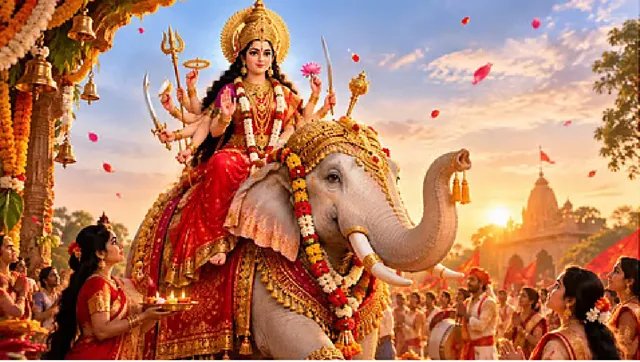
In Sanatan Dharma, Shardiya Navratri, which starts from Pratipada of Shukla Paksha of Ashwin month, has immense importance from both spiritual and worldly point of view. In this nine-day long festival, nine divine forms of Maa Durga—Shailputri, Brahmacharini, Chandraghanta, Kushmanda, Skandamata, Katyayani, Kalratri, Mahagauri and Siddhidatri—are duly worshipped. According to religious beliefs and Goddess Bhagwat Purana, not only the worship of Mother Goddess in Navratri, but also the special astrological and natural significance of the vehicle on which Jagadamba, the mother of the world, is coming to the earth and on which vehicle she is departing on the day of Vijayadashami i.e. immersion. Although the daily vehicle of Maa Bhagwati is Singh (lion), specific riders have been pre-determined in the scriptures depending on the Vaar i.e. day for the arrival and departure of Navratri. In the Shardiya Navratri of the year 2026, Maa Ambe is arriving riding on Gaj i.e. elephant, which is considered a very auspicious, auspicious and all-welfare sign in astrology and folk tradition.
During Navratri, the vehicle of Mother Goddess is determined by the day on which Ghatasthapana i.e. Pratipada Tithi falls, and the Vaar of the day of immersion decides the departure vehicle. There is a very famous and authentic verse on this subject in Devi Bhagwat Purana:
Shashisurye gajarudha shanibhaume turangme.
Guru Shukre Cha Dolayan Budhe Nauka Prakirtita ॥
The meaning of this verse is that if Navratri starts on Sunday or Monday, then Mother Goddess comes riding on an elephant (Gaj). When the Kalash is established on Saturday or Tuesday, the goddess’s ride is considered to be a horse. When Navratri starts on Thursday or Friday, Mata arrives on a doli (palanquin), while when it starts on Wednesday, Mata arrives on a boat. In Shardiya Navratri 2026, due to Pratipada Tithi and Ghatasthapana being completed on Sunday, Mother Bhagwati has arrived on the most sacred vehicle, elephant.
In the scriptures, elephant is considered a symbol of knowledge, peace, patience, opulence and glory. When Mother Durga enters the earth riding on Gajraj, it is a sign that economic prosperity will expand in the country and society in the coming times. Due to its effect, there is bumper production in the agricultural sector, the balance of rainfall remains naturally favourable, and the reserves of food and water remain full. From an astrological point of view, the elephant is associated with the blessings of both Lord Jupiter and Mahalakshmi. Therefore, the arrival of Mata at Gaj clearly indicates the increase in business activities in the nation, improvement in the standard of living of the people, social harmony and freedom from diseases and ailments. There is a strong possibility that this year will prove to be especially fruitful and prosperous for the farmers and the general public.
Just as the vehicle of arrival decides the direction of the future of the country and the world, in the same way the vehicle of departure is decided by the day on which the immersion of Mata is taking place on Vijayadashami i.e. Dashami Tithi. According to Devi Bhagwat, the classical rule of results of vehicles of departure is as follows:
Shashi sun day if sa vijaya mahishagamne rooj shokakara.
If Shani Bhomadine is victorious, Turgamne Turangme will break the fruit.
Guru Shukre Jadi Sa Vijaya Gajavahanaga Shubh Vrishtikara.
If on the occasion of Wednesday, Vijaya Narvahanaga, then auspicious good fortune will be given.
That is, if the immersion takes place on Sunday or Monday, then the mother goes on the buffalo (Mahish), which is the cause of disease and grief. When the immersion takes place on Saturday or Tuesday, the Mother Goddess goes on horseback, due to which there is a fear of political turmoil or crisis. When immersion takes place on Wednesday, there is a human ride (carriage), which brings happiness and peace. Whereas on Thursday or Friday, when Vijayadashami falls, the Mother again departs on an elephant, which is an indicator of abundant rainfall and great prosperity. The vehicle of departure according to the day of Vijayadashami indicates what precautions citizens have to follow throughout the year.
In this most auspicious time of the arrival of Mother Goddess on elephant, devotees should take a pledge to perform Ghatasthapana and worship in their homes. On the day of Pratipada, after morning bath, make a clean altar in the north-east corner and sow barley in the sacred soil. On top of that, keep pure water, Ganga water, Durva, coin, Akshat and five leaves of mango or Ashoka in a copper, brass or clay urn. Install a coconut (shriphal) wrapped in red cloth on the Kalash. If you are lighting Akhand Jyoti in the house, then keep in mind that the lamp should be installed in the southeast corner (south-east) and it should be kept protected from wind gusts for 9 days. Follow Satvik diet during the entire Navratri period, recite Durga Saptashati and do Kanya Puja in the last days by paying respect to the girls every day. By worshiping with devotion and devotion, Mother Bhagwati frees the family from all troubles and bestows blessings of health and prosperity.