 look news india

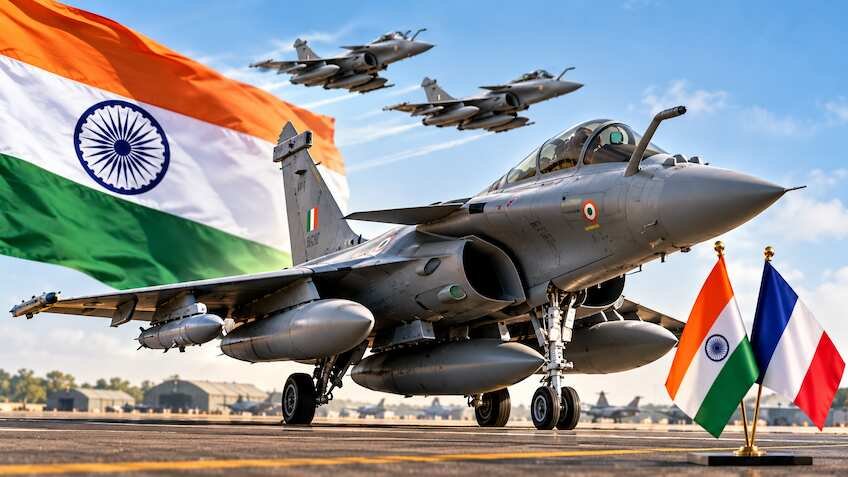
The procurement process of 114 new Multi-Role Fighter Aircraft (MRFA) has been expedited to immediately strengthen the declining fighter squadron capability of the Indian Air Force and to ensure strategic advantage on both the fronts (China and Pakistan). In the annual press conference organized before Air Force Day, Air Force Chief Air Chief Marshal AP Singh has clarified the situation regarding the country’s biggest defense deal. The Air Force chief confirmed that talks with France for the purchase of 114 modern fighter aircraft are in progress. If all the technical, commercial and administrative formalities are completed within the deadline, this historic defense contract can be formally signed by the end of the financial year 2026-27 i.e. March 2027.
The deal is being taken forward under a G-to-G (Government-to-Government) agreement with the French government after receiving preliminary approval by the Defense Acquisition Council (DAC) in February. With an estimated cost of around Rs 3.25 lakh crore (about $38 to 40 billion), the project is independent India’s largest ever defense procurement campaign. The main objective of this agreement is to expand the existing fleet of Rafale fighter aircraft in the Indian Air Force and reduce the cost of maintenance, logistics and training. When large numbers of the same platform are inducted into the Air Force, its spare parts, pilot training and operation of ground support systems become very economical and practical.
If this deal for 114 new Rafale aircraft is successfully concluded, the Indian Armed Forces will have the world’s largest foreign fleet of Rafale aircraft.
-
Indian Air Force (IAF): 36 Rafale jets are already deployed at Ambala and Hashimara airbases. With the addition of new 114 aircraft, the Air Force will have a total of 150 state-of-the-art Rafale aircraft.
-
Indian Navy: The procurement process for 26 Rafale-M (Marine) aircraft for INS Vikrant and INS Vikramaditya is in the advanced stages.
-
Total Strength: India will have the invincible force of a total of 176 Rafale fighter jets to protect both land and water borders.
The most revolutionary term of this deal is the combination of transfer of technology (ToT) and indigenous equipment. The first 18 aircraft out of 114 will come directly from France in ‘fly-away’ condition, while the remaining 96 aircraft will be manufactured in India under a joint venture between domestic defense companies and Dassault Aviation. Both the Defense Secretary and the Air Force Chief have clarified that these aircraft will be fully integrated with the ‘Uttam’ AESA radar, Astra Beyond Visual Range (BVR) missiles, Rudram anti-radiation missiles and indigenous Electronic Warfare (EW) suite developed by India’s DRDO. This will not only end the dependence on foreign weapons but in future India will not have to look to any other country for ammunition.
Air Force Chief Air Chief Marshal AP Singh also expressed concern over the declining combat strength of the Air Force. At present the Indian Air Force has only 29-30 squadrons active against the sanctioned strength of 42 squadrons. This gap is increasing further due to the gradual retirement of obsolete MiG-21 and MiG-29 aircraft. He said in clear words that the country is in dire need of inducting at least 36 to 40 new fighter aircraft into the fleet every year for the coming few years to maintain its overall military capability and combat preparedness. For this, it will be mandatory to accelerate the production of indigenous Tejas Mark-1A, Tejas Mark-2 and fifth generation Advanced Medium Combat Aircraft (AMCA).
The Air Force Chief laid special emphasis on the fact that India should not be limited to only assembling fighter aircraft, but will also have to manufacture jet engines within the country. He termed it the ‘Spiral Development Model’, under which aircraft are always kept adapted to new global challenges through periodic software and hardware updates. This mega deal of 114 new Rafale jets will not only make the Indian airspace impenetrable, but will also increase India’s conventional deterrence capability manifold in the face of the deployment of fifth generation aircraft like China’s J-20 on the northern border.