 look news india

New Delhi. In farming, from sowing to harvesting of crops, the biggest challenge faced by the farmers is to keep the crops safe from the attack of pests and diseases. Pink bollworm in cotton, stem borer in paddy, fall armyworm in maize and sucking insects in pulses, oilseeds and vegetables cause huge economic losses every year. To deal with these, farmers spray chemical pesticides indiscriminately, which not only increases the cost of farming but also has a negative impact on the fertility of the land and the environment. To find an environment-friendly and economical solution to this problem, the Agriculture Department of the Central and various State Governments have started promoting the use of Pheromone Trap and Yellow/Blue Sticky Trap under Integrated Pest Management (IPM). The government is providing huge subsidy of 50 to 75 percent to the farmers on the purchase of these traps.
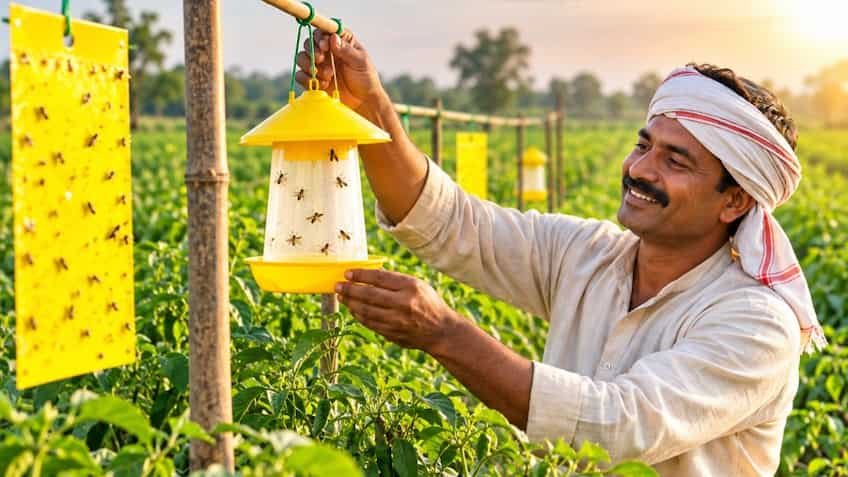
Pheromone traps and sticky traps are scientific methods of biological and physical pest control, in which insects are attracted and destroyed without any poisonous chemicals. In pheromone traps, artificial hormones (lure) containing the odor of female insects are used. Attracted by this smell, only male insects are attracted towards the trap and get trapped in the plastic bag or funnel. Due to the destruction of male insects, the reproduction cycle of insects is broken and eggs or caterpillars of the next generation are not produced.
Sticky traps, on the other hand, are typically yellow and blue colored sticky plastic sheets. Small sucking insects like whiteflies, aphids, thrips and jassids are naturally attracted to bright colours. When they fly and sit on these sheets, they stick to them due to the special glue applied on them and die there. Yellow sticky trap proves to be very effective for whiteflies and aphids and blue trap is mainly for the control of thrips.
Under the schemes of Agriculture Department like National Food Security Mission (NFSM), Rashtriya Krishi Vikas Yojana (RKVY) and Sub-Mission on Agricultural Mechanization, farmers are being given huge grants on these equipments:
-
Government subsidy from 50% to 75%: Generally, 5 to 8 pheromone traps and 10 to 15 sticky traps are sufficient for one acre of field. The government provides 50 to 75 percent subsidy on these sets of traps and lures, leaving the farmer to bear only one-fourth of the actual price.
-
Reduction in medicine expenses by up to 40%: According to agricultural scientists, if traps are installed in the field at the initial stage of crop production, there is a direct saving of 35 to 45 percent in the expenditure on expensive chemical sprays.
-
Timely Monitoring (Pest Monitoring): These traps not only kill the insects, but also warn the farmer as to which insect activity has started in the field, so that appropriate biological measures can be taken at the right time.
Experts have issued scientific guidelines for setting these traps to achieve maximum results:
-
Keep in mind the height: Pheromone traps and sticky traps should always be tied to wooden or bamboo sticks about 1 to 1.5 feet above the height of the crop. As the crop grows, the height of the trap should also be increased.
-
Wind Direction: Traps should be placed at the edges of the field and in the direction favorable to the wind flow so that the smell of pheromone can spread evenly throughout the field.
-
Changing Lure: The effectiveness of pheromone capsules or lures usually lasts 30 to 45 days. After this it is necessary to apply a new scent pad.
The subsidy is provided directly to registered farmers under a transparent system by the Agriculture Department:
-
Registration on the portal: Interested farmers should login to the official DBT portal of their state agriculture department (like UP Krishi Darshan, Rajkisan Sathi, MahaDBT, or MP DBT portal).
-
Selection of plan: Go to the ‘Integrated Pest Management’ or ‘Crop Protection Equipment’ section and select the pheromone trap and sticky trap options.
-
Required Documents: Attach the Khatauni (Jamabandhi) of the land, copy of bank passbook, and farmer’s identity card with the application.
-
Verification and Delivery: After verification by the Agricultural Extension Officer (ADO/Kisan Mitra) of the concerned block or tehsil, farmers can get these traps at concessional rates from the nearest Krishi Vigyan Kendra (KVK), Sadhan Cooperative Society or authorized vendors.
Indiscriminate use of chemical pesticides is not only deteriorating the health of the soil but also destroying friendly insects (like bees and ladybird beetles). By taking advantage of this subsidy scheme of the government, farmers can take strong steps towards more safe and environment-friendly farming at lower cost.