 look news india

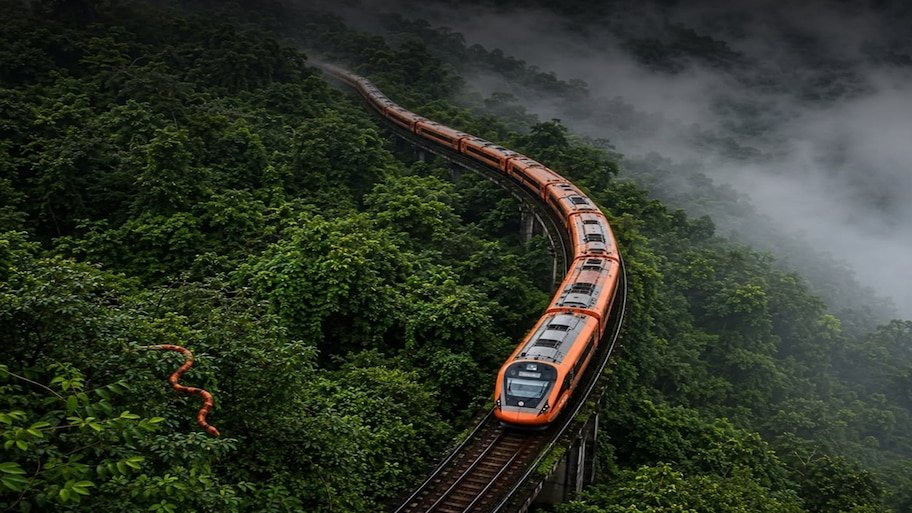
New Delhi. A new golden chapter of modernity, speed and indigenous technology has been added in the history of Indian Railways. While on one hand the construction work of Mumbai-Ahmedabad high-speed bullet train corridor is progressing rapidly in the country, on the other hand, Indian Railways’ indigenous semi-high speed Vande Bharat Express, already running on the tracks, has surprised everyone by crossing the milestone of maximum speed of 180 kilometers per hour (180 kmph) during the trials.
The train demonstrated excellent stability, minimal vibration and world-class safety standards even at a speed of 180 km/hr in the trials conducted by the Research Designs and Standards Organization (RDSO) and technical teams of the Railways. This historic achievement has made it clear that the country’s general broad-gauge network is now fully capable of operating global level high-speed trains. Vande Bharat is now directly challenging the supremacy of the country’s most prestigious trains—Rajdhani and Shatabdi Express, completely changing the landscape of intercity and long distance travel.
Traditional Rajdhani or Shatabdi Express trains have a heavy-duty locomotive at the front, which pulls the entire train of coaches. Due to this arrangement, the train takes a long time to reach its maximum speed (acceleration) and stop (deceleration). In contrast, Vande Bharat Express ‘Self-propelled’ or distributed power technology (Distributed Power EMU Technology) But it works.
Major advantages of this technology:
-
Rocket-like acceleration: Vande Bharat is capable of accelerating from zero to 100 km/h in just 52 seconds, which is comparable to many bullet trains and high-speed sports cars. Rajdhani Express takes about two to three times the time to reach the same speed.
-
Aerodynamic Nose Cone: The front part of the train is streamlined and aerodynamic like a bullet train, due to which there is a huge reduction in air resistance and the train can easily reach speeds of up to 180 km/h with low power consumption.
-
Advanced Regenerative Braking: Energy is not wasted when braking, but the electricity is fed back into the grid, allowing the train to save approximately 30% energy.
When the train touched the 180 km/h speed mark, the ‘glass of water’ test conducted inside the cabin attracted worldwide attention. Even while running at full speed, not a single drop of water spilled out of the water glass kept on the table. This is a direct testimony to its advanced semi-active bogie suspension and superior ride index.
Compared to Rajdhani and Shatabdi, passengers are getting modern facilities:
-
KAVASCH Safety: The train is equipped with a fully indigenous automatic train protection system ‘Kavach’, which automatically applies brakes and stops two trains coming head-on on the same track in case of human error.
-
180-degree revolving seats in Executive Class: The seats in the Executive Chair Car rotate in the direction of train movement, which is not available in Rajdhani or Shatabdi.
-
Airplane-like cabin and bio-vacuum toilets: The train has fully sealed gangways, odor-free bio-vacuum toilets, touch-free sensors and CCTV cameras, passenger information system and Wi-Fi infotainment screens in every coach.
Although the train is capable of running at 180 km/h, in regular commercial operations it is run at between 130 to 160 km/h. To overcome the existing limitation of tracks, Railway Board has launched a mega campaign of track upgradation under Mission 160+:
-
Delhi-Mumbai and Delhi-Howrah Route: Both these busiest Golden Quadrilateral routes are being prepared for the speed of 160 km/hr. For this, strong fencing is being done on both sides of the track so that cattle or people cannot come on the track.
-
Automatic Signaling and Thick-Web Switches: Old junction points are being replaced with modern thick-web switches on the tracks, so that trains can easily pass through turns without reducing speed.
This rapid expansion of Vande Bharat and continuously improving speed records has taken Indian Railways to the point of self-reliance, where in the coming years, every corner of the country is going to be connected with high-speed, secure and comfortable connectivity.