 look news india

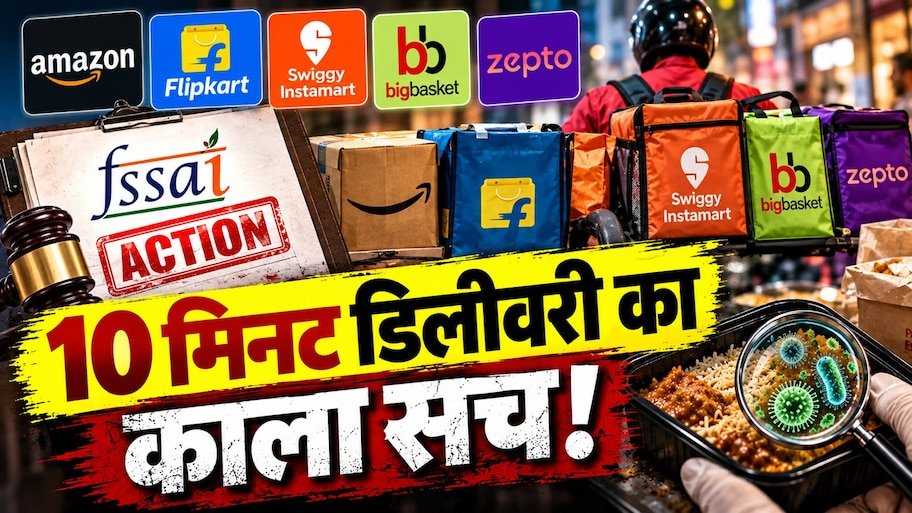
New Delhi. In this busy life, the country’s top food safety regulator has taken the biggest action against quick-commerce and e-commerce platforms that provide delivery of ration, fruits, vegetables, dairy products and packaged food within 10 to 15 minutes in a few clicks on mobile. The Food Safety and Standards Authority of India (FSSAI) has initiated formal penal action against the country’s five largest food companies on serious allegations of blatant flouting of rules, making false health claims that mislead consumers and even listing banned and poisonous food items online.
The five major platforms against which the regulator has tightened the noose include Amazon (Amazon Seller Services), Swiggy Instamart, BigBasket (Innovative Retail Concepts), Flipkart India (Flipkart India) and Zepto (Zepto Marketplace). FSSAI has made it clear that India’s e-commerce boom cannot come at the expense of consumers’ health and safety. This information given by the authority through social media and official statements has left crores of consumers ordering online in shock, as dangerous fraud and violation of rules were going on openly on the platforms on which they trusted to order daily food.
In the cases registered by FSSAI under the Food Safety and Standards Act, 2006 (FSS Act, 2006) and related rules, three very serious revelations that are jeopardizing the health of consumers have come to light:
-
Online sale of poisonous and banned products like Datura: The most shocking and dangerous case is that of poisonous plant Dhatura (fruits and seeds) being listed and sold online in the guise of food products or herbs. FSSAI investigation found that Amazon, Swiggy Instamart and BigBasket But Dhatura fruits and seeds were being sold and displayed unabated. Datura is completely unsafe, poisonous and banned for human consumption under the law. Its easy availability on food platforms could prove fatal.
-
Misleading and fake claims on dairy products: Swiggy Instamart and BigBasket But several products from popular dairy brand Milky Mist—notably Fresh Low-Fat Cream, Farm Fresh Curd and Greek Yoghurt—were found to contain misleading information and false nutritional claims in their listings. The product descriptions on these platforms were not in accordance with the dairy standards prescribed by FSSAI.
-
Misbranding and non-compliance in ‘Hapilo’ snacks: The five leading platforms—Amazon, Flipkart India, Swiggy Instamart, Zepto and BigBasket—Action has been initiated against Happilo over the product named ‘Happilo Premium Date Bites – Zesty Orange’. The investigation found that the online listings made misleading and unverified claims regarding the health benefits, ingredients and quality of this product, which are in direct violation of Packaging & Labeling Regulations.
As the pace of quick-commerce has increased in the metro cities of the country, questions have also started being raised on the quality of their dark stores and warehouses. State Food Safety Commissioners and FSSAI teams have conducted surprise inspections at several dark stores in the last six months.
This investigation revealed that:
-
Hiding expiry date: While ordering goods on the online app, customers are not given clear information about the ‘manufacturing date’ and ‘best before’ of the product, due to which many times the goods which are very close to expiry are delivered to the customers’ homes.
-
Lack of temperature and cold-chain: The prescribed temperature (4 degrees Celsius or below) at which sensitive dairy products like milk, butter, cheese and curd should be stored is not followed in many mini-warehouses, leading to the risk of bacteria growth.
-
Incomplete verification of sellers: Third-party sellers list non-standardized food items on platforms without displaying valid FSSAI license numbers, to which aggregator companies turn a blind eye.
The food safety regulator has made it clear that no e-commerce platform will be allowed to shirk the responsibility of food safety merely in the guise of being an ‘intermediary’. The punitive action initiated under various sections of the FSS Act, 2006 includes stringent legal provisions including heavy financial penalty, immediate blocking of the concerned illegal food listings, and suspension or cancellation of the food license of the concerned warehouse in case of repeated violations.
The authority has issued strict instructions to all e-commerce platforms to ensure that every food product on their platforms has a valid FSSAI license number, accurate nutrition facts and strict adherence to FSSAI standards. Additionally, to sensitize consumers, the regulator is now also sharing public information about such violations on social media so that the general public remains fully alert while making online purchases.
Consumers themselves need to be cautious amid increasing irregularities on online platforms:
-
Check expiry at the time of delivery: As soon as the packet comes in hand, first check its manufacturing date (Mfg Date) and expiry date (Expiry Date). If the date is erased or overwritten, return the packet immediately.
-
Check FSSAI 14-digit number: Any packaged food must mandatorily have a 14 digit FSSAI license number and a green/red veg-non-veg logo.
-
Sealing and packaging conditions: If the packet looks puffed, the seal is broken or the texture of the dairy product seems unusual, do not consume it at all.
-
File a Direct Complaint: If you find expired, substandard or misbranded food on any online platform, immediately lodge a complaint with evidence on FSSAI’s official ‘Food Safety Connect’ app or National Consumer Helpline.