 look news india

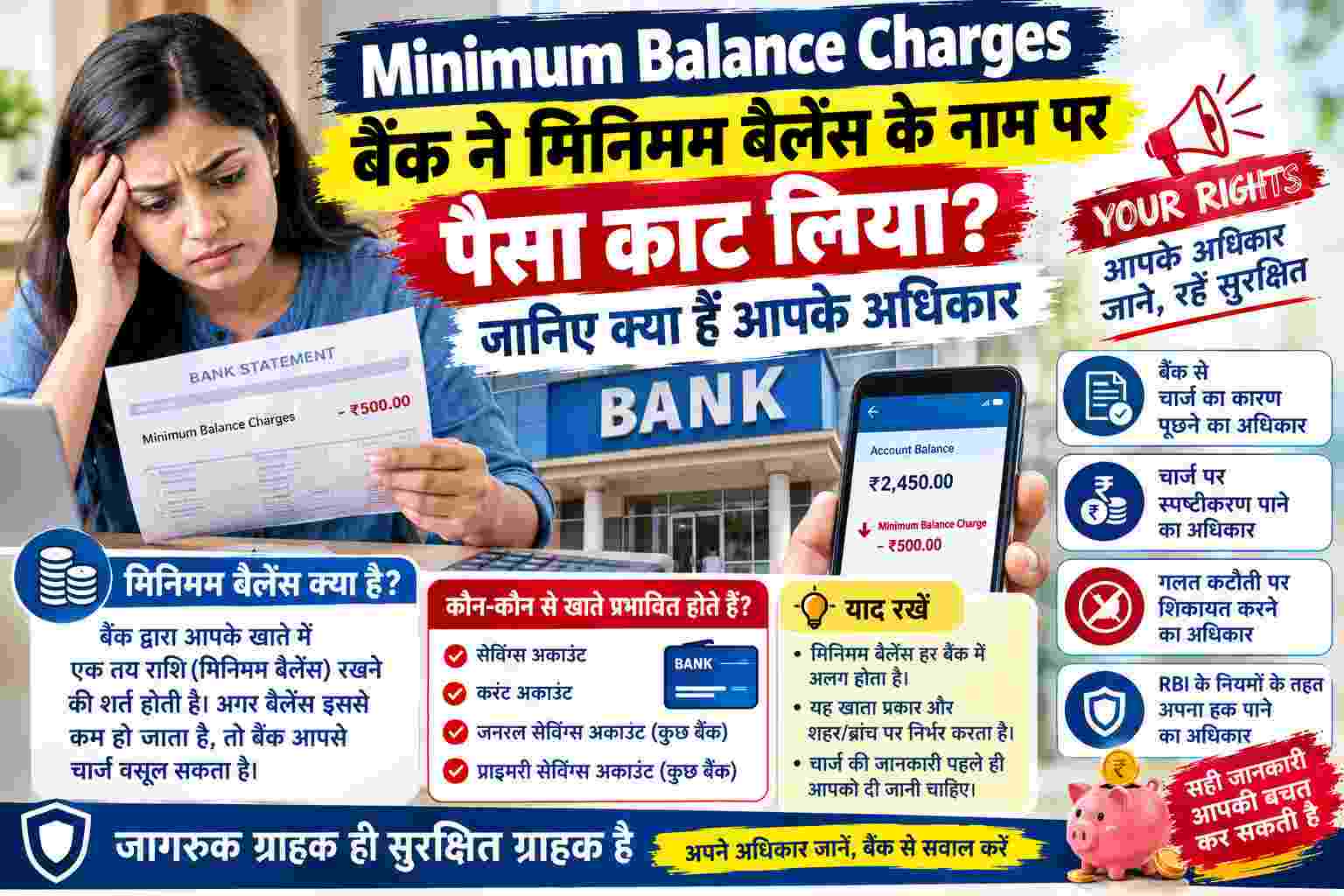
Crores of consumers having Savings Bank Account in India often face the problem that banks deduct penalty in the name of ‘Non-Maintenance of Minimum Average Balance – MAB’ as soon as the balance is less than the prescribed limit. Many times, due to lack of information, account holders are not able to understand whether this deduction has been made as per the correct rules or whether the bank has collected the charge arbitrarily.
The Reserve Bank of India (RBI) has laid down very strict and clear guidelines regarding imposition of minimum balance penalty by banks to protect the financial interests of customers. If a bank has deducted money from your account in violation of the rules, you not only have the right to protest, but also have full legal right to get a refund.
According to the master circular of RBI, no bank can impose penalty on the account of any customer on its own will. The following mandatory conditions apply:
-
It is mandatory to give warning through SMS or email first: The bank cannot impose charges directly on any customer. If the average minimum balance in the account is falling short, it is the legal obligation of the bank to give prior notice to the customer through SMS, email or letter. The bank has to give at least 30 days (Grace Period) to the customer to complete the balance. If money is deposited within this period, no charge can be deducted.
-
Account can never go negative: The strictest rule of RBI is that the balance of any savings account should not go below zero i.e. minus/negative due to minimum balance penalty. If you have ₹100 left in your account and the bank’s penalty is ₹250, the bank can reduce the balance to zero by only deducting ₹100, it cannot be shown as -₹150.
-
Charge will be levied only in proportion to shortfall: The penalty should always be in proportion to the percentage of shortfall in the minimum balance and not a one-sided flat huge amount. For example, if you have ₹4,500 in your account within a limit of ₹5,000, the penalty will be based on the shortfall of ₹500, rather than if the balance is ₹500 only.
-
Clear information at the time of account opening: It is mandatory for the Bank to clearly inform the customer in writing about the Minimum Average Balance (MAB/QAB) limit and the charges associated with it at the time of opening the account.
Different banks have different minimum balance limits depending on the locality (metro, urban, semi-urban and rural):
| bank name | Metro/Urban Branch | semi-urban branch | rural branch | penalty range |
| State Bank of India (SBI) | Zero | Zero | Zero | No penalty (completely free) |
| HDFC Bank | ₹10,000 | ₹5,000 | ₹2,500 (or FD) | ₹150 to ₹600 + GST |
| ICICI Bank | ₹10,000 | ₹5,000 | ₹2,000 | ₹100 to ₹500 (6% of reduction) |
| Punjab National Bank (PNB) | ₹2,000 | ₹1,000 | ₹500 | ₹100 to ₹250 + GST |
| Bank of Baroda (BoB) | ₹2,000 | ₹1,000 | ₹500 | ₹100 to ₹200 + GST |
The country’s largest government banks SBI has completely abolished the requirement of maintaining minimum balance and penalty on all its general savings accounts from March 2020..
If the Bank has arbitrarily deducted Minimum Balance Charges from your account, as a consumer you have the following rights:
-
Right to ask for refund: If the bank did not send you a 30-day notice or warning message before imposing the penalty, you can seek a refund of the entire penalty citing deficiency of service.
-
Right not to allow account freezing: The Bank cannot illegally block your account operations or check/UPI transactions merely because of minimum balance penalty.
-
Right to account conversion: If you are unable to maintain the minimum balance, you will have to freeze your account. BSBD (Basic Savings Bank Deposit Account) Or you have full right to convert to zero balance account.
If your account was incorrectly charged, follow these steps to get a refund:
1. Written complaint to the Branch Manager
First of all, go to your home branch and submit a written application to the branch manager or lodge an online ticket on the bank’s official customer care portal. Write clearly in this that as per RBI rules, you had not received any prior SMS/email alert of reduction in balance, hence the deducted amount should be refunded immediately. Most banks credit this money back to the account after internal review.
2. Contact with the Principal Nodal Officer of the bank
If satisfactory resolution is not found within 30 days at the branch level or the bank refuses the refund, you can escalate the complaint to the Nodal Officer/Zonal Grievance Cell of that bank. The emails and contact addresses of the nodal officers are publicly available on the website of each bank.
3. RBI Banking Ombudsman
If the bank does not respond within 30 days or rejects the complaint, you can file a complaint online with the Integrated Ombudsman Scheme of the Reserve Bank of India:
-
Official CMS Portal of RBI cms.rbi.org.in Go to.
-
Upload bank details, account number and a copy of the complaint sent to the bank.
-
If negligence is found on the part of the bank, then the Ombudsman not only gets the money deducted but can also get compensation for mental distress.
To avoid the hassles and penalties of recurring minimum balance requirements, account holders can adopt the following options:
-
Change to BSBDA Account: As per RBI rules, it is mandatory to open ‘Basic Savings Bank Deposit’ account in every bank, in which there is no minimum balance requirement (Zero Balance) and basic facilities like ATM/chequebook are generally available.
-
Track Salary Account: If your job has changed and salary has not been received in the old salary account for 3 months, then banks convert it into a normal savings account. To avoid this, either convert it into a new salary account or close that account in time.
-
Alternative to SBI or Small Finance Banks: Keep accounts in such banks where there is no minimum balance requirement on savings accounts.