 look news india

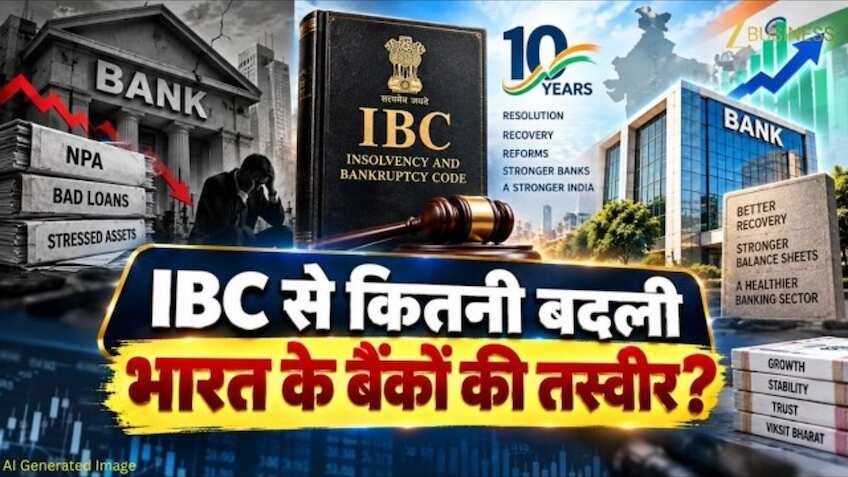
The ‘Insolvency and Bankruptcy Code’ (IBC) implemented in the year 2016 has proved to be the biggest and transformational economic reform in the history of the Indian financial system and corporate world. Today, when 10 years of this historic law have been completed, the picture of the banking scenario of the country has completely changed. During the year 2017-18, when the Gross NPA of the country’s Scheduled Commercial Banks (SCBs) had reached an alarming level of 11.8 percent, the banking sector was considered to be in deep crisis. The capital of banks was stuck in bad loans and their ability to give new loans was almost exhausted. But according to the latest data of the Finance Ministry, by March 2026, the gross NPA ratio of scheduled commercial banks has come down to a historic low of 1.73 percent. This figure not only testifies to the strengthening financial health of banks, but also reflects the revolutionary change in India’s credit culture.
Before IBC, the recovery structure in India was very weak and entangled in legal issues. In those times, the process of recovery through the Board for Industrial and Financial Reconstruction (BIFR) and Debt Recovery Tribunals (DRT) used to drag on for 6 to 8 years. This belief had become widespread among industrialists that ‘even if the company goes bankrupt, the promoter will always remain rich.’ Banks kept making rounds of courts just to auction the properties and in the end only 15 to 20 paise were recovered from one rupee.
IBC overturned this entire equation and abolished the ‘Debtor-in-Control’ system and established the ‘Creditor-in-Control’ model. Under Section 29A of the IBC, it was made mandatory that if a promoter deliberately does not repay the loan, he cannot bid again in the auction process of his own company. This fear of losing control over the company brought about a revolutionary change in the behavior of corporate promoters.
According to data compiled by the Insolvency and Bankruptcy Board of India (IBBI) and the Ministry of Corporate Affairs, IBC has delivered phenomenal financial results over the past decade:
-
Record of Direct Recovery: Financial creditors (financial and operational creditors) have ensured direct recovery of over ₹4.32 lakh crore through approved resolution plans.
-
Returns better than liquidation value: Among the companies that went into resolution, banks have received an average of 167 per cent of the liquidation value and about 95 per cent of the fair value.
-
Miracle of Pre-Admission Settlement: The law’s greatest impact was seen outside the tribunal. Even before the case was formally registered in the National Company Law Tribunal (NCLT), more than 30,000 companies settled dues worth more than ₹14 lakh crore by reaching settlements with banks.
-
Revived companies: The primary objective of IBC was not to close down the companies but to save them. Of the total closed cases, about 58 per cent (over 4,000 companies) had successful revival and were able to restart under new capable management.
With the impact of IBC, India’s ‘Twin Balance Sheet Problem’ (in which the balance sheets of both banks and corporates were in bad shape) has now transformed into ‘Twin Balance Sheet Advantage’.
The NPA of public sector banks (PSBs) has fallen from ₹6.16 lakh crore in March 2021 to ₹2.45 lakh crore in March 2026. Similarly, the bad loans of private banks have also come down to ₹1.26 lakh crore. The provision coverage ratio (PCR) of banks now stands above 75 to 80 per cent, while the capital adequacy ratio (CRAR) is at a strong level of 16 to 17 per cent. Due to this, big financial institutions like State Bank of India (SBI), Punjab National Bank, Bank of Baroda, HDFC Bank and ICICI Bank are now registering record profits and are in a position to give new loans on a large scale to the country’s infrastructure and manufacturing sector.
Despite these impressive success figures, some serious structural challenges have emerged for the IBC in its 10th year:
-
Violation of deadlines: According to law, resolution of any company should have been completed within 180 to 270 days (maximum 330 days). But currently, due to complex litigation and repeated appeals, the average resolution time has increased to beyond 700 to 740 days.
-
Big Haircut: In many old and big cases, banks have had to suffer huge haircuts (losses) of 70 to 80 percent. Especially in the financial year 2025-26, the average recovery rate against total claims has fallen to 23-24 percent, which is a matter of concern.
-
Shortage of judges in NCLT: The pendency of cases is increasing due to vacancies and inadequate judicial infrastructure in NCLT benches across the country.
The government is now working on comprehensive amendments to make the next decade of the IBC more effective. This includes project-wise insolvency for real estate projects, state-of-the-art IT-enabled e-platform to make the entire process free from human intervention and implementation of ‘Cross-Border Insolvency Framework’ for recovery of foreign assets. Overall, the 10 years of IBC have proven how a stringent and transparent law can transform a crumbling banking system into one of the most resilient and strong financial pillars in the world.