 look news india

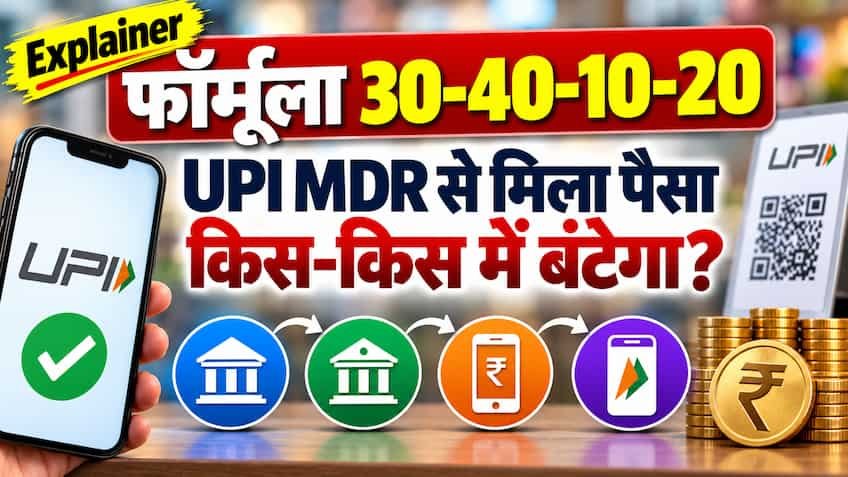
Crores of financial transactions take place every day through Unified Payments Interface (UPI) in India. Bank-to-bank UPI transfers remain completely free for general consumers, but Merchant Discount Rate (MDR) applies for larger merchant transactions or prepaid payment instruments (PPI/wallets) and credit cards on UPI. When a merchant or service provider is charged a fee in the form of MDR, the question arises as to whose pocket the money earned goes to.
In this huge system of digital payments, no single institution is entitled to the entire revenue. National Payments Corporation of India (NPCI), Issuer Bank, Acquirer Bank and Third-Party Payment Apps (TPAP) work together behind this. A fixed proportion of revenue has been earmarked to meet the infrastructure and operational expenses of all these partners, which is understood in the industry as the ’40-28-12-8 formula’.
Whenever MDR is charged on an eligible UPI transaction, every Re 1 collected (or total revenue pool) is divided based on a pre-determined percentage. This arrangement ensures that every technical and financial player involved in the transaction gets its fair share.
The direct details of the share of various parties under this revenue sharing are as follows:
-
40% (Issuer Bank – 40 paise): The customer’s bank, from where the money is deducted. This bank is responsible for security risks, maintenance and authentication of the Core Banking System (CBS).
-
28% (Acquirer Bank – 28 paise): The shopkeeper or merchant’s bank, which maintains the merchant account and ensures credit of funds.
-
12% (Third Party Application Providers – 12 paise): Apps like Google Pay, PhonePe, Paytm, which provide easy interface and software facilities to the users and merchants.
-
8% (NPCI Network – 8 paise): Part of the organization that operates the central switching network and UPI architecture.
-
Remaining 12% (Operational & Merchant Partner Pool – 12 paise): Point of sale (POS) vendors, part of soundbox servicing and field support operations.
The principle behind this revenue allocation is not just financial gain but also the compensation of huge technical and operational costs.
Issuer Bank (Why 40% Share?): The biggest share is given to the customer’s bank because it has to handle the heaviest server traffic, 256-bit security encryption, fraud detection and two-factor authentication (UPI PIN). The direct risk of server downtime lies with the bank itself.
Acquirer Bank (Why 28% share?): The merchant’s bank handles risk management (KYC, anti-money laundering) and merchant settlement. Apart from this, the financial responsibility of settling situations like chargeback and refund also lies with this bank.
Payment Apps/TPAP (Why 12% share?): Apps that develop technology and user interfaces get this share to maintain the user base, maintain server APIs, and complete security audits at the app level.
NPCI (Why 8% share?): National Payments Corporation of India operates UPI switches across the country 24×7. Research on inter-bank net settlement and new features (like UPI Lite, UPI AutoPay) is funded from this fund.
Regarding this revenue sharing, there is often a doubt in the minds of common citizens and small shopkeepers whether this fee will be deducted on their normal transactions also.
As per the clear guidelines of RBI and NPCI:
-
Zero charges (Zero MDR) remain applicable on normal person-to-person (P2P) bank account transfers.
-
No MDR is deducted on bank transfers on common QR codes of small retailers (grocers, fruit-vegetable vendors, etc.).
-
This fee is applicable primarily on wallet/PPI (Prepaid Payment Instruments) based merchant transactions or large merchant payments on RuPay Credit Card (UPI) of more than Rs 2,000, which are borne by large merchants.
While this transparent revenue structure ensures the financial stability of digital payments companies, India’s digital payments infrastructure is continuously expanding without any hindrance.