 look news india

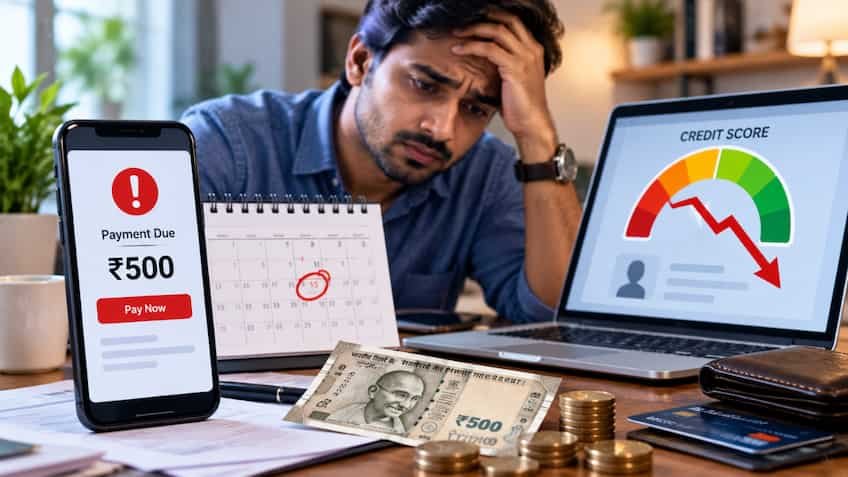
In today’s digital and cashless era, the use of credit cards and ‘Buy Now Pay Later’ (BNPL) services has become common. People swipe credit cards indiscriminately for shopping, utility bills and online food delivery. But often it happens that a user pays his huge expenses, but due to some old charge, auto-subscription or minor purchase, a small balance of ₹ 300, ₹ 500 or ₹ 700 is left in the bill. Most people become worried thinking that “It is only Rs 500, we will see next month what the bank will do for such a small amount.” If you also think so, then this carelessness can prove to be most fatal for your financial credit profile.
In the algorithms of the country’s four major credit information bureaus—TransUnion CIBIL, Experian, Equifax and CRIF High Mark—recognized by the Reserve Bank of India (RBI), your ‘payment discipline’ (repayment history) is given more importance than the default ‘amount size’. In the calculation of 300 to 900 points of CIBIL score, about 35 percent weightage is given only to whether you have paid your due amount on time or not. The credit scoring model does not look at whether your outstanding was for ₹5 lakh or just ₹500; For the system, in both cases, non-payment of money after the due date is considered a serious default and financial indiscipline. Many professionals working in Uttar Pradesh’s Lucknow, Kanpur, Noida, Ghaziabad and metro cities across the country are shocked when their CIBIL score drops from 780 to below 700 and banks reject them when they apply for a new home loan or car loan.
The biggest fear in the minds of credit card holders is that if they forget the due date for paying the bill, will the bank send a default notice to CIBIL the very next day? On this, the Reserve Bank of India (RBI) has given a strong security cover to the consumers. Under the Master Direction on Credit Card and Debit Card of RBI, it is legally mandatory for all banks and credit card issuing institutions to provide ‘3-Day Grace Period’.
As per RBI rules:
-
If your credit card bill due date is the 5th of the month, the bank cannot levy any Late Payment Charges on you nor report your account to the credit bureaus as ‘Past Due’ until the 8th.
-
If you make full payment of ₹500 within this 3 day grace period, there will be zero (0%) impact on your credit score and your CIBIL score will remain completely safe.
-
However, it is important to understand that this 3-day grace period only protects against late fees and CIBIL reporting; If you have not paid your bill by the due date, regular finance charges (interest) from the original date of purchase may continue to apply on the outstanding amount.
If the 3 day grace period passes and you still haven’t deposited that ₹500, the bank’s system immediately goes into penal mode. Most banks have different slabs of late payment fees:
-
There are generally no late fees for dues of less than ₹100.
-
In the dues slab of ₹100 to ₹500, major banks like HDFC Bank, ICICI Bank, Axis Bank and Kotak Mahindra Bank charge a late payment fee of ₹100 (SBI cards keep the late fee at zero up to ₹500).
-
If your dues reach ₹501 or more, the late fee directly increases to ₹400 to ₹500.
-
GST at the rate of 18 percent is added separately on this late fee.
-
On top of this, a hefty compound interest of approximately 3.5% to 3.75% per month (42% to 45% APR on annual basis) starts accruing from the date of purchase.
As a result, the ₹500 that you thought was trivial turns into ₹1,000 to ₹1,200 in next month’s bill after adding late fees, interest and taxes.
The most sensitive and dangerous column in the credit report is ‘DPD’ i.e. Days Past Due. When a lender or bank looks at your CIBIL report, it first checks this DPD track. In normal and healthy accounts, ‘000’ or ‘STD’ (Standard) is written in place of DPD, which means that every payment has been made on time.
But if payment of ₹500 is continuously postponed, its step-by-step effect is as follows:
-
Delay from 1 to 29 days: The account becomes overdue, late fees are charged, but most banks usually don’t report it in formal ‘default category’ until the 30 days have passed.
-
Delay of more than 30 days (30+ DPD): If more than 30 days have passed since the bill arrived and even the minimum amount due has not been deposited, the bank reports ‘030 DPD’ to the credit bureau. As soon as 30 DPD is recorded in the report, your CIBIL score can drop by 50 to 80 points in an instant.
-
60 to 89 days delay (60+ DPD): Recovery calls and SMS are triggered, the account gets moved to a ‘Special Mention Account’ (SMA) and the score breaks by more than 100 points.
-
Delay more than 90 days (90+ DPD/NPA): This small account of ₹500 gets declared as ‘Non-Performing Asset’ (NPA) or ‘Sub-Standard’ in the books of the bank. After this, the bank blocks the card and your profile gets registered in CIBIL as ‘defaulter’. Once 90+ DPD is achieved, the CIBIL score increases by 150 to 200 points.
In earlier years, banks sent data to credit bureaus only once a month or at intervals of 30 to 45 days, giving customers little time to rectify their defaults. But the Reserve Bank of India has made the rules very strict to bring transparency in the credit reporting framework. Now banks and non-banking financial companies (NBFCs) are mandatorily required to send fresh data to credit bureaus on four fixed dates in a month (9th, 16th, 23rd and last day of the month).
This weekly and fortnightly reporting cycle simply means that even a small mistake will now be reflected in your credit report within a matter of days. However, a major consumer-friendly provision has also been added in the new rules that it is mandatory for any bank to give advance warning to the customer through SMS or official email before reporting the customer’s default to the credit bureau. If the bank reports the default directly without prior notice, the customer can file a complaint with the Banking Ombudsman (RBI Ombudsman).
This question troubles every financially conscious citizen. When you go to the bank in future to take a home loan of Rs 50 lakh or a car loan of Rs 10 lakh, the loan officer of the bank does not notice that you had not repaid ₹ 500. The loan granting bank’s automated risk assessment software only reads ‘Past Due’ or ‘Missed Payment Flag’ and your CIBIL score in your report.
If your credit score drops from 750 to 680 or 650, there are three serious consequences:
-
Direct rejection of loan: Many major banks (like SBI, HDFC, ICICI) auto-reject applications with scores less than 750 in their online systems.
-
Expensive Interest Rates: Even if a bank approves a loan, it considers you a ‘high risk borrower’ and charges 1.5% to 2.5% higher interest rate. 1% more interest charged on a 30 year home loan means an additional loss of lakhs of rupees.
-
Credit card limit reduction: Existing banks may reduce the credit limit of your card or reject applications for new cards.
If you suddenly find that your credit card or small loan payment of ₹500 has been missed even after the due date and 3-day grace period, instead of panicking, take these 4 steps immediately:
-
Get paid in full instantly without wasting 1 minute: First of all, immediately pay 100% of the entire dues and late fees imposed on it through mobile app or UPI.
-
Call Customer Care and ask for ‘Goodwill Reversal’: If you have a clean past record and this is the first time you have accidentally missed a payment, call the bank’s customer care and politely explain that it was an unintentional technical or personal mistake. If you have been a consistently timely payment customer, banks often waive late fees as a ‘goodwill gesture’.
-
Make a written request to the bank for correction of CIBIL: Make a special request to the Customer Care that since you have made the full payment, this account should not be reported as overdue to CIBIL in the upcoming reporting cycle.
-
Activate Auto-Debit: To avoid such human errors in future, it is mandatory to activate ‘Auto-Pay’ or ‘NACH Mandate’ from your bank account. Always set auto-debit to ‘Total Amount Due’, so that even ₹1 is not missed.
In matters of money, one should never ignore any amount considering it small. In the financial world, your dues of ₹500 may be trivial for the bank’s balance sheet, but it can prove to be a huge stain on your personal credit and CIBIL score. Timely payments and digital alerts are the only sure shot formula to keep your credit profile always in the golden circle of 750+.