 look news india

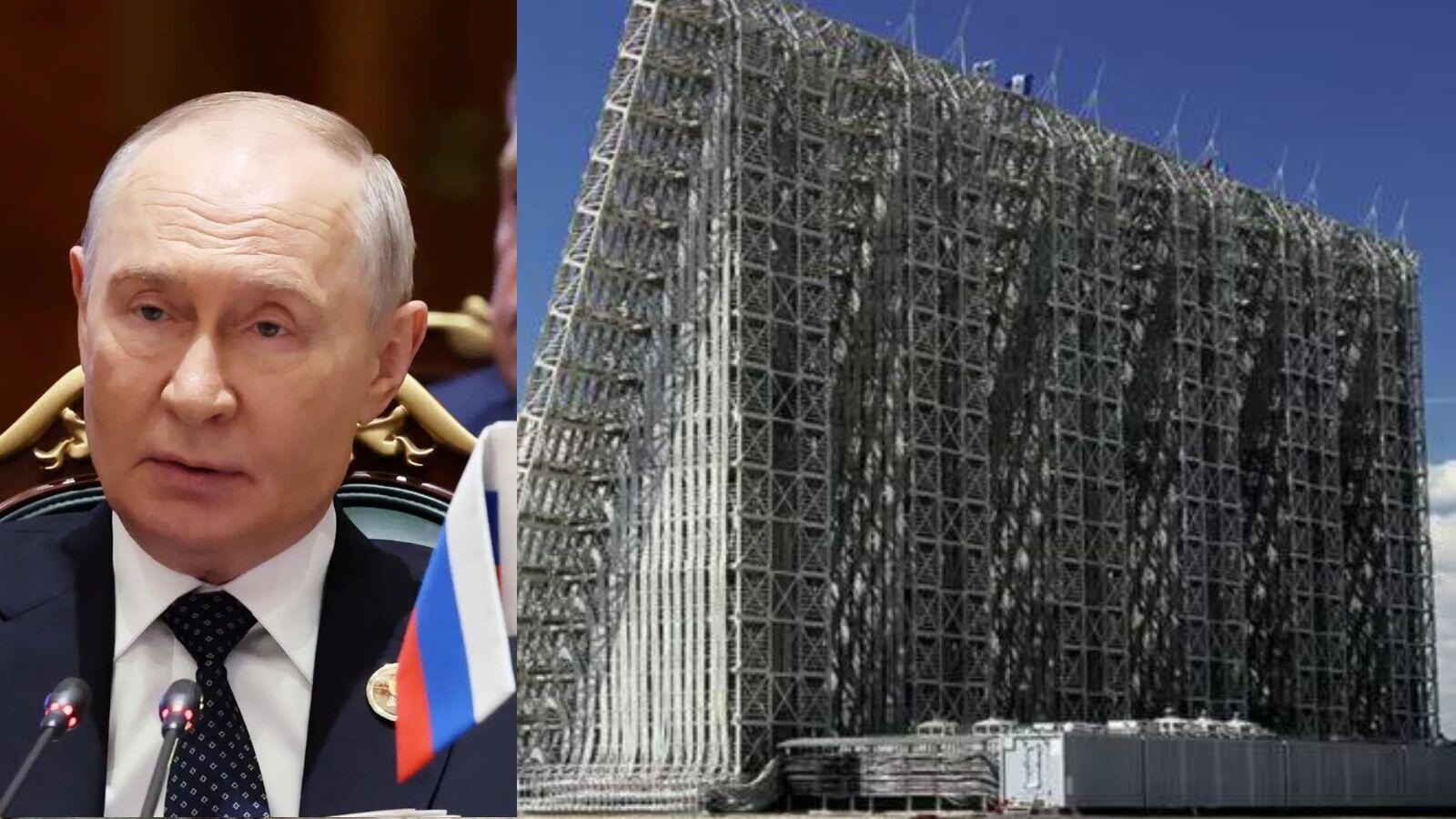
These days there is a lot of buzz in the international defense market regarding a possible historic defense agreement between Russia and India. The discussions regarding the advanced early-warning radar system ‘Voronezh-M’ between India and Russia are in the final stages, has attracted the attention of global defense experts. Defense sector experts believe that this technology can prove to be a milestone in India’s air defense architecture. This state-of-the-art radar system is counted among the world’s most powerful and accurate early-warning surveillance systems, which works on metric wavelength (VHF) and is fully capable of keeping a close watch on every enemy move from thousands of kilometers away.
This radar system developed by Almaz-Antey, a leading institute of Russian defense industry, is known to detect both traditional and modern air threats in the blink of an eye. Its biggest feature is that it can track long-range targets even beyond the curvature of the ground (horizon). When it comes to security and strategic edge, India is on the path of continuously strengthening its defense capabilities. In this context, this huge wall-like radar system is being considered very important for the strategic interests of the country, which completely meets the needs of modern warfare.
In Russian military technology, Voronezh-M is considered to be an infallible weapon or rather a ‘Brahmastra’ of surveillance, which has the power to turn the tables on the battlefield. Just as Brahmastra is considered infallible and the ultimate weapon in mythology, similarly in modern electronic warfare and air security, this radar is being considered as the armor that destroys every hiding maneuver of the enemy. The range of this radar is so wide that it can monitor both space and sky over a radius of 6,000 kilometers in its horizontal range and more than 8,000 kilometers in its vertical range.
The most frightening feature of this radar (for the enemies) is that it detects satellites moving in space, intercontinental ballistic missiles (ICBMs), hypersonic weapons and even stealth aircraft at a very early stage. According to reports, this radar has the amazing ability to track even an object as small as the size of a football in the sky miles away. Being based on Phased Array technology, it can track hundreds of targets simultaneously and direct the beam very quickly. That is why in the Russian military fleet it is considered a revolutionary and infallible weapon on both the defensive and offensive fronts.
This defense deal is going to have far-reaching consequences for India from a geographical and strategic point of view. Under the proposed plans, this radar system is likely to be installed in Chitradurga district of Karnataka, which will provide wide strategic coverage from the southern and central part of the country. With India’s neighboring countries constantly racing to modernize their missile capabilities and air forces, the Voronezh-M radar will give India an unmatched ‘first-look’ and ‘early-warning’ advantage. If any missile or stealth fighter jet flies from the enemy camp, India will be able to detect it in the vicinity of its launching pad, which will give enough time to activate the air defense system.
Another most positive aspect of this deal is related to ‘Make in India’ and Self-reliant India campaign. Under this agreement, there is a provision for at least 60 percent of this giant radar to be manufactured locally in India. The Electronics and Radar Development Establishment (LRDE) under the Defense Research and Development Organization (DRDO) will oversee the entire project, in which dozens of Indian private companies and defense startups will also become partners. This will not only boost defense manufacturing within the country but will also create thousands of technical jobs, which will also prove to be a big boost for the local economy.
In today’s era when Artificial Intelligence (AI) and modern search engine technologies are processing defense analysis and strategic news, such defense treaties are redefining the pattern of global security. Moving beyond purchasing conventional weapons, India is now focusing on technologies that are data-driven, highly energy-efficient and modular. The Voronezh-M radar can be installed with much less time and less personnel than conventional radar systems due to its modular nature. This technology is perfectly suited for the AI-enabled battlefields of the future, where speed of information decides victory and defeat.
Despite international geopolitical pressures and the threat of US sanctions (like CAATSA), India’s move forward in this direction with Russia proves that New Delhi is not ready to compromise on its strategic autonomy. On one hand, India is sharing state-of-the-art surveillance and drone technology with western countries, on the other hand, by finalizing such huge and irrefutable radar deals with Russia, it is making its security as strong as iron gram. Overall, the arrival of Voronezh-M radar in India will bring about a huge change in the regional balance of power, providing an impenetrable security wall to the country’s security wall.