 look news india

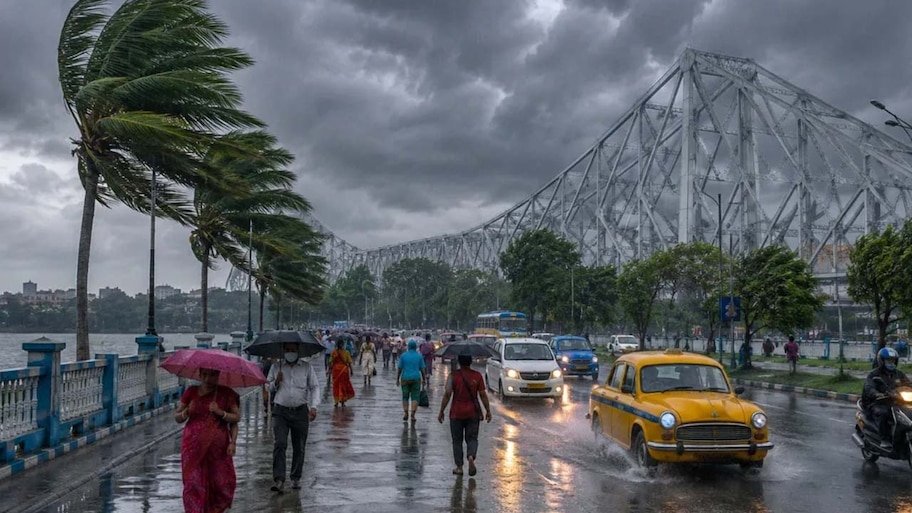
The Indian Meteorological Department (IMD) has issued a widespread alert of torrential rainfall, severe thunderstorms and lightning in 24 states and union territories after the reactivation of the southwest monsoon over large parts of the country. According to meteorologists, the low pressure area formed in the north-western part of the Bay of Bengal and the monsoon trough line passing through central India is in a highly active state at present. Along with this, the confluence of moisture-laden westerly winds coming from the Arabian Sea and easterly winds rising from the Bay of Bengal has created a powerful circle of dense monsoon clouds over North India, Northeast and the Ganga plains.
Under the influence of this weather system, Delhi-NCR, Uttar Pradesh, Bihar, Jharkhand, Madhya Pradesh, Rajasthan, Uttarakhand, Himachal Pradesh, West Bengal and North-Eastern states will see widespread rainfall activities during the next 48 to 72 hours. The Meteorological Department has clarified that in many plains and coastal areas, strong wind gusts can reach a speed of 50 to 70 kilometers per hour, due to which there is a possibility of damage to weak structures, electric wires and crops.
Monsoon is completely favorable in Uttar Pradesh and clouds remain active in most of the divisions of the state. According to the bulletin issued by the Meteorological Center Lucknow, there is a possibility of heavy rain and thundershowers from western Uttar Pradesh to the districts of Awadh and Purvanchal.
The department has issued yellow and orange alerts of moderate to heavy rain in more than 20 districts including Meerut, Muzaffarnagar, Agra, Mathura, Aligarh, Bijnor, Badaun, Pilibhit, Shahjahanpur, Sitapur, Unnao, Kanpur, Rae Bareli, Etawah, Azamgarh, Ayodhya, Deoria and Gorakhpur.
Due to the continuation of intermittent drizzle and heavy showers in the capital Lucknow and surrounding areas, the temperature has dropped by 3 to 4 degrees Celsius, which has brought relief to the people from the sultry heat. However, due to waterlogging in Terai and rural areas, farmers have been advised to make proper drainage arrangements for paddy and oilseed crops.
The sky is densely covered in the national capital New Delhi and the adjoining National Capital Region (NCR)—Noida, Ghaziabad, Gurugram and Faridabad. According to the Meteorological Department, several rounds of light to moderate rain with thunderstorms can be recorded throughout the day in Safdarjung and Palam, the primary weather centers of Delhi. One or two spells of heavy rain along with strong winds are also expected in some areas.
The maximum temperature of the day is likely to be between 29 to 31 degrees Celsius, due to which the weather will be pleasant. However, incessant rains may cause waterlogging and heavy traffic jams in low-lying areas, underpasses and major junctions in Delhi and Gurugram. Delhi Traffic Police has advised drivers to drive with caution and avoid taking two-wheelers on flooded roads.
The Meteorological Department has issued a warning of the most sensitive situation in the eastern Indian state of Bihar. Weather Center Patna has expressed the possibility of severe lightning and intense thunder in more than 15 districts of the state.
According to the department, torrential rain with strong thunderstorms is expected in Patna, Gaya, Jehanabad, Bhojpur, Samastipur, Purnia, Araria, Kishanganj, Katihar, Bhagalpur, Begusarai, Gopalganj, Rohtas, Buxar and Vaishali districts.
In Bihar, lightning during monsoon proves to be a major disaster for life and property. The State Disaster Management Department has put all the District Magistrates on high alert and issued instructions to prevent farmers, shepherds and laborers from going to open fields, especially in rural areas. Due to rainfall in the catchment areas of Ganga, Gandak, Kosi and Bagmati rivers, the water level is also being continuously monitored.
The period of seasonal upheaval has also intensified in the neighboring state of Jharkhand. Meteorological Center Ranchi has issued a yellow alert for rain and strong winds at a speed of 30 to 40 kilometers per hour in most parts of the state.
There is every possibility of moderate to heavy rainfall in Ranchi, Jamshedpur (East Singhbhum), Deoghar, Bokaro, Ramgarh, Khunti, Palamu, Dhanbad, Giridih, Gumla, West Singhbhum and Latehar.
Due to continuous rainfall, the water level of the state’s major dams – Patratu, Tenughat and Chandil Dam is rising, due to which the Irrigation Department is making preparations to release additional water. People living on hill slopes and in kutcha settlements have been asked to remain alert. The electricity department has also issued a public warning not to go near poles and transformers during strong winds.
Apart from North and East, the deep impact of the monsoon system is visible in other parts of the country also. There is heavy rain with strong winds and lightning in Bhopal, Indore, Ujjain, Jabalpur and Gwalior divisions of Madhya Pradesh.
Torrential rains are being recorded in Kota, Udaipur, Jaipur and Bharatpur areas of eastern Rajasthan.
At the same time, due to heavy rains in the hilly states of Uttarakhand and Himachal Pradesh, the risk of landslides and mountain debris hitting the roads has increased. Chardham pilgrims and tourists traveling on national highways in Chamoli, Uttarkashi, Rudraprayag and Nainital districts of Uttarakhand have been instructed to stop at safe stops till the weather clears. On the other hand, in Assam, Meghalaya and Arunachal Pradesh of the North-East, due to the spate of Brahmaputra river, there is a flood-like situation in the low-lying areas.
In view of the increased risk of inclement weather and especially lightning, the National Disaster Management Authority (NDMA) and the Meteorological Department have issued life-saving guidelines for citizens:
-
Distance from trees and poles: Never take shelter under a tall tree, electric pole, mobile tower or tin shed during heavy rain or thunder. Lightning always strikes higher objects first.
-
Do not stay in open fields: If you are in a field or open field and there is no permanent house nearby, then instead of lying on the ground, sit in a squat position with both legs together, placing your head on your knees and cover your ears with your hands.
-
Stop using electronic devices: While inside the house, remove the plugs of TV, fridge, computer etc. from the wall socket. Do not use wired landline phones and avoid talking while keeping the mobile phone charging.
-
Avoid metal objects and water: Farmers working in the fields should immediately move away from iron plough, hoes, tractors or fencing. Get out of the pond, river or filled water immediately.
-
Usage of Damini App: Download the Central Government’s ‘DAMINI’ mobile app, which issues alerts 20 to 30 minutes before lightning strikes in your area, ensuring safety of life and property.