 look news india

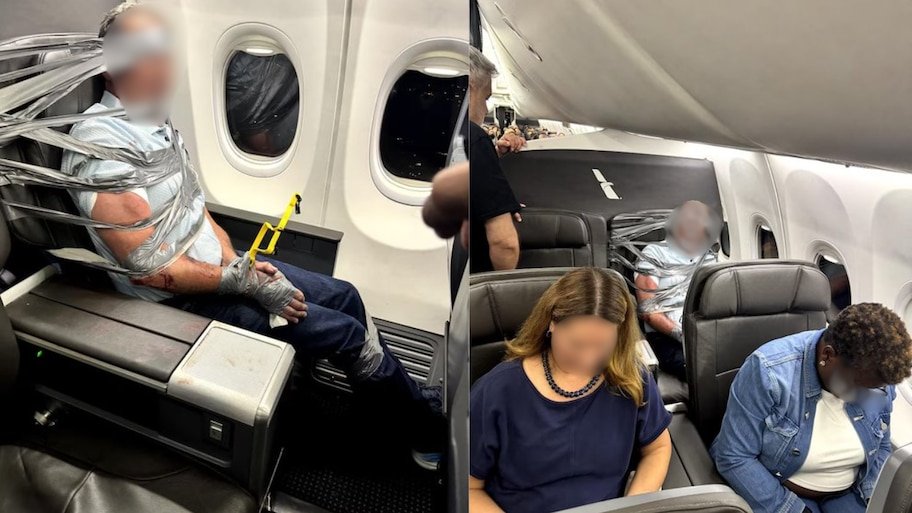
A commercial passenger plane flying peacefully at an altitude of 30 thousand feet amidst the clouds in the sky suddenly created a ruckus when a mad passenger started creating havoc in the air itself. Everything was going normally during the flight, but shortly after take-off, a male passenger got up from his seat for no apparent reason and started screaming. According to eyewitnesses, the man appeared to be extremely mentally unbalanced and violent. He first abused and assaulted passengers sitting nearby, and when flight attendants tried to calm him down, he pounced on them as well. The passenger’s aggressive attitude increased to such an extent that he ran towards the emergency exit door of the plane and tried to pull its handle and kick the safety wall of the cockpit. An attempt to tamper with the emergency gate inside the pressurized cabin at an altitude of 30,000 feet left more than 150 passengers on board the plane gasping for air and screams of children and women echoed throughout the plane.
The situation inside the plane was getting worse by the second and the accused was not ready to listen to anyone. He was repeatedly attacking crew members and trying to bite and punch them. At a time of such serious crisis, when the safety of the aircraft and all the passengers on board was in direct danger, three to four courageous male co-passengers on board the aircraft immediately came forward on the prompt appeal of the cabin crew. The co-passengers displayed indomitable courage and caught hold of the violent passenger from behind and threw him on the floor.
However, due to his heavy weight and violent frenzy, he was constantly struggling to free himself. To control this emergency, flight attendants resorted to heavy duct tape and cable ties (zip-ties) present in the plane’s emergency kit. The passengers and crew worked together to tie the accused’s hands behind his back, cuff his legs tightly and then return him to his seat, securing his upper and lower body completely to the seat with several strong turns of duct tape. His mouth was also partially taped to prevent him from biting or spitting at other passengers. The passengers inside the plane heaved a sigh of relief only after the unruly passenger was completely paralysed.
Considering the unexpected violent commotion inside the cabin and the seriousness of the tampering at the gate, the Chief Captain of the aircraft did not consider it appropriate to waste even a moment. The pilot immediately informed Air Traffic Control (ATC) of the seriousness of the situation, informed about the presence of an unruly passenger (Level-3 Unruly Passenger) in the aircraft and sought permission for an emergency landing. ATC immediately stopped all normal traffic on the route and gave clearance to the aircraft to land on priority basis at the nearest international airport.
As soon as the plane touched the runway, the airport security forces, CISF/local police and paramedical teams already deployed there surrounded the plane from all sides. As soon as the plane’s doors opened, security personnel rushed in and detained the unruly passenger who was tied with duct tape to his seat. The police handcuffed the accused and took him directly to the local police station, where he is being interrogated strictly. Security officials recorded the statements of all passengers and cabin crew on the plane and the plane departed for its destination several hours after the security checks were completed.
This is not the first incident of tying a passenger with duct tape inside an aircraft, but the question that definitely arises in the minds of the general public is whether it is legally correct to tie a passenger in the air like this? According to the safety guidelines of the International Civil Aviation Organization (ICAO), the US Federal Aviation Administration (FAA) and India’s Directorate General of Civil Aviation (DGCA), unruly passenger behavior is divided into three major levels:
-
Level 1 (verbal harassment): Using foul language or ignoring crew instructions.
-
Level 2 (Physical Attack): Pushing, raising hands or throwing objects at crew or passengers.
-
Level 3 (deadly danger): Attempting to enter the cockpit, open an emergency gate, or commit a deadly attack with a weapon/object.
According to aviation rules, in a Level-3 situation, the safety of the life of the aircraft and the hundreds of passengers on board becomes paramount. In such a situation, if a passenger is out of physical control, the pilot-in-command of the aircraft has the legal authority to order the cabin crew and passengers to use ‘reasonable force and non-lethal physical restraints’ to control the person. Restraint tape or duct tape is considered an official safety device in the emergency kits of airlines on international flights, so that a violent person can be completely neutralized until a safe landing.
Police and aviation security authorities have registered a case under stringent legal provisions against this unruly passenger who risked the lives of hundreds of people in the air. An FIR has been registered against the accused under relevant sections of the Anti-Hijacking Act, obstructing aircraft security, assault on public servants and attempt to commit culpable homicide. If found guilty under these sections, the accused may be punished with rigorous imprisonment for several years and heavy fine.
Additionally, the airline has initiated the process of placing the accused passenger on the ‘No-Fly List’ with immediate effect on the recommendation of its Internal Security Committee. Under this, a complete ban can be imposed on him from flying in any domestic and international airline for life or for a minimum of 2 to 5 years. Not only this, preparations are being made to recover legal compensation from the accused through a civil suit for the additional financial loss of lakhs of rupees that the airline has suffered due to fuel dumping, aircraft diversion and airport handling due to the emergency landing.
Recent years have seen an alarming increase in incidents of passengers misbehaving, drunkenly causing ruckus or attacking flight crew on global and domestic flights. Aviation and mental health experts believe that the mental stress associated with air travel, excessive alcohol consumption in flight, lack of sleep and in some cases panic attacks or phobias trigger such extreme violent behavior in passengers.
Experts have demanded airlines and regulatory bodies to conduct strict pre-flight screening of passengers’ intoxication level and behavior at the boarding gates themselves, so that any suspicious or unusual person can be stopped before boarding the plane. This heart-wrenching incident that happened at an altitude of 30 thousand feet has once again proved that there is no bigger rule than safety in an aircraft flying in the sky, and when necessary, only extraordinary steps taken for safety save hundreds of lives.