 look news india

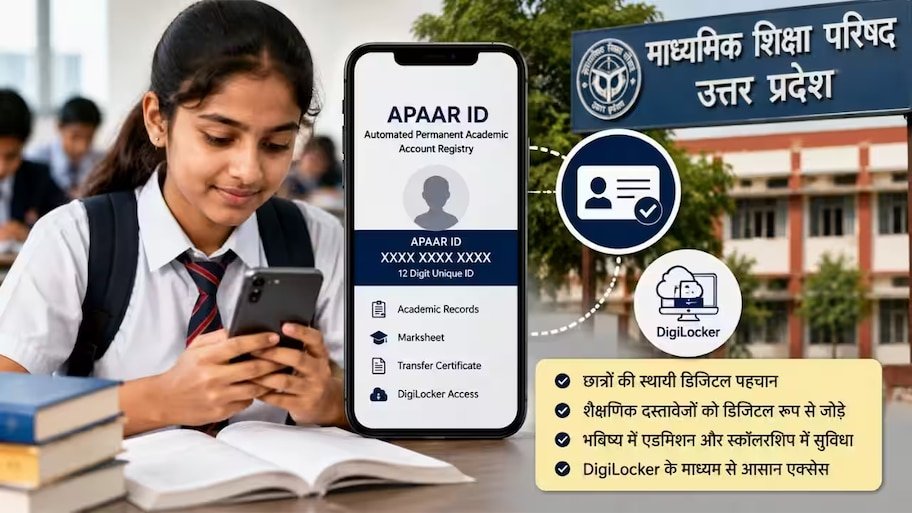
Uttar Pradesh Secondary Education Council (UPMSP) has issued an important official instruction regarding the process of filling advance registration for class 9th and 11th and board exam form for class 10th and 12th for the session 2026-27. UP Board has directed the principals of all government, non-government aided and unaided secondary schools of the state to complete the work of preparing ‘APAAR ID’ of each student on priority basis before entering the details on the board registration portal. To implement the Central Government’s ‘One Nation, One Student ID’ vision under the National Education Policy 2020 (NEP 2020), the UP Board has asked all schools to ensure 100 percent digital ID entry of students.
The full name of AAPAR is ‘Automated Permanent Academic Account Registry’. It is a unique and permanent digital identity number of 12 digits issued to students ranging from school students to students studying in higher educational institutions across the country. Just as Aadhaar card is necessary for the identity of every citizen, similarly, Aapar ID acts as a ‘digital academic passport’ for student life. This 12-digit unique code stores a student’s entire educational journey—nursery, primary, secondary, 10th-12th board results, graduation, post graduation, skill certificates, sports and other extra-curricular achievements on a single cloud network. Even if a student changes school, board or state, this ID does not change and the new institution instantly verifies the old records online.
According to the new guidelines of UP Board, schools have to complete the two most important procedural tasks before the board exams and advance registration:
-
Collection of Parental Consent Form: Since most of the students from class 9th to 12th are minors (under 18 years of age), written and digital consent of the parent or legal guardian is mandatory before sharing the data of any student under data privacy and digital security rules. Schools will have to fill the consent form signed by the parents in offline format and keep it safe in their records.
-
100% data matching on UDISE+ portal: School administration and nodal teachers will have to login to the UDISE+ portal of the Government of India and match the name, father’s name, date of birth and gender recorded in the Aadhar card of the students 100% verbatim with the school register. If there is any discrepancy between Aadhaar and school records, the same will be rectified first, only after which the student’s PEN (Permanent Education Number – PEN) and Aapar ID will be generated from the UDISE portal.
With the implementation of Apar ID, there are some important changes in the process for parents and students:
-
Linking of active mobile number with Aadhaar: During Aapar ID generation, a One Time Password (OTP) is sent to the mobile number linked to the Aadhaar of the student or parent. Parents of students who have old or closed mobile number registered in Aadhaar will have to immediately go to the nearest Aadhaar Service Center and get the current mobile number updated.
-
Uniformity of spelling in documents: Many times the name or date of birth in the student’s Aadhar card is different from the school’s TC (Transfer Certificate) and admission form. After the new rules, parents will have to ensure that the spelling of the name is completely the same in both the documents, otherwise the OTP verification will fail.
-
Freedom from the hassle of physical documents: Parents will now be free from the fear of making dozens of photocopies of their children’s old mark sheets, transfer certificates and character certificates or losing them, as all certified documents will be automatically linked to Apar ID through DigiLocker.
Uttar Pradesh Secondary Education Council has given great relief to the students and parents by issuing clarification in this regard. The Board Secretary and the Education Department have made it clear that if due to any technical reason, delay in Aadhaar updation or network problem, the Aapdar ID of any student has not been generated yet, then his advance registration of 9th-11th or application form of 10th-12th board exam will not be stopped under any circumstances. At present, entry of Apar ID has been sought on priority at the alternative level. However, the board has given strict instructions to the schools to make Apar ID of maximum students by the last date and try to feed them in the board database so that no student is inconvenienced in future.
Students can generate their Apar ID through two means: with the support of the school or directly through the DigiLocker portal.
-
Through school: Parents will sign the consent form received from the school and submit it to the class teacher along with a copy of their Aadhaar. The nodal teacher of the school will verify the details of the student by logging into the ‘Student Module’ of the UDISE+ portal and after Aadhaar authentication, generate Apar ID and provide a 12 digit number or printed card to the student.
-
Via DigiLocker/ABC Portal: Students or parents directly visit DigiLocker app or official website (digilocker.gov.in). Go to ‘Search Documents’ and search for ‘APAAR’ and enter student name, date of birth, school UDISE code and Aadhaar number. As soon as the OTP received on the mobile linked to Aadhaar is entered, a 12-digit Apar ID will be generated and saved in the ‘Issued Documents’ section of DigiLocker. After this, register this 12 digit number in your school.
-
Secure storage of digital marksheets and certificates: 10th and 12th board results, mark sheets and migration certificates will be available in digitally signed format directly in DigiLocker without any human intervention.
-
Paperless Verification in College Admission: After passing 12th, you will be free from the long queues of physical document verification at the time of CUET, NEET, JEE or graduate admission in universities.
-
Direct benefits of scholarships and government schemes: Linking the Apar ID in Uttar Pradesh Government’s Post-Matric Scholarship, Pre-Matric Scholarship and Meritorious Student Incentive Schemes will prevent ineligible or fake applications and speed up transfer of money through DBT to the bank accounts of genuine beneficiaries.
-
Credit Transfer and Benefits of New Education Policy: The integration of Apar ID with the Academic Bank of Credits (ABC) implemented in higher education will make it easier for students to transfer their credits when transferring from one college to another.
-
Permanent ban on fake degrees and fake certificates: With all educational documents being secured on a centralized national database with blockchain and digital security, fake marksheets and educational fraud will be completely curbed across the country.