 look news india

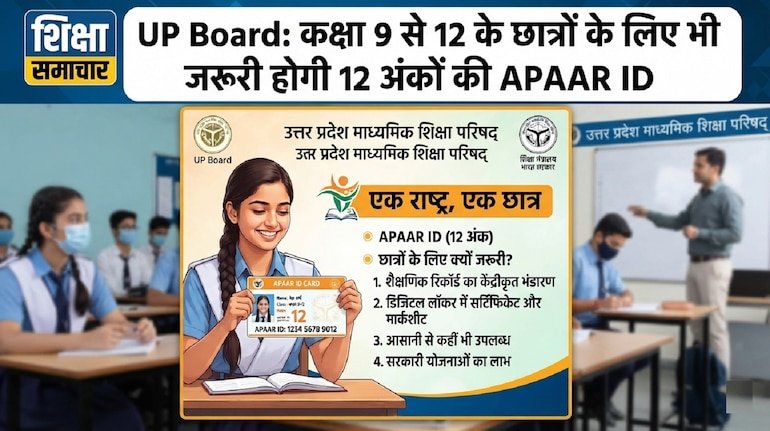
Uttar Pradesh Secondary Education Council (UPMSP), commonly known as UP Board, has taken a historic step towards making the secondary and higher secondary education system of the state modern and transparent. Implementing the ‘One Nation, One Student ID’ initiative envisaged under the National Education Policy (NEP 2020) of the Central Government, the UP Board has made it mandatory for all registered students from class 9th to 12th to create ‘Apaar ID’ (Automated Academic Permanent Account Registry – APAAR ID).
Strict guidelines in this regard have been issued by the Secondary Education Council headquarters in Prayagraj to all the District School Inspectors (DIOS) of the state and the principals of recognized government, non-government aided and unaided secondary schools. The main objective of this digital identity card is to securely and verifiably preserve all the academic records, examination results, certificates and co-curricular achievements of the students from primary level to higher education and career in a single integrated digital database.
‘Aapar ID’ is a 12 digit unique identification number issued on the lines of Aadhaar card. It is allotted only once to a student for lifetime. Whether a student changes school, city or takes admission in another state or university for higher education, his Aaphar ID will never change.
All the following important details will be updated and secured in real-time in Apar ID’s digital platform:
-
Educational Qualification and Marksheet: Complete history from class 9th registration to class 10th (High School) and 12th (Intermediate) board marksheets, passing certificates and roll numbers.
-
Academic Bank of Credits (ABC): Automatic transfer and accumulation of credits earned at higher education level.
-
Sports and extra-curricular achievements: Certificates obtained in state or national level sports competitions, Olympiads, NCC, NSS, science fairs and cultural programs.
-
Scholarships and Government Benefits: Tracking and Direct Benefit Transfer (DBT) details of various pre-matric and post-matric scholarships offered by the state and central government.
-
Skill Development and Vocational Training: Badges and certificates attesting to technical skills learned under Skill Development Mission or Vocational Courses.
UP Board students do not need to go to any cyber café or external center in person to get Apar ID made. This process is being conducted entirely through the respective schools and principals. The school administration will generate Aapar ID of each student through the ‘Unified District Information System for Education’ (UDISE+) portal operated by the Ministry of Education, Government of India.
The main process of registration is set out as follows:
-
Written consent of parents (Parental Consent): Since most of the students of class 9 to 12 are minors, written consent form of parent or guardian will be mandatorily taken for the use of their Aadhaar data.
-
Verification of Aadhaar Card: The name, date of birth (DOB) and gender recorded in the student’s Aadhaar card will be matched with the school admission register (SR Register) and class 9th/11th registration records.
-
Data Entry on UDISE+ Portal: The details of the student will be verified and submitted in the student module of the U-DISE portal by the nodal teacher or computer operator of the school.
-
12 Digit ID Generation: As soon as the data is matched with the Aadhaar server, a 12 digit digital Apar ID will be generated by the system.
-
Linkage to DigiLocker: Once the Apar ID is generated, it will be directly linked to the student’s official DigiLocker account, from where the student can download their digital Apar card anytime.
This is considered to be the biggest digital reform ever in the history of UP Board. The implementation of this system will provide many long-term benefits to students, parents and educational institutions:
-
Fear of documents getting lost or torn: Often the original marksheets are lost during flood, fire, travel or transfer. With Apar ID, all educational documents will always be safe on the cloud, which can be retrieved at any time in valid digital form.
-
Full stop on fake marksheets and fake degrees: Marksheet verification used to take months in government and non-government jobs. Through Apar ID, any recruitment agency or employer can check the authenticity of documents in seconds by scanning the QR code.
-
There will be no problem in school transfer: If the parents of a student are transferred from Lucknow to Varanasi or from UP to any other state like Delhi, Maharashtra or Bihar, then by just presenting the Apar ID while taking admission in the new school, the entire old academic background of the student will be immediately transferred to the system of the new school.
-
Transparent Scholarship Distribution: Due to Apar ID being directly linked to Aadhaar and bank account, fraud in scholarship distribution and incidents of ineligible people availing benefits will be completely stopped.
Parents often have many apprehensions regarding security and privacy regarding the collection of digital data. The Ministry of Education and UP Board have clarified that Apar ID works on a completely secure and encrypted platform.
Key security standards related to data protection:
-
Confidentiality of Data: Student personal data will not be shared with any non-academic or commercial third parties.
-
Voluntary and Consent Based Process: Parents reserve the right to give their consent or withdraw their consent to the use of their child’s Aadhaar data at any time in the future.
-
Masked Aadhaar Security: The original Aadhaar number of the student remains completely masked (hidden) in the system, due to which there is no scope for any kind of data misuse or cyber fraud.
According to the officials of the Council of Secondary Education, in the coming time, the system of board exam admit card, examination center allocation and result release is also being integrated with Apar ID.
Its impact on future academic admission:
-
Ban on ‘Munnabhaiyas’ in board exams: Biometric and Apar ID based verification at the examination centers will help in immediately detecting fake candidates (Impersonators) appearing in the examination in place of others.
-
Direct admission to universities: After passing 12th, when students apply for CUET, JEE, NEET or admission to Undergraduate (BA, B.Sc, B.Com, B.Tech) in any state university, they will not have to upload separate documents of 10th and 12th again and again. By simply entering the Aapdar number, their complete authenticated data will be automatically filled in the form.
The administration has directed all the principals to organize special parent-teacher meetings (PTM) in their schools and complete the AAP registration of 100% students within the stipulated time limit, so that the board registration of any student is not disrupted.