 look news india

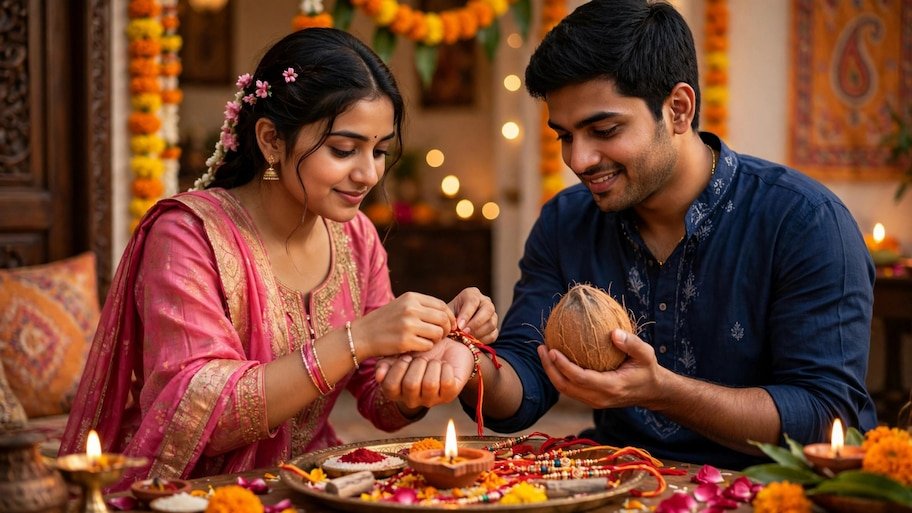
Many special rules and traditions have been laid down in Sanatan Dharma regarding Rakshabandhan, the holy festival of immense love, trust and protection between brothers and sisters. On the day of Rakshabandhan, sisters tie Raksha Sutra on the wrist of their brother, wishing for his long life, health and success. On this auspicious occasion, it is considered extremely essential to have a special item along with Roli, Akshat, Deepak and sweets in the puja plate, and that is ‘Coconut’ which has been called ‘Shriphal’ in the scriptures. According to the scriptures and folk traditions, it is mandatory to keep a coconut in the brother’s right hand before tying Rakhi. It is believed that without following this rule the ritual of Rakshabandhan remains incomplete.
Shreefal means the abode of Goddess Lakshmi and the Trinity.
In the Sanatan tradition, coconut is not called an ordinary fruit but is called Devphal i.e. ‘Shriphal’. The literal meaning of ‘Shri’ is wealth, opulence and Mother Lakshmi. According to religious beliefs, when Lord Vishnu incarnated on the earth, he brought with him Goddess Lakshmi, Kamdhenu cow and Kalpavriksha (coconut tree). The three points on the upper part of the coconut are considered to be the trinity of Lord Shiva and the symbol of Brahma, Vishnu, Mahesh (Trinity). When a sister places quince in the palm of her brother, it symbolically means that she is seeking the blessings of Goddess Lakshmi, wealth, good health and blessings of the Trinity in her brother’s life.
Impenetrable protective shield from negative energy and evil eye
According to Ayurveda and Indian energy science, coconut has the amazing ability to absorb negative energy from the environment and attract positive waves. On the holy festival of Rakshabandhan, when a sister applies Tilak to her brother and ties Rakhi, the ‘Aura’ of the brother’s body becomes fully active. By placing a coconut in the palm, all the negative energies, evil eyes and invisible defects around the brother are neutralized by the coconut. This coconut acts as a protective shield, which protects the brother from all kinds of evils, accidents and dangers.
Balance of planets in horoscope: Moon and Jupiter get strength
From an astrological point of view, coconut is considered to be related to the water element and the planet Moon, while its hard outer shell represents Saturn and the inner white part represents the Moon. The festival of Rakshabandhan is celebrated on the full moon date of the month of Sawan, when the moon is in its full influence. On the day of full moon, the moon affects the mind. Keeping a coconut filled with water in the brother’s hand strengthens the Moon in the horoscope, which brings mental stability, concentration and positive thoughts. Along with this, touching quince with yellow Kalava or Roli provides strength to Jupiter (Jupiter) in the horoscope, which increases respect and knowledge and intelligence.
Complete and accurate Vedic method of tying Rakhi
According to the scriptures, it is mandatory to follow the right direction, purity and sequence while tying Rakhi so that the full results of the ritual can be achieved.
-
Selection of direction: On the day of Rakshabandhan, the brother’s face should be towards east or north, while it is considered best for the sister’s face to be towards the west.
-
head cover: While tying Rakhi, both brother and sister should cover their heads with a clean handkerchief, scarf or cap.
-
Tilak and Akshat: First of all, sister should apply Roli and sandalwood tilak on brother’s forehead. After this, apply unbroken whole rice (Akshat) on the tilak.
-
Quince in the palm: Place a coconut (shriphal) wrapped in red cloth or tied to a mauli and some dakshina in the brother’s right hand.
-
Tying the Raksha Sutra: Tie Raksha Sutra by making three knots on brother’s right wrist. During this, the mythological protection mantra is “Yen Baddho Bali Raja Danavendro Mahabalah. Ten Twan Committed Nami Rakshe Ma Chal Ma Chal.” Pronounce.
-
Aarti and sweets: After this, light a lamp and perform Aarti for your brother and feed him pure Satvik sweets with your own hands.
An unbreakable confluence of Narali Purnima and regional traditions
This relationship between Rakshabandhan and coconut is seen in different cultural forms in different states of India. In the western coastal states, especially Maharashtra, Goa and Gujarat, the day of Rakshabandhan is celebrated with great pomp as ‘Narali Purnima’. The fishermen community on this day offer coconuts to the sea to pacify and please the sea god Varuna so that he can get protection from natural calamities. Whereas in North India, Rajasthan and Madhya Pradesh, after tying Rakhi to the brother, the sisters give the coconut as a gift to the brother or the brother keeps the coconut in the puja place or safe of his house throughout the year so that there is happiness and prosperity in the house.
Keep these precautions related to coconut and worship on Rakshabandhan
The coconut used in puja on the day of Rakshabandhan should not be dry, broken or damaged from inside under any circumstances. Always use only fresh coconut with water and coir in worship. Along with this, take special care that the work of tying Rakhi should never be done during ‘Bhadra Kaal’. In the scriptures, tying Rakhi during Bhadra period is considered completely prohibited because any auspicious work done during Bhadra period does not give auspicious results. Only after seeing the auspicious time should one give quince fruit in hand and tie the Raksha Sutra.