 look news india

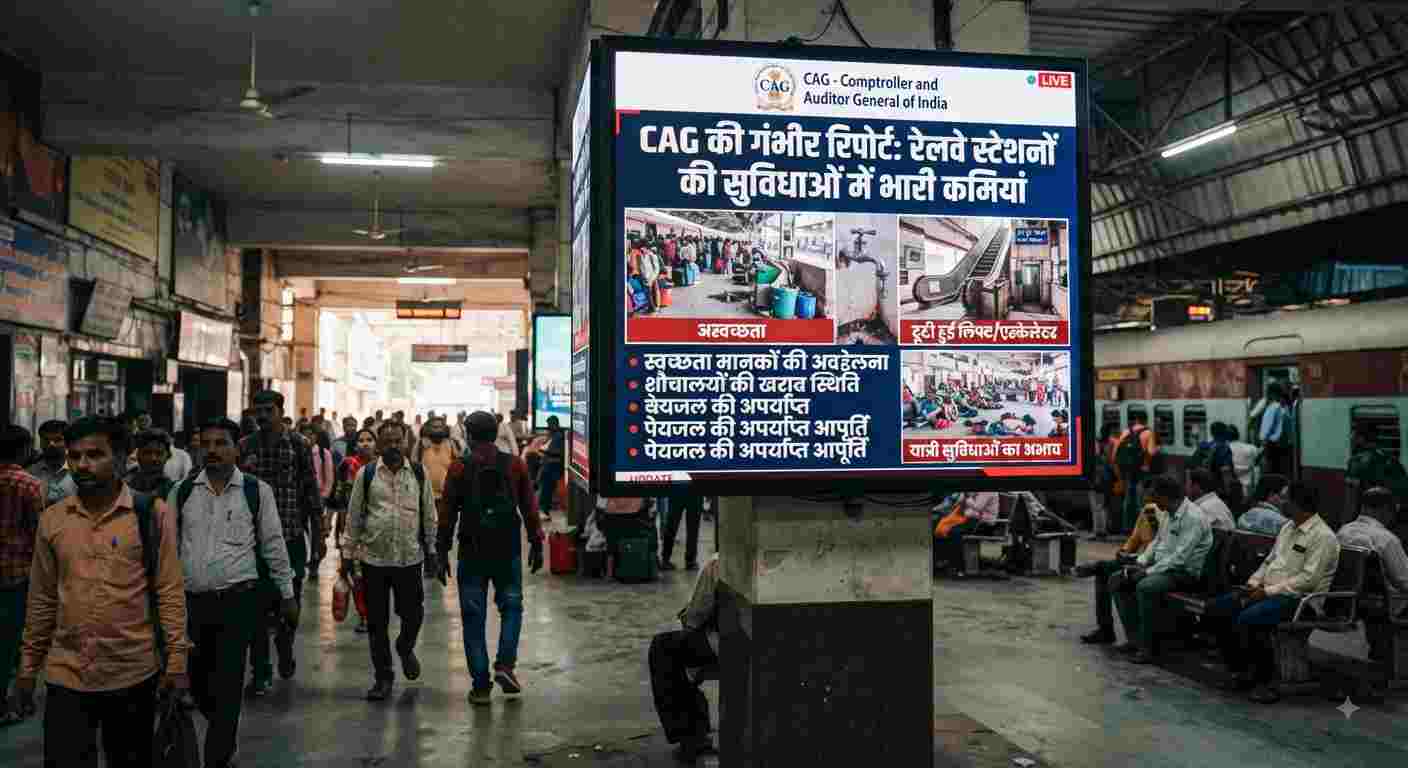
Amidst the claims of modernization of Indian Railways, high-speed trains and ‘Amrit Bharat Station Scheme’, the latest audit report of the country’s top auditor Comptroller and Auditor General (CAG) has exposed the ground reality of railway stations. This detailed report titled ‘Passenger amenities and cleanliness at non-suburban stations in Indian Railways’ tabled in Parliament has revealed that about 89.45 percent (about 90%) of the railway stations in the country have failed miserably in meeting the minimum essential amenities (MEA) prescribed for passengers.
The CAG had conducted a thorough inspection of 512 non-suburban railway stations falling under all 16 railway zones in the country, including 187 stations selected under the Amrit Bharat Scheme. The audit found that 458 out of 512 stations were severely lacking one or more of the essential amenities like clean drinking water, adequate toilets, seating benches, platform sheds, fans, water coolers or direction boards. Out of total 512 stations in the country, only 54 stations were found where facilities were available without any deficiency as per the standards set by the Railway Board. The audit is based on data and ground observations over a five-year period from 2019-20 to 2023-24, covering stations handling over 7,400 trains and over 2.9 billion passenger movements daily.
E. Coli bacteria found in human feces found in water cooler: Contaminated water at 8 major junctions including CSMT
The most shocking and health-threatening aspect of the CAG report is related to the quality of drinking water being served to the passengers at the stations. Chemical and bacteriological analysis of water samples taken by railway health inspectors found that ‘E. coli’ bacteria were present in the water coolers installed for passengers at 8 major railway stations of the country.
E-coli is a bacteria commonly found in human and animal feces or sewage water, which can cause severe diarrhea, food poisoning, stomach cramps, and in extreme cases, kidney failure. The stations where E-coli was found in water coolers included Central Railway’s Chhatrapati Shivaji Maharaj Terminus (CSMT Mumbai), Kalyan, Lonavala, Bhivandi Road, Southern Railway’s Coimbatore and Palakkad Junction, South Central Railway’s Hyderabad, and Eastern Railway’s Madhupur Junction. Apart from this, testing of tap water on the platform found total coliform bacteria at 49 stations in 8 zones in the year 2022-23 and 56 stations in 9 zones in the year 2023-24. According to the report, at 63 stations the amount of disinfectant ‘residual chlorine’ in water was beyond the prescribed limit (0.2 to 0.5 ppm) and at 59 stations the water was not even bacteriologically tested.
Severe shortage of toilets and taps: Shortage of water taps at 2,035 stations, shortage of urinals at 403 stations.
Analyzing the data of the Railways’ ‘Passenger Amenities Management System’ (PAMS), the CAG said that the lack of infrastructure is not limited to any one zone, but has become a systemic failure in the entire railway network.
Major structural deficiencies revealed in the audit:
-
Toilets and Urinals: There was a severe shortage of latrines (toilets) in proportion to the number of passengers at 201 stations, while at 403 stations far less than the prescribed number of urinals were available. The cleanliness of the ‘pay-and-use’ toilets was found to be extremely poor.
-
Drinking Water Tap: There were not enough taps in proportion to passengers at 2,035 stations across the network. There was shortage of water coolers at 40% stations and shortage of taps at 27% stations.
-
Fans and Shelters: 42% of the stations did not have the necessary fans to provide relief from the heat and many platforms did not have a platform cover shed to protect passengers from sun and rain.
-
Unauthorized entry way: At dozens of stations, stray cattle were found roaming on the platforms due to broken boundary walls and opening of unauthorized paths, creating filth and a serious threat to the safety of passengers.
There is no shortage of budget, yet 36% to 44% of funds remain unspent: result of poor planning.
The reason for the deteriorating passenger facilities is not the lack of budget, but the poor planning and implementation of the railway authorities. Making a strong comment, the CAG highlighted that during the financial year 2019-20 to 2023-24, 36 percent to 44 percent of the budget allocated by the Central Government for passenger amenities was surrendered without spending every year.
Out of the budget released for passenger amenities in the financial year 2023-24 alone, about Rs 5,956 crore could not be spent. Apart from this, out of 395 sanctioned works related to development and improvement at stations, 59% of the works were running behind schedule by more than 1 year to 4 years. Despite a clear order by the National Green Tribunal (NGT), till March 2024, no railway zone had operated official webpages giving information on waste management and sanitation action plans at stations.
Medical emergencies and passengers with disabilities are largely ignored.
The condition of emergency health services for passengers falling ill at stations or victims of accidents was also found to be extremely worrying. In the CAG investigation, at 441 out of 512 stations, neither any ‘Emergency Medical Room’ (EMR) was present nor the standard medical first-aid box as mandated under railway rules was kept.
Serious discrepancies were also noticed on the accessibility front for disabled and elderly passengers:
-
Priority seating: There was no clear arrangement for reserved seats for disabled and senior citizens at 490 stations.
-
Disabled Friendly Toilet: At 134 stations, wheelchair-accessible toilets were not available or were found locked.
-
Help Center: Help booths and tactile pathways (special floors for the visually impaired) meant to assist the physically challenged were missing at 131 stations.
Complaints increased on rail assistance: 42% passengers said- not satisfied with the solution
The direct impact of deteriorating facilities and dirt at the stations has come to the fore in the form of anger among the passengers. The number of passenger complaints registered on Railways’ grievance redressal portal ‘Rail Madad’ increased from 69,196 in the financial year 2022-23 to 74,967 in 2023-24.
When Railways took feedback from passengers after resolution of complaints, the percentage of passengers who were dissatisfied with the resolution of their complaints increased from 37% to 42%. This figure proves that complaints are being closed on paper, but passengers are not getting real relief on the ground.
CAG’s strict recommendations to Railway Board: Change the system immediately
In the conclusion of its report, the Comptroller and Auditor General has recommended the Railway Board and the Ministry of Railways to implement several concrete corrective steps with immediate effect:
-
Strict adherence to Uniform Water Quality Protocol: Automatic chlorine monitoring and mandatory regular bacteriological testing of water should be ensured at all stations, so that supply of toxic bacteria can be prevented.
-
Time bound reinstatement of MEA: Adequate toilets, water taps and sheds should be installed within 6 months by identifying the deficiencies on priority basis at all 458 stations.
-
Full Utilization of Budget: The budget of thousands of crores being surrendered should be used in purchasing modern automatic cleaning machines instead of outsourcing the infrastructure and cleaning system of the stations.
-
Monitoring of Amrit Bharat Scheme: Instead of focusing only on the new facade and external decoration of the station, the primary needs of the common passenger on the platform should be met first.
This comprehensive report of CAG has made it clear that unless the administrative system of Railways brings fundamental changes in its functioning, utilization of funds and accountability, the dream of world-class stations will remain unfulfilled for the common Indian passengers.