 look news india

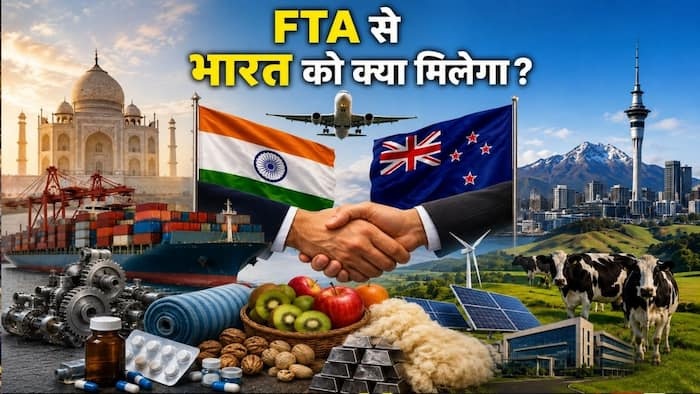
Today a very big and historic chapter is going to be added in the history of India’s rapidly changing global strategy and economic diplomacy. Prime Minister Narendra Modi has reached New Zealand’s city of Auckland after completing his successful official tour of Australia. Today i.e. on Saturday, 11th July 2026, the much awaited Free Trade Agreement (FTA) between India and New Zealand is to be completely finalized (launched on the ground) in Auckland.
Although the top leadership of both the countries had officially signed this mega FTA deal on 27 April 2026, but this personal visit of Prime Minister Modi is being considered a very big step to provide strategic and political strength to this trade treaty. Once this historic agreement is implemented, 57 percent of the bilateral trade between the two countries will become completely tariff-free.
‘Watershed Moment’ came in relationships after 40 years
This New Zealand visit of PM Modi is not a normal formal visit in terms of Indian foreign policy. this past First official visit by an Indian Prime Minister to New Zealand in 40 years Is. Earlier in the year 1986, the then Prime Minister Rajiv Gandhi had visited New Zealand.
After intense economic diplomacy of the last two years, this watershed moment has come in the relations between the two countries. Official negotiations for this free trade agreement began for the first time in March 2025, which was finalized within a record 9 months and signed in April 2026.
What is the biggest feature of this India-New Zealand FTA?
This agreement is not limited to just buying and selling of goods between the two countries, but it is a common platform for technology, digital infrastructure, higher education and agricultural innovation.
-
100% rebate to Indian exporters: After the implementation of this deal, exports from India to New Zealand will increase. Import duty on 100% products will be completely abolished. That means Indian textiles, gems and jewellery, pharmaceuticals (medicines) and engineering goods will be sold in New Zealand markets without any additional tax.
-
Relief to 95% of New Zealand products: In return, the Indian government will also give huge reduction or relief in custom duty on about 95 percent of the products coming from New Zealand.
-
Attention to the safety of domestic farmers: To safeguard its economic sovereignty and rural economy, India has taken measures to protect its most sensitive sectors—especially Dairy sector (milk, cheese, ghee) and traditional agricultural products has been completely kept out of the scope of this entire deal, so that the interests of Indian farmers are not affected.
Big investment of $20 billion and wings to MSMEs
Under this historic agreement, the Government of New Zealand and the big companies there have agreed to invest in various strategic sectors of India within the next 15 years. 20 Billion USD Has made a big commitment to make Foreign Direct Investment (FDI) of Rs. This huge investment will give new impetus to India’s emerging manufacturing hub, future sectors like digital infrastructure, green energy and semiconductors. Along with this, India’s micro, small and medium enterprises (MSME sector) will also get a big platform to connect with the global supply chain, which will create millions of new jobs in the country.
What will be the impact on the pockets and lifestyle of common consumers?
After the implementation of this Free Trade Agreement (FTA), many big and positive changes will be seen in the household budget and lifestyle of common Indian consumers:
-
Premium fruits and honey will be cheaper: New Zealand’s world famous premium Kiwi fruit, packed with fresh apples and anti-bacterial properties ‘Manuka Honey’ Now available in Indian markets at very low prices and abundant availability.
-
Wine lovers will get relief: The heavy import duty charged by the Indian government on New Zealand’s premium and international wines will be gradually reduced in a phased manner, making these brands cheaper in India.
-
Affordable medicines and best medical technology: The special agreement between the two countries in the field of medicine will ease the access of modern medical equipment and life-saving medicines to India, which will make health services affordable.
Golden opportunities open for Indian students and professionals (Visa Rules)
On the education and employment front, this deal is no less than a big jackpot for the Indian youth. Under the new rules the visa regime has been made extremely liberal:
-
3 to 4 year post-study work visa: Indian students pursuing higher education in STEM (Science, Technology, Engineering and Maths) subjects from New Zealand universities will now be able to pursue higher education after completion of their studies. Post-study work visa for up to 3 years Will get (permission to work). At the same time, Indian researchers doing PhD from there will be given work visa for up to 4 years.
-
New path for working holiday visa: Every year for Indian youth 1,000 ‘Working Holiday Visa’ A completely new quota is being started, through which the youth will be able to work as well as roam there.
-
5,000 Special Employment Visa: 5,000 special employment visas have been reserved annually for Indian IT professionals, construction engineers, healthcare experts and teachers.
-
Global recognition of local skills: For the first time, India’s traditional skills have been given great recognition in this deal. Now Indian Chef, Yoga Trainers and AYUSH Experts Will be provided special priority and legal recognition under professional working visa in New Zealand.
A big strategic message to China in the Indo-Pacific region
Talking about economic figures, bilateral trade between the two countries was 855 million dollars in the year 2015-16, which will increase in the year 2024-25. 1.298 billion US dollars In which India continues to be in a ‘trade surplus’ situation.
But this tour is not limited to just business. This coming closer of India and New Zealand is very important geopolitically amid China’s increasingly aggressive expansionist policies in the Indo-Pacific region. Both the countries stand together to combat maritime security, cyber crime, disaster management and maintaining the ‘Rules-Based International Order’. India’s middle class is expected to grow to 71 crore by 2030, which will be the world’s largest consumer market. In such a situation, for New Zealand and for India, this democratic country of the South Pacific is emerging as each other’s biggest and most reliable strategic pillar.