 look news india

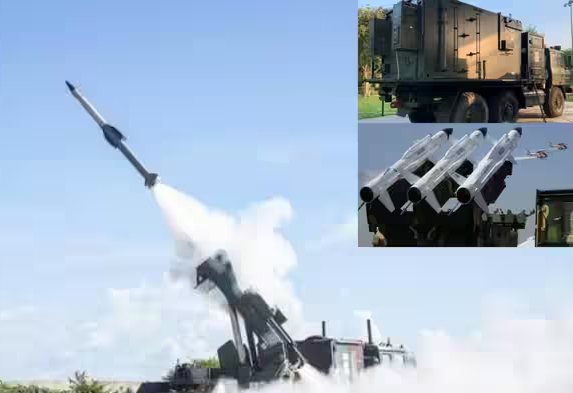
The Indian Army is once again going to take a huge and historic step towards upgrading its technical strength and firepower. The Indian Army is now completely focusing on the ‘Akashteer’ project to destroy the plans of the enemies in the blink of an eye in modern battlefields. Through this state-of-the-art air defense control and reporting system, the Army is engaged in making its ‘sensor-to-shooter’ network stronger and more accurate than ever. This means that as soon as the radars deployed on the country’s border detect the movement of any enemy fighter jet, drone or missile, the accurate command will reach the modern missile system in the blink of an eye without any human delay and the enemy will be destroyed in the air.
In today’s time, when the nature of wars has completely focused on digital, drone based and artificial intelligence, real-time data sharing along with traditional defense systems has become the most important weapon. The ‘Akashteer’ command and control system being developed by the Indian Army is a great example of this modern technology. This project will not only provide an impenetrable security cover to the Indian Air Defence, but will also establish a strong digital coordination between the weapons and radar units deployed at different locations so that every movement of the enemy can be closely monitored round the clock.
What is ‘Akashteer’ project and how does this perfect ‘sensor-to-shooter’ network work?
‘Akashteer’ is part of the ambitious plan of the Indian Army whose main objective is to make the country’s air defense network completely automated and integrated. Often the challenge in the battlefield is that the short time it takes for the radar to detect the enemy and transmit the information to the launcher firing the missile at it, gives the enemy a chance to dodge. The ‘sensor-to-shooter’ grid eliminates this gap completely. Under this system, as soon as the radar or sensor installed in any corner of the country detects any aerial threat, it immediately sends the exact target coordinates in hundredths of a second to the nearest and suitable missile launcher or anti-aircraft gun through the ‘Akashteer’ control centre.
The biggest advantage of automation in this entire process is that the scope for human error becomes zero in it. When the enemy attacks with supersonic missiles or modern stealth drones, only a few seconds are left to take a decision. At such a time, the ‘Akashteer’ system, with the help of artificial intelligence and state-of-the-art computing algorithms, immediately decides with which weapon the threat can be destroyed in the air in the shortest time and in the most effective manner. This technology is fully preparing the Indian Army for any future hybrid and electronic warfare.
New and impenetrable maze of security on Indian borders
The need of the hour has been to strengthen India’s air defense systems in view of the constantly changing geopolitical equations on both its northern and western borders. ‘Akashteer’ is emerging as a perfect weapon to deal with the threats of increasing drone attacks, spy planes and cruise missiles from China and Pakistan. The system has been designed to work equally effectively in hilly areas, deserts and plains. As a mobile command post, it can be immediately deployed at any strategic location, which greatly increases the strategic mobility of the army.
Apart from this, through this modern network the coordination between the Indian Army and Air Force will also become better. It is often seen that different security forces have their own separate radars and systems, but ‘Akashteer’ creates a common digital platform where all the air defense units can see the sky situation live on the same screen at the same time. This avoids double efforts and in case of any air attack, immediate collective response can be given, due to which no move of the enemy is successful.
Another major success of self-reliant India and domestic defense technology
The biggest feature of the ‘Aakashteer’ project is that it has been completely developed with indigenous technology under the ‘Self-reliant India’ campaign. Bharat Electronics Limited (BEL) and Defense Research and Development Organization (DRDO) along with other major defense companies of the country have jointly developed this state-of-the-art software and hardware. This is a huge diplomatic and technological victory for India in reducing its dependence on foreign weapons and systems. When such world-class command and control systems start being built in the country, not only foreign exchange is saved but the security of the country’s sensitive military technology is also completely ensured.
Defense experts believe that in the coming days, India can also export such indigenous air defense systems to friendly countries, because today many countries around the world are showing keen interest in this defense technology of India. Systems like ‘Akashteer’ prove that the Indian defense industry is now becoming a global hub of not just adopting technology but also creating cutting-edge technology. When Indian Army soldiers enter the field with such high-tech indigenous equipment, both their confidence and the country’s defense preparedness become manifold stronger.
Complete preparation of Indian Army for future wars
As the methods of warfare are changing, the importance of electronic and cyber warfare is increasing rapidly along with conventional weapons. The ‘Akashteer’ system is not just a link between a radar and a missile, but it is a secure and jammer-proof digital network that can easily defeat enemy electronic attacks. Even if enemy countries try to jam our communications, this system remains continuously active through its strong encryption technology. This is proof that the Indian Army is fully equipped and advanced technically to deal with every challenge of the future.
This step of strengthening the ‘sensor-to-shooter’ network from radar to missile through ‘Akashteer’ will prove to be a milestone in the Indian defense history. The enemies of the country should now understand well that before they can point a finger towards the Indian sky, they will have to face this infallible and modern security wall of ours. This step of the Indian Army assures the 140 crore citizens of the country that our borders and our skies are in completely safe hands, which is ready at every moment to give a befitting reply to any threat.