 look news india

The world economy once again seems to be trapped in a maze of uncertainties and serious challenges. Amidst this global turmoil, the International Monetary Fund (IMF) has reduced the global growth rate estimate for this year in its latest report on Wednesday (8 July 2026).
IMF has reduced this year’s global growth forecast from 3.1 percent to 3 percent. At the same time, this estimate for the year 2027 has been made at 3.4 percent. According to the report, this pace is much lower than the average growth rate of 3.5% seen in the year 2024-25.
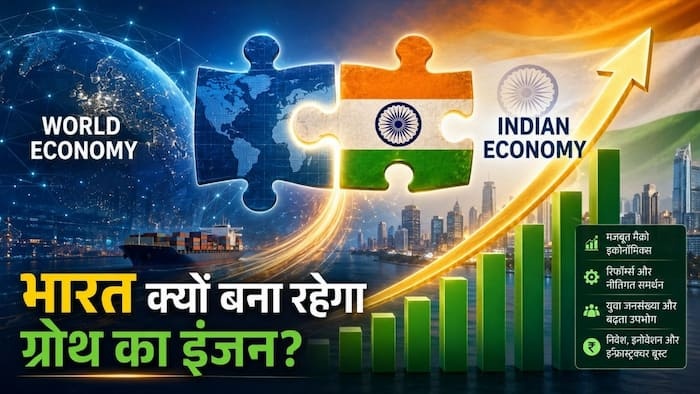
However, amidst this all-round disappointment, there is a very reassuring news for India. Due to global pressures, IMF has reduced India’s growth rate estimate marginally from 6.5% to 6.4%, but despite this, India will retain its title of the fastest growing major economy in the world. Not only this, considering India’s internal strength, IMF has increased the country’s growth rate estimate for the year 2027 to 6.5%.
Let us understand the meaning of this IMF report in simple language and know how India is roaring when the entire world is slowing down.
World trapped in contradictory web of ‘war and technology’: IMF
Released by IMF for July ‘World Economic Outlook Update’ The report describes the global economy as trapped in a ‘conflict of war and technology’.
-
On one side the shadow of war: The escalating military conflict in the Middle East and the Ukraine war continue to wreak havoc on global supply chains. The Middle East is the center of the world’s energy market, so the increase in tension there has a direct impact on the supply of crude oil and natural gas. Due to oil becoming expensive, freight transportation and production costs increase, due to which inflation can remain at high levels for a long time.
-
Expectations of AI on the other hand: The only thing of relief amid this gloomy environment is that industries around the world Artificial Intelligence (AI) is being adopted very rapidly. The increasing investment in AI has boosted global productivity, thereby reducing the impact of the recession to some extent. However, the IMF has also warned that excessive over-valuation or speculative investment in the AI sector could also lead to the bursting of the economic bubble in the future.
When the world is slowing down, why is India’s pace fast?
According to IMF and economic experts, there are 5 main pillars working behind this strong economic growth of India:
1. Strong Domestic Demand
Most of the world’s big economies (like China, Germany, Japan) are mainly dependent on their exports, which breaks their back when a global recession occurs. On the contrary, the real engine of India’s economy is our domestic demand. The country’s rising per capita income, rapid urbanization, unprecedented expansion of the middle class and ever-increasing consumption keep our markets completely safe from the shocks of recession.
2. Government’s record investment on infrastructure
For the past few years, the Government of India has been making large-scale capital expenditure on the country’s infrastructure i.e. roads, national highways, railway network, modern ports and logistics corridors. This huge public investment is not only creating lakhs of new jobs in the country, but is also attracting the private sector for investment.
3. Strength of ‘Make in India’ in manufacturing sector
‘Make in India’ campaign and Production Linked Incentive (PLI) Strategic plans like this have brought a flood of domestic and foreign investment in core sectors like electronics, smartphones, semiconductors, automobiles and defense production. Global companies are currently making India their new manufacturing hub as an alternative to China under the strategy of ‘China Plus One’ ($China\ +1$).
4. Revolution of Digital Public Infrastructure (DPI)
India’s digital ecosystem has today become an example on the global stage. UPI, digital identity systems, digital payments and direct digitalization (DBT) of government schemes have given unprecedented momentum to the country’s economy. Due to this, the Indian economy has become increasingly formalized, due to which the government’s tax collection has reached record levels and transparency in business has increased.
5. Unbroken empire of service sector
IT Services ($IT\Services$), Fintech, Financial Services and foreign companies are rapidly opening in India. Global Capability Centers (GCC) Providing a strong backbone to the country’s economy. The world’s top Fortune 500 companies are drawing on India’s talent pool to operate their core technology and back-office services, leading to a steady inflow of foreign exchange into the country.
Why was India’s forecast reduced by 0.1% and expectations for 2027 increased?
The very slight reduction of 0.1% in India’s estimates for the current financial year by the IMF is not due to any internal weakness of India. This is entirely due to external global factors. India’s oil import bill may increase due to the slowing down of the global economy, and tensions in the Middle East may have some impact on Indian exports.
But most importantly, the IMF India’s growth rate increased to 6.5% for the year 2027 Is done. This is direct evidence that the world’s largest economic institution has full confidence in India’s economic reforms, digital public infrastructure and production capacity. If the global geopolitical situation normalizes in the times to come, India’s development journey will set new dimensions.