 look news india

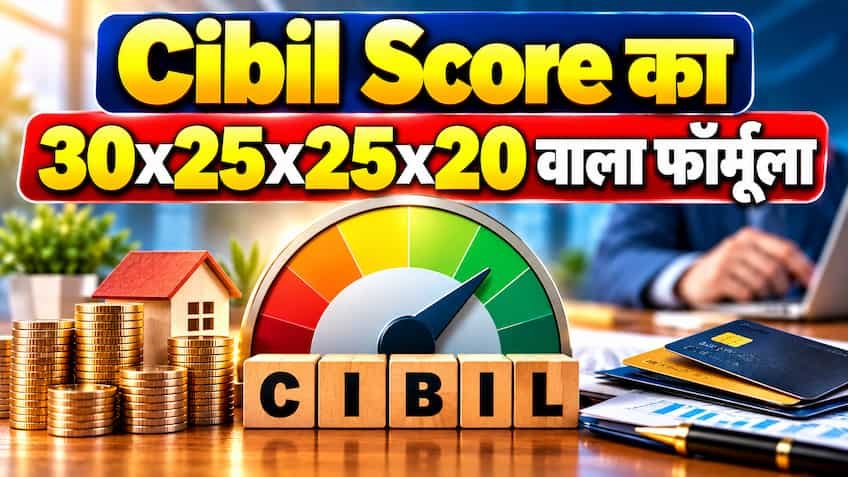
Credit score is a mirror of the financial reputation of any person. Be it a home loan, personal loan or a new credit card—the first thing banks check is the CIBIL score. CIBIL score is determined between 300 to 900 points, in which 750 or more The score is considered excellent. CIBIL Bureau does not decide the score on the basis of any single activity, rather it works on a precise weighted model which is developed by financial experts. 30:25:25:20 formula They say.
Different weightages are given to 4 main components in the calculation of CIBIL score:
| Factor | Weightage | Impact on a 600 point scale | main base |
| Payment History | 30% | ~180 points | Track record of EMI and bill payments |
| Credit Utilization (Credit Exposure) | 25% | ~150 points | What percentage of the total limit was spent? |
| Credit Mix & Age | 25% | ~150 marks | Secured vs Unsecured Loan and Account Age |
| Hard Inquiries (Recent Credit Inquiries) | 20% | ~120 points | Recent application for a new loan or card |
On-time payments are the strongest foundation of your score. Paying minimum credit card due protects against default, but paying the entire bill on time gives maximum boost to the score.
-
100% payment on time: Increase in score in 3 to 6 months by paying EMI or card bill on time every month 20 to 40 marks Continuous improvement is seen.
-
1 EMI also missed: A delinquency of more than 30 days (DPD – Days Past Due) will result in the score being immediately down 50 to 70 points Can drop.
-
Settlement or Write-off: Getting the loan ‘settled’ instead of ‘closed’ results in a negative flag in the report, which can cause the score to drop by 80-100 points.
It shows how much of the total available credit card limit you are using. This ratio as per banking standard less than 30% Should stay.
-
Example: If the total card limit is ₹1,00,000, the monthly billing cycle balance should remain within ₹30,000.
-
Less than 30% usage: slowly while keeping the score steady 15 to 25 marks Increases.
-
80% to 90% limit usage (max out): Banks consider you ‘credit hungry’, which increases your score every month. 15 to 30 points decline Can come.
-
Quick fix method: If the utilization is more than 30%, make partial payment 2-3 days before the date of bill generation so that lower balance is reported to the bureau.
A balanced loan portfolio is considered better than a lopsided loan profile.
-
Balanced Mix: Having an auto/home loan (secured) rather than just a personal loan or credit card (unsecured) shows financial discipline.
-
Keeping old credit cards active: Closing the oldest card reduces the average credit age, which can lead to an unexpected 10-15 point drop in score. Keeping old, active cards running without annual fees helps keep your score stable.
Whenever you apply for a loan or card in a bank, the bank fetches your detailed CIBIL report, which is called ‘Hard Enquiry’.
-
Multiple applications in a short period of time: Score on every hard inquiry by applying loan at 4-5 places in 15 days 5 to 10 points Can be cut immediately.
-
Effect of soft inquiry: By checking the score yourself on CIBIL portal or banking app at your level. 0% effect Does matter.
-
Lock credit utilization at 25%: If your total card limit is ₹2,00,000, do not let the monthly statement balance exceed ₹50,000. If needed, request the bank to increase the limit so that the utilization reduces automatically.
-
Activate Auto-Debit: Set up auto-pay from bank account for all ongoing EMIs and credit card bills so that there is never a single day’s delay.
-
Stop new loan applications for the next 90 days: Do not apply for any new cards or unsecured loans so that the number of hard inquiries remains zero.
-
Check for mistakes in CIBIL report: Download your free CIBIL report once a year. If the status of a closed loan is showing as ‘Active’ or incorrect overdue, immediately file an online dispute on the CIBIL portal; Once there is improvement, the score may jump by 30-50 points.