 look news india

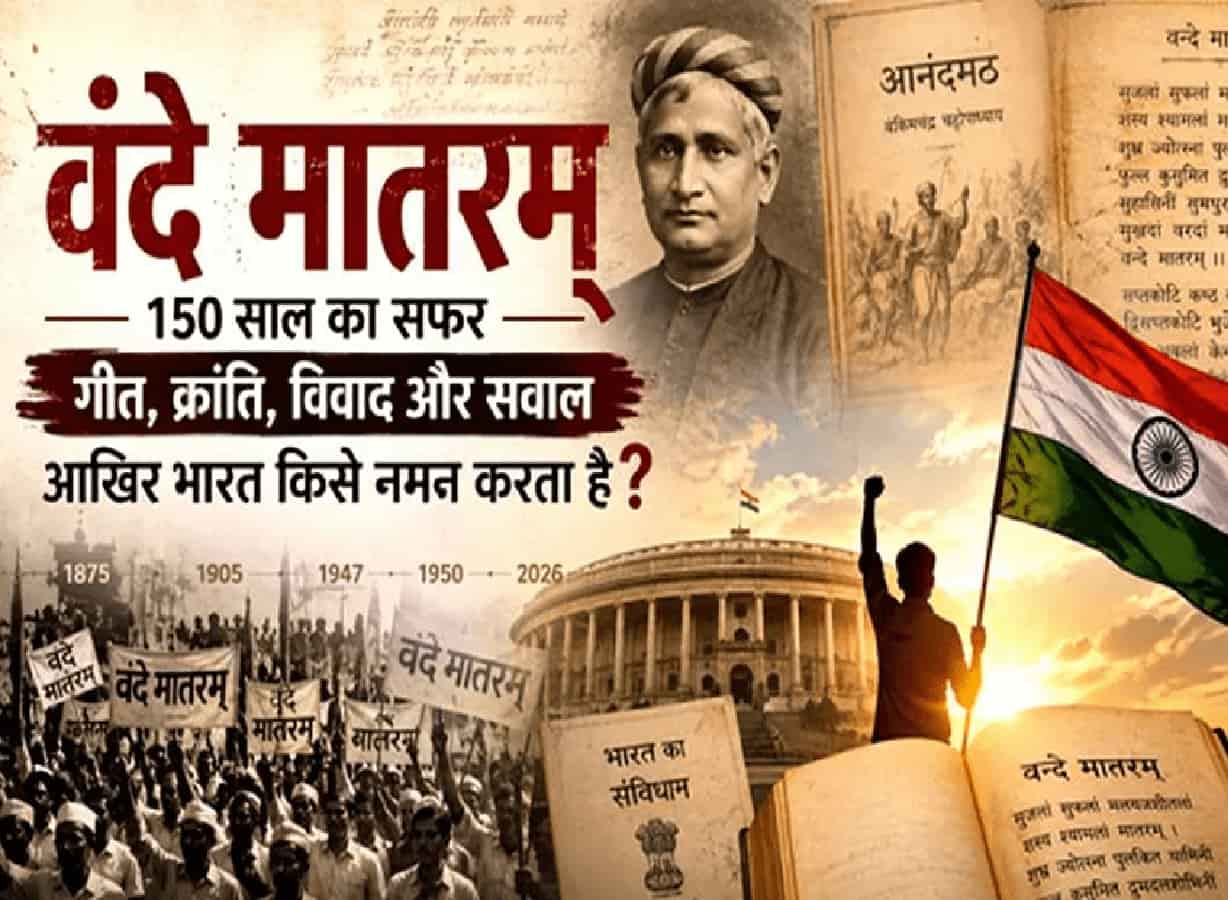
two words. One hundred and fifty years of history. And in today’s times, the temperature of political circles is once again heating up. ‘Vande Mataram’ is not just a song, but it is a living document of the collective consciousness of India that we feel in these two words.
The pain of slavery, the unwavering dream of independence, the roar of the Swadeshi movement, the indomitable courage of the revolutionaries, the dignity of the Constituent Assembly and the warmth of modern politics – all this has been in step with the historical journey of ‘Vande Mataram’. Today, when this song is completing 150 years of its composition and is again at the center of debate, this is not an irrefutable proof of the weakness of this composition, but of its eternal power.
When the earth was not just land, it was mother.
In Indian civilization, the tradition of seeing the earth not just as a geographical piece of land, but associating it with life and motherhood is centuries old. It is clearly stated in the Prithvi Sukta of Atharvaveda:
“Mata Bhoomiah Putroham Prithivyaah” (The Earth is my mother and I am the son of the Earth.)
It would be an excess with history to consider this as ancient evidence of modern nationalism, because the concept of modern nation-state did not exist at that time. But in the 19th century, Bankimchandra Chattopadhyay linked this cultural and spiritual land with the suffering of colonial India and called the motherland as ‘mother’. It is from here that the modern and historical journey of ‘Vande Mataram’ formally begins.
1875: Journey from poetry to nationalism
According to government records, Bankimchandra composed ‘Vande Mataram’ on 7 November 1875, which was later included in his famous novel ‘Anandamath’. Its literal and direct meaning is – ‘Salute to the mother’.
In its first two differences, this mother is not a war goddess, but an actual motherland full of water, greenery, blooming crops and cool breeze. But how could a loving tribute to one’s own motherland in slave India remain only a literary creation? Voices of politics and resistance automatically got included in this.
In the year 1896, the great poet Rabindranath Tagore gave voice to it in the Calcutta session of the Indian National Congress, after which it came out of the pages of literature and came to the vocal platform of the national freedom movement.
1905: When a song became the slogan of independence
When the nationwide ‘Swadeshi Movement’ began in 1905 in protest against the partition of Bengal—in which meetings, processions and demonstrations were organized in support of the boycott of foreign goods and Swadeshi—the only proclamation that resonated everywhere was: Vande Mataram.
Now it was no longer just a poem, but had become a direct and powerful challenge to the British power.
The British rule realized its immense power and made every effort to ban its public use. In the year 1906, a nationalist English newspaper named ‘Bande Mataram’ was also brought out with the same name, with which veteran nationalists like Sri Aurobindo and Bipin Chandra Pal were associated. A song had now become the main identity of the Indian freedom struggle.
Complexities of history and ideological churning
An important milestone and ideological turning point also comes in this journey. The first two stanzas of ‘Vande Mataram’ describe nature and the scenic beauty of the motherland, while the subsequent stanzas associate the motherland with Durga and other traditional symbols.
At this point the question arose whether a common national song of a multi-religious and multicultural country could be associated with religious symbols?
This is not an artificial question created by today’s politics. There was a serious discussion on this among the fighters and leaders of the freedom movement. In the year 1937, after discussions within the Congress, it became a tradition that only the first two stanzas of the song should be sung on national and public occasions. The main reason for this was that the early differences had a veneration of the motherland and nature, to which no one could object, while the later religious images had objections from some communities.
Therefore, to simply call it “the song was cut” today would be oversimplifying the pages of history. Also, it would be completely wrong to say that there were no religious symbols in the original composition. The truth is that this ideological complexity is the biggest historical truth of ‘Vande Mataram’.
First dawn of independence and constitutional status
On the midnight of 14 August 1947, when the country was on the threshold of independence, the historic meeting of the Constituent Assembly began with ‘Vande Mataram’ sung by Sucheta Kripalani. The song which was once banned by the colonial government, witnessed the birth of independent India. Its broadcast in the voice waves of Pandit Omkarnath Thakur on the morning of 15 August immortalized it forever in the early cultural memories of independent India.
On 24 January 1950, the President of the Constituent Assembly, Dr. Rajendra Prasad, formally announced that ‘Vande Mataram’ would be given equal status to ‘Jana Gana Mana’ in recognition of its historical contribution to the freedom struggle.
-
Jan Gana Mana — National Anthem of India.
-
Vande Mataram — National Song of India.
Both are not rivals or alternatives to each other, rather their historical and constitutional roles are completely different. One became the anthem of the constitutional identity of independent India, while the other remained an indelible voice of the sacrifice of the freedom struggle and emotional dedication towards the motherland.
Why has a new controversy erupted today after 150 years?
During the year 2025-26, the country is celebrating 150 years of the establishment of ‘Vande Mataram’. Meanwhile, the central government issued new guidelines regarding the full six-beat version of the national anthem and the protocol for singing it for government and official functions.
After this, the debate again intensified in the country whether the entire song should be sung or only the traditional two parts?
-
One side argues that the original and complete literary work should be fully respected.
-
The other side cites the historical tradition of 1937 under which various parties and institutions have taken decisions according to their priorities.
This debate is no longer limited to only art and culture, but nationalism, politics, history and ideological viewpoints have come face to face openly. However, many political ironies have also emerged in the meantime, which show that the policies of political parties on the ground sometimes take a practical form different from their central statements.
Conclusion: Nationalism and the big question of responsibility
The real issue of today’s debate on ‘Vande Mataram’ is not just about singing two songs or six songs, but the bigger question is that who will decide the definition of nationalism in our country and how?
A nation is not driven by the tide of emotions alone, nor is its soul satisfied by a paper constitution alone. The nation is run by a mature balance between emotion and reason. ‘Vande Mataram’ teaches us to love our motherland deeply, but democratic India also teaches us that not only people like us live in this motherland, but people who think differently from us, adopt different worship methods and every citizen who disagrees also resides with equal rights.
Today, as we celebrate 150 years of this song, it asks us a very serious and difficult question—is patriotism limited only to statements and slogans, or is it our moral responsibility too? Saluting the motherland is not just chanting a song on the stage, but protecting its environment, its rivers, its forests, its democracy and its Constitution is also true patriotism.