 look news india

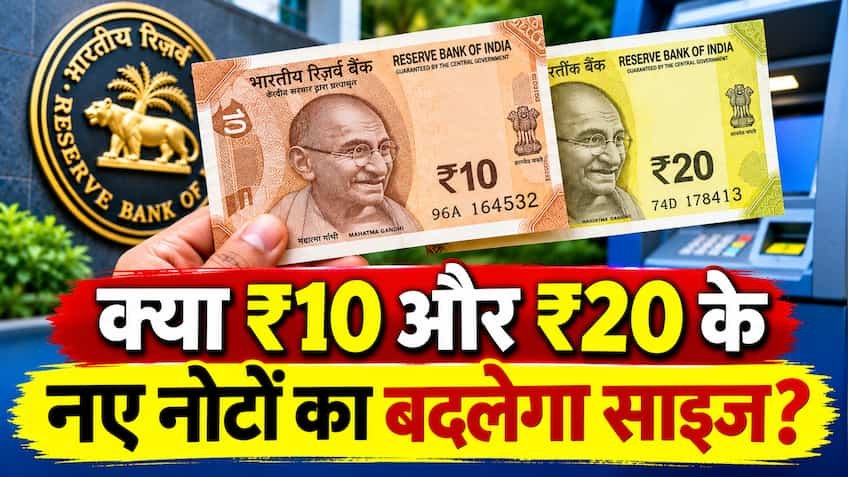
Whenever the Reserve Bank of India (RBI) prepares the outline of a new note or currency series, the eyes of the general public and the entire banking system remain focused on its size, thickness and physical security features. During the ‘Mahatma Gandhi New Series’ released after 2016, when new notes of ₹2000, ₹500, ₹200, ₹100 and ₹50 were issued, their size was kept much smaller than the old notes. While on one hand this change made it easier to keep notes in the purse, on the other hand it created a months-long technical crisis for the entire cash logistics and banking infrastructure of the country. Now that discussions are going on about the new versions of ₹10 and ₹20 (including polymer/plastic trials), it is important to understand whether the size of the notes will be smaller this time too and what is the impact on the ground level of changing the size of a note.
As per the policy standards and technical guidelines of the Reserve Bank, there is little scope for any major change in the physical dimensions of the new ₹10 and ₹20 notes. Official size of ₹10 note in the current Mahatma Gandhi New Series 63 mm × 123 mm (chocolate brown colour) and size of ₹20 note 63 mm × 129 mm (greenish yellow colour) is already set in quite compact and small format as per international standards. The central bank’s priority this time is not to reduce the size of the notes, but to strengthen their substrate (material) and durability, so that there is 100% compatibility with existing machines and cash trays.
When the lavender colored new ₹100 note (66 mm × 142 mm) and the Florentine blue colored new ₹50 note (66 mm × 135 mm) were released in 2018, their size was significantly different from the old larger notes (old ₹100: 73 mm × 157 mm). Due to this change the entire country had to face technical challenges at many levels:
-
Jamming of ATM and cash dispenser: Inside the Automated Teller Machine (ATM), special cassettes and picker rollers are installed to take out the notes. When new small notes were inserted in the cassettes set according to the old big notes, due to lack of grip of the rollers, the notes started getting stuck together and the machines started showing errors.
-
Failure of note counting machines: The sensors in currency counting machines and bundling equipment installed at banks, petrol pumps and large retail counters were used to the old wide size. She would either reject the small notes as half torn or pull out two notes together.
-
Parallel circulation headache: Until the old high denomination notes were completely withdrawn from the market, it became technically impossible for banks to load notes of two different sizes in the same ATM.
A change of just 2 to 5 millimeters in the length or width of any note is not limited to paper cutting only, but has an impact on the entire financial structure:
-
Re-calibration of more than 2.5 lakh ATMs across the country: There are more than 2.5 lakh ATMs and Cash Recycler Machines (CRM) operating in India. Whenever the size of a note changes, hardware engineers from ATM vendors (e.g. NCR, Diebold Nixdorf) have to visit each ATM to physically change the brackets, spacers and sensor settings of the cassettes, a process called ‘re-calibration’.
-
Unnecessary logistics expenses worth crores of rupees: Re-calibration of each ATM costs an average of ₹2,500 to ₹4,000 including manpower, transport and spare parts. Banks have to bear an additional financial burden of ₹700 crore to ₹1,000 crore in re-calibrating the ATM network across the country.
-
Transaction delay and dry ATM problem: The process of re-calibration is not accomplished overnight. It takes 3 to 6 months for engineers to reach every corner of the country. During this time, that particular cassette in the ATM is closed, due to which the cash in the ATM starts running out quickly (Cash Dry).
Under the note designing rules of the Reserve Bank, the height and width of notes of all denominations are deliberately kept different. In India, notes from ₹10 to ₹500 increase in length with increasing value (e.g. ₹10 note is 123 mm, ₹20 is 129 mm, ₹50 is 135 mm, ₹100 is 142 mm and ₹500 is 150 mm):
-
Facility for Visually Impaired Citizens: Due to different lengths, blind or low vision citizens can easily recognize the value of the note by folding it in their hands or touching it.
-
Convenience in manual transactions: Sorting and separating different notes from bundles in vegetable markets, auto rickshaws and daily markets is extremely fast and accurate due to the difference in size.
-
Prohibition of Counterfeiting: If all the notes are of the same size, then with the help of chemical wash, fraudsters can easily erase the ink from ₹ 10 or ₹ 20 notes and print a fake ₹ 500 note on them. Due to different sizes, printing of larger notes on smaller notes becomes technically impossible.
Given the re-calibration experiences of the previous currency series and the nature of circulation of smaller notes, the entire focus of the Reserve Bank of India is on increasing the life of the notes rather than tinkering with the size. Since ₹10 and ₹20 notes circulate mainly in hand, at grocery stores and at bus-train ticket counters rather than at ATMs, their current size is already considered compact and ideal. Only high security features, waterproofing and strong substrate are being given priority in the new editions so that the public can get a strong and long lasting currency without any banking disruption.