 look news india

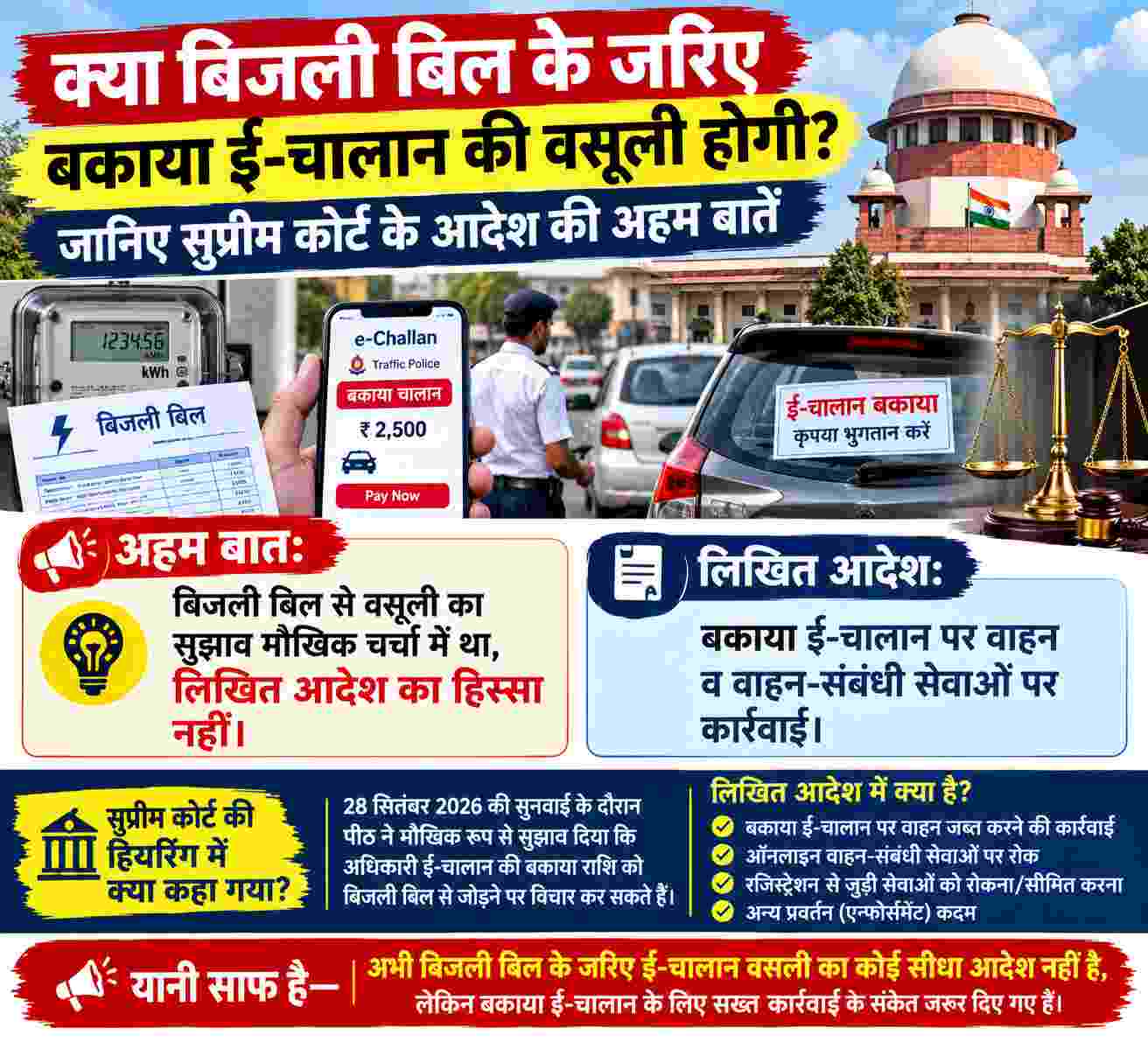
In recent times, a discussion has gained momentum among the vehicle owners who do not pay the e-challan issued after violating the traffic rules on the road, whether the outstanding challan can be recovered by adding it to the electricity bill. When consideration of different proposals began at the administrative level to recover e-challans worth crores of rupees pending for a long time in different parts of the country, the matter became the center of judicial review and public debate.
The Supreme Court, while clarifying the legal limits and statutory rights on this entire subject, has made it clear that any fine under the law can be recovered only through the process prescribed by the relevant Act. The Motor Vehicles Act and the Electricity Act are two completely different legal realms. The court underlined that an essential public utility service like electricity cannot be used as a weapon of direct coercion for recovery of any other non-related statutory penalty unless there is a clear and valid law passed by the legislature for the same.
Crores of vehicle owners across the country are facing huge loss of revenue due to non-payment of e-challan for a long time. In states like Uttar Pradesh, Delhi, Maharashtra and Karnataka alone, lakhs of vehicles have more than one challan outstanding.
The administration has clarified that instead of linking it to the electricity bill, the following strict measures are being implemented under the law:
-
Summons in Virtual Court and Lok Adalat: If the challan is not paid on time, the case is transferred to the Virtual Traffic Court, from where court summons is issued.
-
Blacklisting on vehicle portal: Vehicles with outstanding challans are blocked or blacklisted on the ‘VAHAN’ portal, due to which transfer of the vehicle, NOC, fitness renewal or national permit is not possible.
-
Moratorium on Insurance Claims and Pollution Certificates (PUCC): Strict rules are being implemented to stop the process of issuing Pollution Control Certificate (PUC) and insurance renewal when the challan is pending.
-
Discussion on recovery from FASTag: Many states have sent a proposal to the Central Government to automatically deduct the challan amount from the Fastag wallet, on which technical review is going on at the policy level.
According to legal experts, the Constitution of India gives every citizen the right to natural justice. If a person has been wrongly issued an e-challan for violating traffic rules, he has every right to challenge it in the court.
Under Section 56 of the Electricity Act 2003, the electricity company can disconnect the consumer’s connection only for non-payment of electricity consumption, meter charges and legitimate dues related thereto. Traffic challan is a quasi-judicial matter. Adding it to the electricity bill without the consumer’s consent or clear order of the court will be a direct violation of consumer protection rights and electricity laws.
Traffic police in cities like Uttar Pradesh capital Lucknow, Kanpur, Noida, Ghaziabad, Delhi or Mumbai are now issuing automated e-challans through Integrated Traffic Management System (ITMS) and cameras.
Drivers are advised to keep checking the status of their official challan from time to time instead of getting into any confusion or misinformation:
-
Visit the official portal of the Ministry of Road Transport and Highways (echallan.parivahan.gov.in) and enter your vehicle number or chassis number.
-
If any valid challan is pending, deposit it immediately through online net banking, UPI or credit card to avoid court appearance and late fees.
-
If a wrong challan has been issued, lodge an immediate objection through the ‘Grievance’ option on the portal.