 look news india

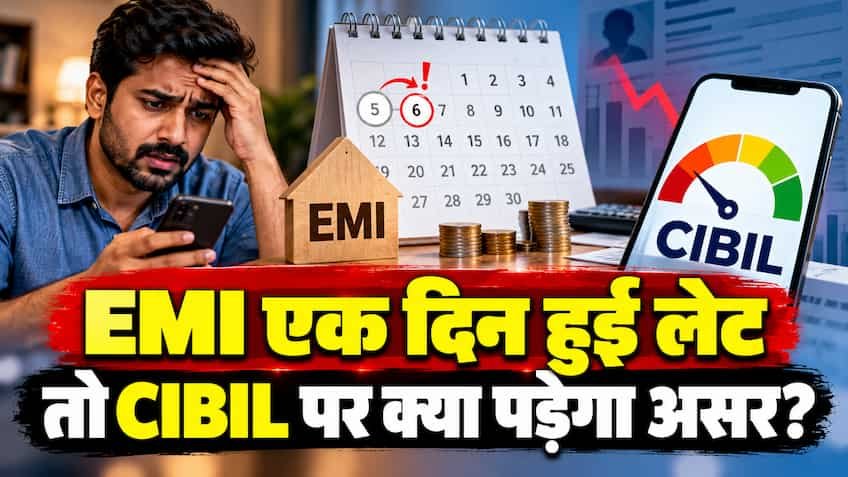
The most common question in the minds of crores of borrowers repaying bank loan, home loan, car loan or personal loan is that if the salary comes late or due to non-balance in the bank account, the EMI is delayed by just 1 day from the due date, will the credit score (CIBIL Score) fall immediately?
The simple and short answer is—no, a delay of just 1 day does not immediately hurt your CIBIL score. As per regulatory guidelines of the Reserve Bank of India (RBI), banks have to adhere to a certain deadline for reporting data to credit information companies (e.g. TransUnion CIBIL, Experian, Equifax, CRIF High Mark). Banks usually send data to credit bureaus on a once a month or fortnightly basis. Additionally, a default is recorded in the credit report only when the payment exceeds the ‘grace period’ or billing cycle period.
The Central Bank (RBI) has issued clear guidelines regarding non-performing asset (NPA) classification of credit card and loan accounts and late payment penalty:
-
3-Day Grace Period: In case of credit cards and many retail loan products, RBI has instructed banks that a grace period of at least 3 days should be given after the due date is over.
-
Reporting to Credit Bureau: If the customer repays the dues within 3 days of the due date, banks cannot report that account to the credit bureaus as ‘late payment’ or ‘default’.
-
DPD (Days Past Due) Count: There is a column in the CIBIL report called DPD. Unless the payment remains pending for more than 30 days (30+ DPD), it is not considered a serious default. Minor technical delays of 1-2 days can be recorded as ‘minor delay’ in the banks internal system, but that does not directly bring down your CIBIL score by 50-100 points.
Even if the CIBIL score does not drop immediately, from a financial point of view Even a delay of 1 day will directly cost you a huge loss of ₹ 1,000 to ₹ 2,500. Can get it done. This happens because banks and auto-debit systems trigger automatic penalties:
| type of fee | Why do you think so? | Estimated cost (loss) |
| NACH/ECS Bounce Charge (Your Bank) | Mandate failure due to insufficient balance in the savings account on the EMI date. | ₹250 to ₹500 + 18% GST |
| Bounce charge of the loan giving bank (Lender Bank) | The bank/NBFC from which the loan is taken imposes a separate bounce fee if the payment is not received. | ₹400 to ₹750 + 18% GST |
| Late Payment Penalty | Fixed penalty charged on the loan account after the due date is crossed. | ₹300 to ₹1,000 |
| Penal Interest | Daily additional interest at the rate of 18% to 24% per annum on the number of days the money is not deposited after the due date. | ₹20 to ₹100 per day |
That is, if your normal EMI of ₹ 15,000 is not deducted on the scheduled date and you make manual payment yourself the next day, you will still have to pay bounce charges and late penalty of both the banks. Fall from ₹1,000 to ₹1,800 It gets applied in one stroke.
If EMI payment is postponed beyond 1 day to weeks or months, its impact on the credit profile increases as follows:
-
1 to 3 day delay: Practically no negative impact on CIBIL score. Bounce charges and late fees cause financial loss only at the bank level.
-
Delay of 4 to 29 days: Negative comments on the profile may appear in the internal records of the bank. If the bank’s fortnightly data cycle occurs, there may be a slight drop of 10 to 20 points in the CIBIL score in some cases.
-
30 to 89 days delay (30+ DPD): This is a serious situation. Bank will officially report 30+ DPD to CIBIL. CIBIL score from this May fall by 50 to 100 pointsand it will be very difficult to get a new loan or credit card for the next 2-3 years.
-
More than 90 days (NPA / 90+ DPD): The loan account will be declared completely ‘default’ and ‘sub-standard’. Legal recovery notices may be issued and your credit score will drop below 600 and into the red zone.
If your EMI date has passed due to some technical reason or lack of funds, instead of panicking, immediately take these steps:
-
Make instant manual payment (Quick Pay / UPI): Don’t wait for auto-debit to run again. Pay the entire dues immediately through UPI, Net Banking or Debit Card by visiting Net Banking, App or official website of the concerned bank using ‘Pay EMI’ option.
-
Send Email to Customer Care (Waiver Request): Write an email to the bank’s customer support or your home branch immediately after making the payment. If your previous repayment track record has been 100% clean, then politely request the bank to give a one-time waiver of bounce charges and late fees as there was a delay of 1 day due to technical reasons. Banks often waive the charge on first bounce for good customers.
-
CIBIL Status Confirmation: Write clearly to the bank that this unexpected delay of 1 day should not be reported as default to the credit bureau (CIBIL).
-
Keep EMI date 3-5 days after salary date: If your salary comes on 1st of the month, the EMI date should always be on 1st or 2nd instead of 1st or 2nd. 5th to 7th Get it set between. With this, even if the salary is credited late by 2-3 days due to weekend or holiday in a month, your EMI will never bounce.