 look news india

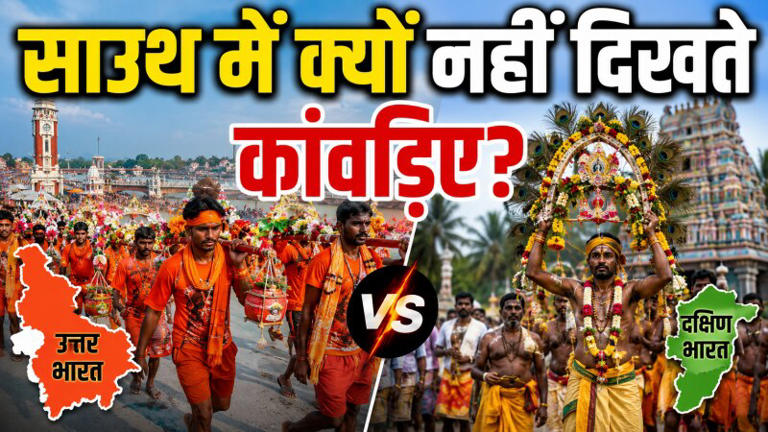
As soon as the month of Sawan arrives, the roads of North India turn saffron. In states like Delhi, Uttar Pradesh, Uttarakhand, Bihar and Haryana, lakhs of Kanwariyas are seen carrying Kanwar on their shoulders and chanting the name of Lord Bholenath. This tradition of performing Jalabhishek of Lord Shiva by bringing Ganga water has been going on in North India for centuries and its scope and craze is increasing every year. But, when it comes to South India, such Kanwar Yatras or Kanwariyas are not seen there. Do the people of South India have less faith in Lord Shiva or is there some deep geographical and cultural reason hidden behind it? Let us know in detail why Kanwar Yatra is not held in South India like North India and what is the real reason behind it.
Geographical position and distance of river Ganga is the biggest reason
The biggest geographical reason behind the popularity of Kanwar Yatra in North India is the availability and distance of the holy river Ganga. Places like Haridwar, Gangotri, Gomukh and Brijghat are very close to the states of North India, from where Kanwariyas can easily reach their local Shiva temples on foot or by other means after filling Ganga water. In contrast, South Indian states like Tamil Nadu, Kerala, Karnataka, Andhra Pradesh and Telangana are located near the coasts and sacred rivers of the South like Kaveri, Godavari, Krishna, but unlike North India, not having direct and easy access to the Himalayan Ganga is a major hindrance geographically. It is practically very difficult to bring Kanwar after covering a distance of thousands of kilometres, hence the practice of such journeys could not develop there.
South India has its own unique temple culture and worship practices.
The diversity of India is clearly reflected in its culture and the methods of worship vary according to the region. South India has very rich, ancient and grand temple traditions for the worship of Lord Shiva, such as the Brihadeshwara Temple in Thanjavur, Tamil Nadu, the Ramanathaswamy Temple in Ramanathapuram or the Murudeshwara Temple in Karnataka. Shiva devotees in South India express their unwavering faith through their local traditions, such as grand rituals on Mahashivratri, special abhishekas and traditional padayatras to temples. There, in Shiva temples, water from local rivers or traditional Abhishekam substances are used for Jalabhishek, due to which they do not feel the need for long distance Kanwar Yatra.
Difference between ‘Kavadi Attam’ tradition of Lord Murugan and Kanwar Yatra of North India
It is a very interesting fact that the word ‘Kavadi’ and the tradition associated with it exists in South India, but its form is completely different from the Kanwar Yatra of North India. In South India, especially Tamil Nadu, a very famous ritual called ‘Kavadi Attam’ is performed in the worship of Lord Karthikeya (also known as Murugan or Subrahmanyam), the younger son of Lord Shiva. In this, devotees dance and reach the temples of Lord Murugan carrying a decorative structure made of wood or bamboo on their shoulders, which is called ‘Kavadi’. However, the Kavadi Yatra of North India is specifically associated with bringing Ganga water and offering it to Lord Shiva in the month of Sawan, while the Kavadi Yatra of the South symbolizes worship and sacrifice to Murugan Swami.
Sawan month celebrations and regional cultural diversity
In North India, where the entire month of Saavan is considered to be the biggest festival of Kanwar Yatra and Rudrabhishek by dedicating it to Lord Shiva, in South India, other religious and cultural festivals have special significance in the months of Saavan and its surroundings. While in Andhra Pradesh and Telangana there is special worship of Goddess Lakshmi and Shiva in the form of ‘Varalakshmi Vratam’ and ‘Shravan Somvaram’, local festivals like ‘Onam’ in Kerala and ‘Aadi Perukku’ in Tamil Nadu are celebrated with great enthusiasm. North Indian style Kanwar Yatras have also not become a trend in South India due to differences in regional cultural beliefs and seasonal traditional events, which reflects the unique cultural identity of each region.