 look news india

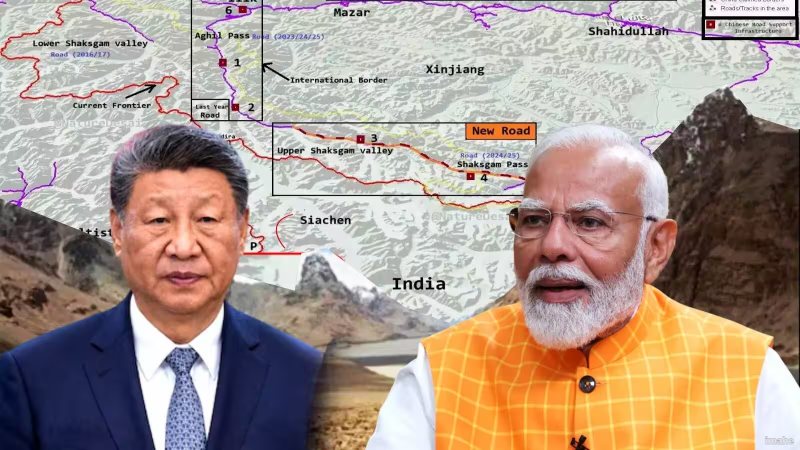
Once again the atmosphere of tension seems to be heating up in Asian geo-politics. A new and very sensitive ‘border agreement’ signed between India’s neighboring countries China and Pakistan has become the center of discussion in global diplomatic circles. The secret and aggressive strategic activities of both the countries on the disputed land of about 5180 square kilometers extending from Shaksgam Valley to China-Pakistan Economic Corridor (CPEC) has greatly increased the uneasiness of New Delhi. This whole matter is not just a land agreement between two countries, but it is a huge geopolitical issue related to the security, sovereignty and strategic balance of South Asia. Let us understand this entire incident and its strategic implications in detail.
This entire area of Shaksgam Valley is extremely sensitive and strategically important from geopolitical point of view. This is the same area which Pakistan had illegally and ignoring India’s opposition, ceded to Beijing under the so-called China-Pakistan Agreement of 1963. Now, through this new border agreement and expansion of the economic corridor, China is trying to further strengthen its military hold in this area. The development of projects and infrastructure passing through this route has a direct impact on the security of India’s northern and western borders. The Government of India has always strongly rejected these illegal agreements and considers them a flagrant violation of its sovereignty and territorial integrity.
Shaksgam Valley and the increasing strategic scope of CPEC: Why is this a matter of concern for India?
The China-Pakistan Economic Corridor (CPEC) passes through Pakistan-occupied Kashmir (PoK), on which India has been continuously registering its strong objection. Under the latest agreements, China is now expanding the scope of its military and commercial activities in the region. The rapid construction activities of roads, military posts and infrastructure by China in the Shaksgam Valley is creating a security challenge for India on a double front. The aim of this pivot between Beijing and Islamabad is to increase their stability in this strategically important area, so that they can gain a strategic edge in the event of any future military conflict.
Indian defense and diplomatic experts believe that under the cover of this new agreement, China has started using this disputed territory completely for its strategic and military purposes. The increasing interference of the People’s Liberation Army (PLA) in this region and deployment of heavy military equipment has become a major challenge for India’s security system. Indian security agencies are keeping a very close eye on this entire incident. New Delhi has also repeatedly made it clear in international forums that any such illegal agreement or construction work that tampers with India’s sovereignty will never be accepted and India is fully capable of protecting its borders.
Threat to regional stability and its far-reaching implications for international diplomacy
The impact of these secret and unilateral agreements between China and Pakistan is not limited to India only, but it has a direct impact on the regional stability of the entire South Asia. Analysts say that China is taking full advantage of Pakistan’s weak economic condition and gradually establishing its control over its land and resources. Pakistan’s government has completely surrendered to China to overcome its internal political crisis and financial crisis, due to which it is forced to accept every condition of Beijing even in matters related to national security. This geopolitical alliance clearly reflects China’s long-standing intention to establish a monopoly on the trade and strategic routes of the Indian Ocean and Central Asia.
Diplomatic experts from Western countries and global forums also agree that China’s increasing military presence in the Shaksgam Valley and CPEC region could prove to be a new headache for global peace in the times to come. China is giving edge to its ambitious ‘Belt and Road Initiative’ (BRI) through this region, which has been opposed by many other countries including India. Citing international treaties and rules, India has repeatedly warned that no third country has any legal right to carry out such activities on the disputed territory of India. Despite this, international laws are being continuously ignored by China and Pakistan, due to which the diplomatic distance between the two countries is increasing further.
India’s strong diplomatic and military response: preparedness to deal with every situation
Amidst all these challenges, India has also made its military preparations on its northern and western borders impenetrable. The Indian Army and Air Force have rapidly developed modern weapons, radar systems and infrastructure in the border areas, so that a befitting reply can be given to any adverse situation. Even on the diplomatic front, India, along with friendly countries, is continuously opposing China’s expansionist policy. This new agreement related to Shaksgam Valley and CPEC has once again proved that India will always have to be extremely alert and attentive towards the security of its borders, as the strategic moves made by the neighboring countries are constantly changing.
In the times to come, the relations between India and China as well as the geopolitical direction of this entire region will depend on what stance the international community takes on this illegal land use. The Government of India has made it clear in its foreign policy and defense matters that the security and territorial integrity of the nation will never be compromised. The dragon’s evil eye and Pakistan’s helplessness on this 5180 square kilometer area extending from Shaksgam Valley to CPEC have made the strategic equations of South Asia extremely complex, on which every country is keeping a close eye.