look news india

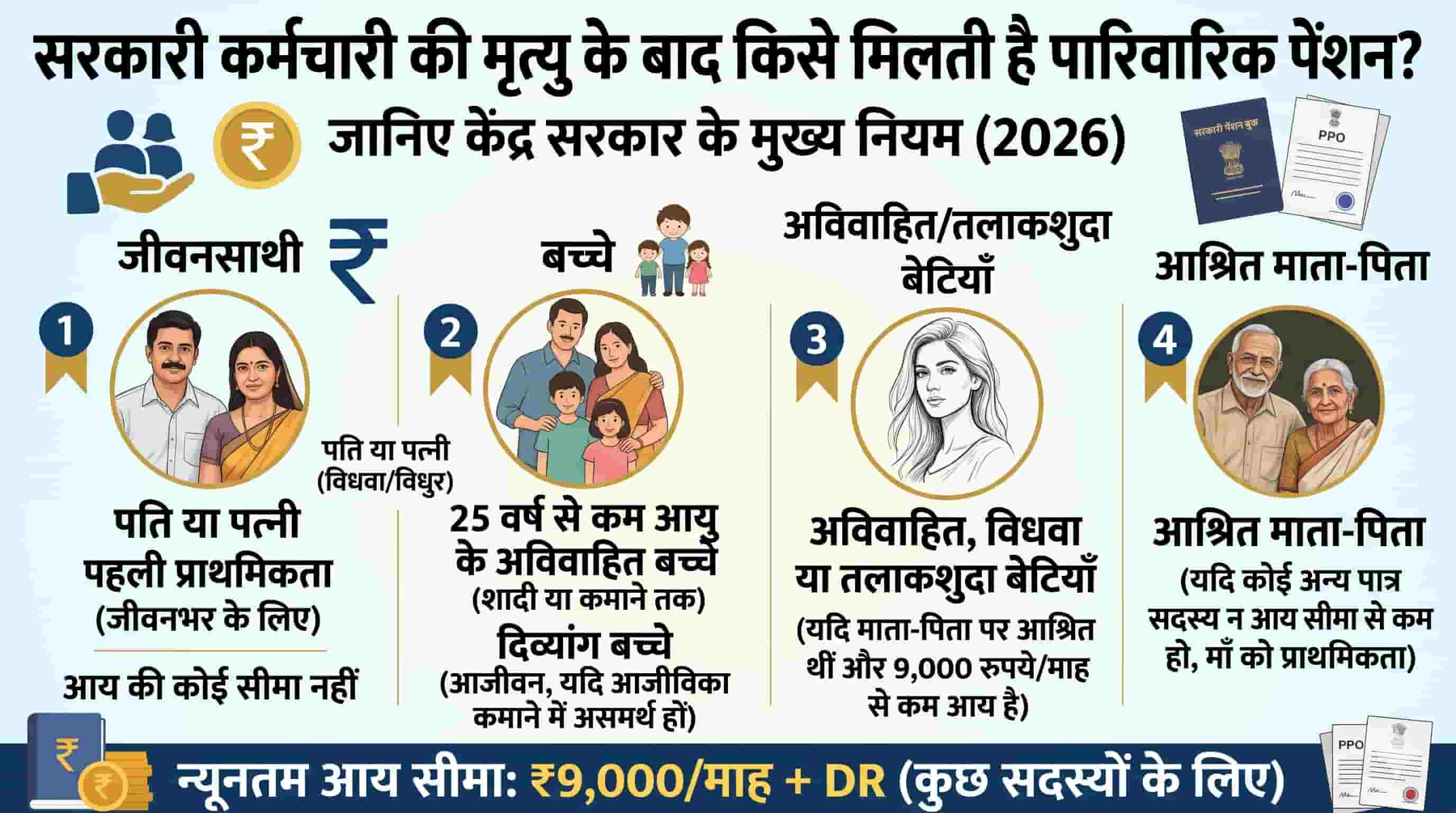
There is often confusion regarding the ‘family pension’ received by the family of a Central Government employee or pensioner after his death. The government has now clarified this matter. As per pension rules, all members of the family are not automatically entitled to family pension. Eligibility is based on proof of relationship with the deceased, the individual’s own personal income and, in some cases, financial dependence on the deceased.
The Department of Pension and Pensioners’ Welfare (DoPPW) issued an office memorandum dated October 29, 2026. It details the criteria related to inability to earn livelihood and financial dependence on the deceased. The order clarifies rules for unmarried, widowed or divorced daughters, remarried childless widows, dependent parents and disabled children or siblings.
Complete exemption from income limit for legal spouse
The Pension Department has clarified that while reviewing family pension claims, it is necessary to check whether the applicant is earning his own livelihood or not. However, legal spouses (husband or wife) are completely exempt from this rule. No income limit applies to them. In other words, no matter what the income of the spouse is, they cannot be barred from receiving family pension.
However, if a childless widow remarries, she does not get this exemption. In such a case, he is subject to the same income limits as other members of the family (except disabled children or siblings).
What is the income limit for other family members?
Under Rule 50(11) of the Central Civil Services (Pension) Rules, 2021, the department has prescribed certain income limits. For eligible family members other than legal spouse and remarried childless widow, monthly income from sources other than family pension should be less than ₹9000 plus dearness relief. This limit applies to income from other sources and does not include the amount of family pension. This amount of ₹9000 is in line with the current minimum family pension.
The income criteria are different for children or siblings who are mentally or physically handicapped. In their case, the total income received from sources other than family pension should be less than the amount of family pension they receive. As per current rules, this amount is 30% of the last pay drawn by the employee and the dearness relief (DR) applicable thereon.
Merely having low income is not enough, proof of being dependent is also necessary.
For some family members, having an income below the prescribed limit is not enough to be eligible for a pension. They will also have to prove that they were financially dependent on the government employee or pensioner while he was alive.
According to the department’s clarification, unmarried, widowed or divorced daughters will have to prove that they were dependent on their parents during their lifetime. Similarly, dependent parents must prove that they were completely dependent on the employee or pensioner immediately before their death. In case of disabled siblings, it is also mandatory to prove that they were financially dependent on the employee or pensioner immediately before his death.
The Pension Department has further clarified that the income limit used to determine financial dependency is the same limit used to assess an individual’s means of subsistence or livelihood. Specifically, for normal family members, income from other sources should be less than ₹9000 (including dearness relief) per month; Whereas for disabled children or siblings, this limit has been set at less than 30% of the employee’s salary (including dearness relief).