 look news india

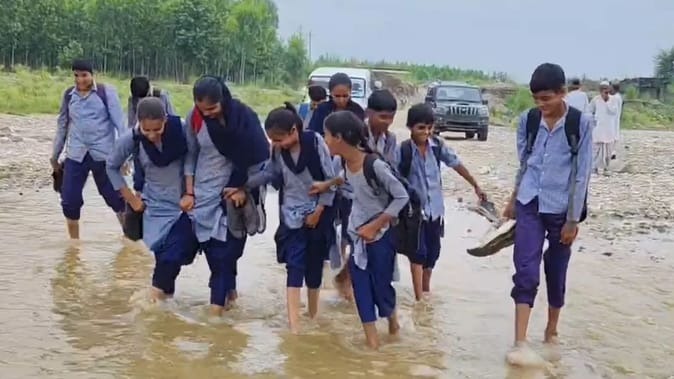
While on one side of the country there is a lot of talk about digital education and smart classrooms, on the other side, a very painful and scary picture has emerged from Jharkhand about how innocent children are still struggling for basic facilities in many remote and rural areas of our country. About 629 children studying in a government school located in a remote rural area of Jharkhand are forced to risk their lives to go to school every day, as there is no safe bridge or paved road on their way. In this monsoon season, when the local drains and rivers of the area are in spate due to rain, these children have to cross the fast flowing water carrying their small bags on their shoulders and risking their lives. Local villagers and parents say that they have appealed to the public representatives and the district administration several times to at least construct a safe bridge for children to travel, but every time they have received nothing except false assurances. Parents remain in fear every moment regarding the safety of their children as they never know when some major accident may cost the lives of these innocent children.
What terrible risks do 629 school-going children face during this arduous daily journey?
When these 629 students leave their homes in the morning to pursue education, their families hold their breath until they return home safely. To reach school, these children have the option of either crossing knee-deep dirty water and a fast-flowing drain, or of quitting their studies, and are forced to play this game of death every day in the pursuit of a better future. Sometimes the rain is so heavy that the water level rises so much that small children narrowly escape from getting swept away in it, who are somehow managed by the elder children or the villagers. School teachers also say that due to such dangerous conditions, the attendance of children is adversely affected and many children are unable to come to school during rainy days. All the tall government claims of Right to Education (RTE) and protection of children seem to be failing completely in front of this overflowing drain, which is a living proof of the insensitivity of our administrative system.
Why is there so much anger among the villagers due to the silence of the local administration and public representatives on this serious problem?
The patience of the local villagers and parents regarding this inhuman and dangerous problem that has been going on for a long time has now completely ended, due to which huge anger is being seen against the administration. Villagers allege that at the time of elections, big leaders come to these inaccessible roads to seek votes and go away promising to build a permanent bridge, but after winning the elections, no one comes to take notice. When the pictures and videos of the deadly journey of these innocent children came to light through the media, then the local administrative officials lost their sleep and they are talking about getting the matter investigated. The question of the public is whether the administration is waiting for some big and untoward accident, only after which their eyes will open and the bridge will be constructed here. In this era of democracy, when the country is flying high in development, the fact that these 629 children of Jharkhand are risking their lives in this way to study is a big stain on our system.
What steps should the government and the education department take immediately to find a permanent solution to this serious crisis?
This painful picture that has emerged in this remote area of Jharkhand has once again proved that there is still a huge gap between paper development and ground reality, which is extremely important to bridge. The State Government, District Administration and Rural Development Department should without any delay pass a proposal for construction of a strong and safe bridge over this drain or river on a war footing so that the lives of these children can be secured forever. Until a permanent bridge is built, it should be the responsibility of the administration to arrange for an alternative and safe boat or temporary bridge for the movement of children so that this journey of education does not become a journey of death. These 629 innocent children, who are called the future of the country, should get their right to education as well as the right to live a safe life, and for this the local administration will have to discharge its responsibilities honestly.