 look news india

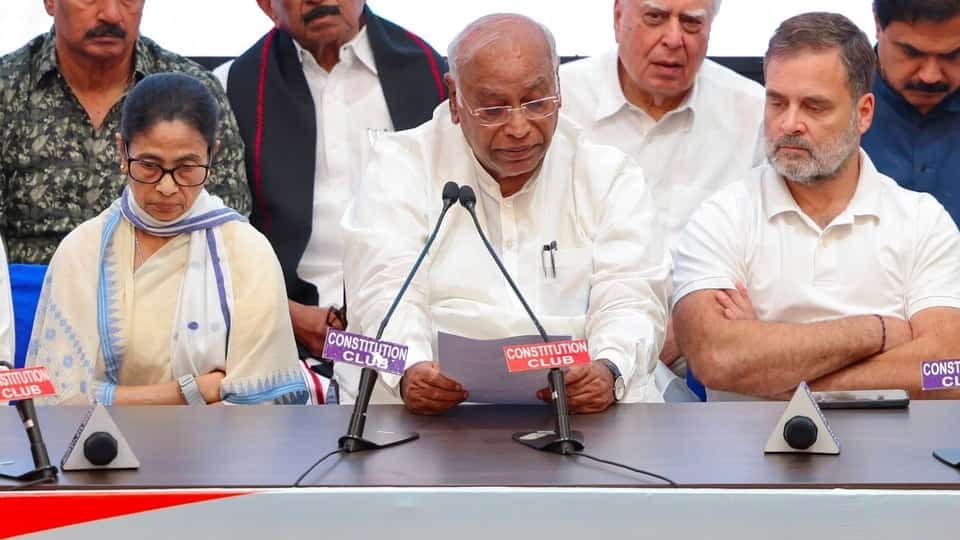
In Indian politics, the faster the electoral equations change, the faster the strategies also change. The recent administrative and electoral guidelines of the Election Commission of India have once again intensified the political stir at the national level. The opposition parties, which were seen standing face to face with each other over seat distribution and local priorities at the state level, are suddenly seen rallying on a common issue. This development has forced political pundits to wonder whether any administrative stance or decision of the Election Commission has given new life and common purpose to the ‘India’ alliance.
A round of impromptu meetings has started in the opposition camps from the political corridors of Delhi to Lucknow, Patna, Mumbai and Kolkata. Analysts believe that whenever procedural or administrative questions arise on the decision of any constitutional body, the scattered opposition prefers to forget its mutual differences and form a united front. This situation also creates new strategic challenges for the ruling party and provides a concrete opportunity to the opposition parties to create a joint political narrative.
The biggest rule of coalition politics is that a common challenge always outweighs internal differences. In the last few months, due to the assembly elections and local politics of various states, the distance that was visible between Congress, Samajwadi Party, Trinamool Congress and Aam Aadmi Party has reduced rapidly after the action of the Election Commission. The opposition has linked the Election Commission’s decision to ‘electoral fairness and democratic balance’ and directly linked it to the policies of the Central Government.
From Parliament to the streets, uniformity is being seen in the statements of the spokespersons and top leaders of all the constituent parties. Whereas earlier the statements used to come scattered from different platforms, now their objections are being lodged before the Election Commission through joint press conferences and joint memorandums. This common stance shows that questions raised about electoral rules or institutional decisions act as glue for the opposition, keeping parties with different ideologies stuck on one ground.
The impact of this decision of the Election Commission is not limited only to the national capital Delhi, rather its impact is clearly visible on the regional politics of the states. The coordination of grassroots workers between Samajwadi Party and Congress in Uttar Pradesh has become more vocal after this issue. Both the parties are trying to convey the message to their cadre at the booth level that it is their joint duty to keep an eye on the electoral processes.
Similarly, in Bihar, Rashtriya Janata Dal (RJD) and left parties have prepared a plan for protests at the district level on the instructions of the Election Commission. The DMK in the southern states, especially Tamil Nadu, has also raised questions on the autonomy of the Election Commission by pushing this national narrative. When an issue resonates equally in both North and South, it gives a pan-India character to the alliance. Regional parties are realizing that instead of fighting separately, by raising their voice together, the weight of their voice increases manifold at the national level.
The strongest basis for the integration of the alliance is becoming the argument that all parties should get equal opportunity i.e. ‘level playing field’ to contest elections. The main allegation of opposition leaders has been that some new rules or decisions of the Election Commission provide a more favorable environment to the electoral strategy of the ruling party, while entangling the opposition in procedural complexities.
This issue has also sparked debate among civil society, legal experts and former bureaucrats. The opposition is capitalizing on this debate to make the public understand that this fight is not just about gaining power, but about protecting the transparency and fairness of the electoral system. When a political fight gets a moral and constitutional basis, its acceptance among the public also increases. This is why the opposition alliance is now seriously considering the strategy of taking this issue to the legal corridors and the threshold of the Supreme Court.
According to political pundits, this environment created by the Election Commission’s decision has facilitated internal coordination within the alliance. When parties face a common crisis, they are willing to adopt a more flexible approach even on complex issues like seat sharing.
The leaders who were earlier making public statements for one or two seats, have now started talking about national interest and coalition dharma. It is now agreed in the meetings going on behind the scenes that attention should be diverted from mutual conflicts and the focus should be on joint election campaigns and joint rallies. This not only boosts the morale of the workers, but also creates an image of a strong and stable alternative among the voters. The Election Commission’s decision, albeit unknowingly, has provided a solid excuse for the top opposition leadership to sit at the same table again and again and share strategies.
The biggest and most important question remains whether this unity arising from the Election Commission’s decision will actually last for a long time or is it just an immediate political reaction. The history of Indian politics is witness to the fact that alliances formed due to external pressure or common opposition sometimes disintegrate due to internal contradictions.
Distribution of election tickets, ambitions of local leadership and the compulsion to contest elections against each other in different states are such thorns which can become obstacles in the path of any alliance. However, in the present scenario it is clearly visible that the immediate opposition has not let this opportunity go. Using the Election Commission’s decision as a catalyst, they have strengthened their weak link and tried to present themselves as an organized force before the people of the country. In the coming days, it will be interesting to see whether this unity remains limited to press conferences only or it also proves successful in transferring the vote bank at the grassroots level.