 look news india

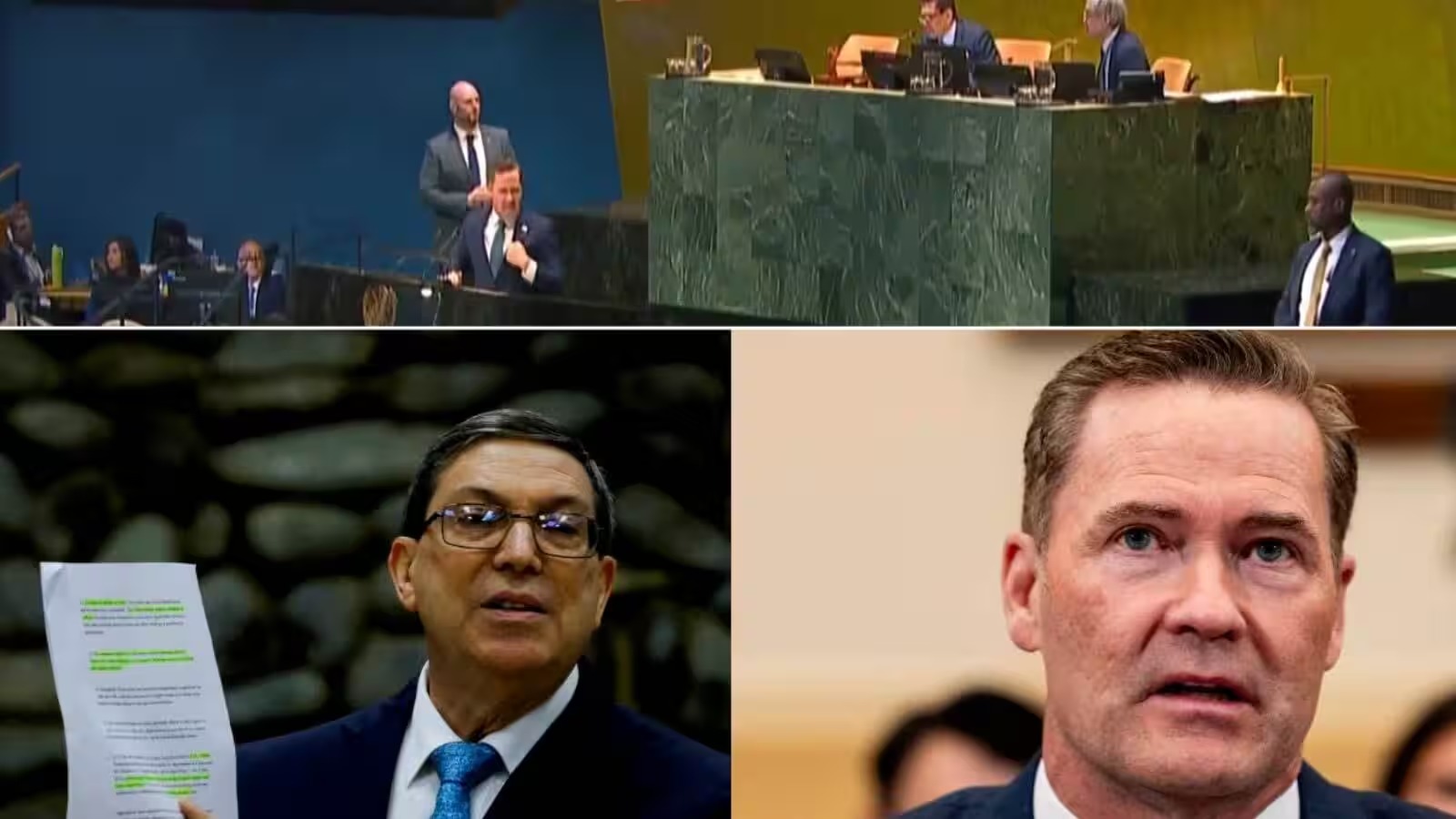
During the high-level session of the United Nations (UN) General Assembly, unprecedented tension was witnessed in the diplomatic corridors when a very heated debate broke out between the Chief Representative of the United States of America and the Foreign Minister of Cuba on bilateral and multilateral issues. The war of words between the diplomats of the two countries in the main hall of the UN Headquarters escalated to such an extent that the US envoy warned the Cuban delegation in a stern and stern tone, saying, “Do you know who you are messing with?” As soon as this sharp sentence was echoed, there was silence in the entire hall and the commotion intensified among the representatives of different countries present there. In the history of the decades-long US-Cuba tension, such direct and aggressive debate has rarely been seen on the UN platform.
The whole matter started when Cuban Foreign Minister Bruno Rodriguez Parilla, while addressing the General Assembly, strongly condemned the decades-old economic, trade and financial sanctions imposed on Cuba by the US. He termed US policies as an ‘economic blockade’ and a serious violation of human rights. In his speech, the Cuban Foreign Minister accused the US of interfering in the sovereignty of Latin American countries and deliberately paralyzing Cuba’s economy. During this time he compared Washington’s policies to a medieval siege, in response to which the American delegation immediately took the stage and counterattacked using the ‘right of reply’.
As soon as the US envoy came on stage, he termed the Cuban Foreign Minister’s allegations as completely baseless, misleading and politically motivated. He said that Cuba’s current economic crisis and the problems of its people are not due to American policies, but are the result of mismanagement, corruption and repression of human rights by the communist government in Havana. During the debate, when the Cuban delegation protested and tried to intervene, the American diplomat’s stance became more tough. He directly warned the Cuban government to stop trying to tarnish America’s image on international forums and mislead the global community.
The US representative stressed in his statement that Washington will never support regimes that violate the freedoms of their own citizens. He reiterated his demand for the release of political prisoners and democratic reforms in Cuba, saying that if Cuba wants to improve international relations, it will have to change its internal policies. This heated debate has presented a real picture of the deterioration in relations between the two countries in the United Nations, which makes it clear that there is no sign of the diplomatic ice melting in the relations between the two countries in the near future.
After this unprecedented debate in the United Nations, reactions of other countries of the Latin American region have also started coming to the fore. Representatives of countries such as Venezuela, Nicaragua and Bolivia supported Cuba and demanded the immediate removal of US sanctions, while many Western countries supported the US stance and stressed the need for a democratic system in Cuba. This development has once again reminded us of the Cold War era, when Latin America used to be the main center of competition among global powers.
Experts believe that this increased tension between America and Cuba will not be limited only to bilateral relations, but it will affect the security and economic stability of the entire Caribbean and Latin American region. Amid growing economic and military ties with Cuba by global superpowers like China and Russia, Washington’s aggressive stance shows that the US is in no mood to tolerate the presence of any third power in its sphere of influence. This heated clash at the UN will remain a major focus point of international diplomacy in the coming days.
After this debate, it is considered certain that a new diplomatic tussle will begin within the United Nations Security Council and the General Assembly regarding various resolutions. Every year Cuba presents a resolution in the United Nations against the US blockade, which receives overwhelming majority support. However, this tough stance given by America makes it clear that despite these proposals and international pressure, it is not going to back down from its strict policies. This impasse is sure to have a direct impact on the trade, diplomatic and humanitarian relations between the two countries.
According to experts in international diplomacy, the use of such informal and strong words at a forum like the United Nations shows that traditional diplomatic boundaries are now blurring. While on one hand Cuba is adopting aggressive propaganda strategy to maintain its global sympathy, on the other hand America wants to send the message through its superpower image and tough attitude that it will not compromise with its strategic interests. In the times to come, it remains to be seen whether both the countries return to the negotiating table or whether this war of words turns into a major political crisis.