 look news india

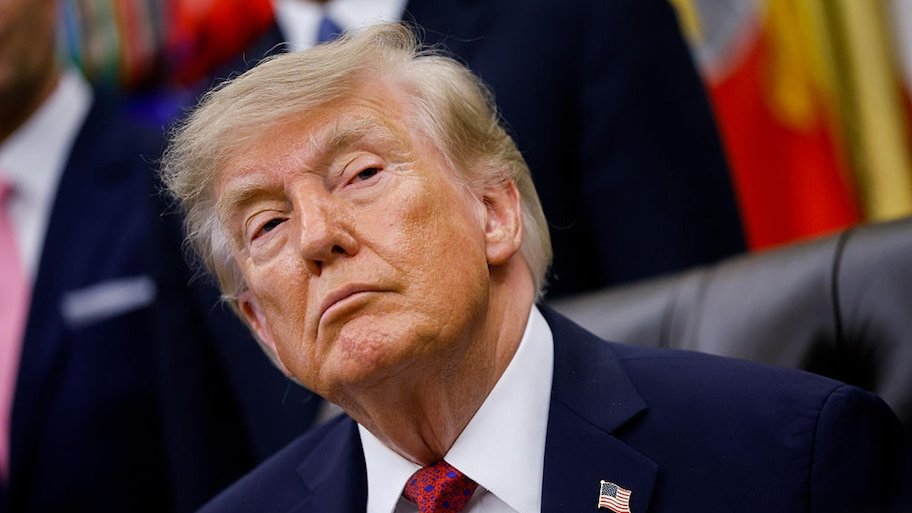
Amidst the ongoing fierce military standoff and naval attacks with Iran in the Persian Gulf and the Strait of Hormuz, US President Donald Trump has started a huge diplomatic maneuver to change the future of Middle East forever. According to the latest inside report by international intelligence sources and American media outlet ‘Axios’, the Trump administration is working on a far-reaching and extremely ambitious ‘long-term strategy’ to be implemented immediately after the end of the ongoing military confrontation with Iran. The US President has given clear indications in private conversations with his close strategists and foreign diplomats that he wants to reshape the entire map and security balance of West Asia which has been burning in the fire of unrest, war and proxy conflicts for the last several decades.
This confidential draft, being prepared by top officials of the US National Security Council (NSC), Pentagon and State Department, is being called Trump’s ‘Super 4’ plan in diplomatic circles. This plan is not limited to just a ceasefire, but is a comprehensive blueprint to forever neutralize Tehran’s influence by bringing the major Arab countries of the region and Israel under a common security umbrella. However, the most shocking thing about this grand strategy is that it has created immense panic and turmoil in the political camp of Washington’s closest ally and Israeli Prime Minister Benjamin Netanyahu.
The main objective of this secret blueprint of the Trump administration is to root out the nuclear instability that has arisen in the Middle East after the attacks of October 7, 2023 and to create a new regional alliance whose security will be guaranteed by the United States itself. Trump’s strategic ‘four’ includes four very important pillars:
-
‘Middle East Defense Alliance’ against Iran: The first and most aggressive part of this plan is to bring the major Gulf Arab states (such as the United Arab Emirates, Bahrain, and Saudi Arabia) into a formal security partnership with Israel. America will play the role of the main ‘Security Guarantor’ in this alliance. Under this, an integrated air defense radar network and maritime task force will be formed, so that Iran’s ballistic missiles and drone attacks can be jointly countered.
-
Saudi Arabia–Israel Normalization (Extension of the Abraham Accords): This is being considered the biggest ‘crown jewel’ of Trump’s foreign policy agenda. Trump wants to expand the ‘Abraham Accords’ started during his first term and establish official diplomatic and trade relations between Saudi Arabia and Israel, the most influential country in the Islamic world. If this agreement comes to the ground, it will be considered Trump’s most historic achievement in the history of modern diplomacy.
-
Gaza’s post-war governance and transition plan: The Trump administration wants to implement a three-tier governance structure for Gaza to end the conflict that has been going on since October 7. Under this, Gaza will be completely ousted from power and Gaza will be rebuilt through a multinational Arab peacekeeping force and an interim council of technocrats, so that Israel can be assured of its border security and a permanent solution to the humanitarian crisis in Gaza can be found.
-
Strict enforcement of Syria-Israel security arrangement and Lebanon ceasefire: Under the fourth point of the plan, Washington will advance negotiations on a special ‘security arrangement’ to prevent unauthorized military buildup on the borders between Israel and Syria. Additionally, the Israel-Lebanon cease-fire agreement will be strictly enforced so that Hezbollah can be confined north of the Litani River and the safe return of Israeli northern border civilians can be ensured.
This grand plan of Trump has given sleepless nights to Israeli Prime Minister Benjamin Netanyahu because its terms are in direct conflict with the current domestic politics of Tel Aviv. General elections are scheduled to be held in Israel on 27 October 2026. Netanyahu is currently governing with the support of his right-wing Likud party and ultra-radical allies (such as Itamar Ben-Gvir and Bezalel Smotrich).
These coalition partners of Netanyahu have a clear stance that they are strictly against handing over power in Gaza to any international or Palestinian authority and are supporters of complete Israeli control over the West Bank and Gaza. On the other hand, Saudi Arabia has repeatedly stipulated that any agreement to normalize relations with Israel is possible only if a clear, time-bound and irreversible framework for the creation of Palestinian statehood is accepted. If Netanyahu succumbs to this pressure from Trump, his own government’s hardline allies will immediately withdraw their support and his government will fall. At the same time, if they reject Trump’s plan, Israel’s relations with Washington will reach a historically low level.
US administration officials say that President Trump is in no mood to wait for Israel’s domestic politics to stabilize or the October 27 election results. Important midterm elections are also to be held in America in November 2026. Trump wants to prove to his domestic public and the global community that he is the same global leader who has the power not to wage war but to resolve decades-old historical conflicts on the negotiating table.
According to White House sources, Trump has held two high-level meetings with his top advisers in recent weeks and is extremely aggressive about the plan. US officials believe that even if there is no clear majority after the October 27 Israeli elections or a political stalemate is formed again, Washington will not shy away from pursuing this plan unilaterally. Trump has a clear view that the future of the Middle East cannot be held hostage to the electoral gains and losses of any one leader or party.
The success of Trump’s ‘Super 4’ plan will also depend on what stance the major countries of the Arab world take on it. Saudi Arabia’s Crown Prince Mohammed bin Salman (MBS) has held several rounds of discussions with US envoys behind the scenes. Riyadh believes that in this era of ongoing war with Iran and missile attacks, getting security guarantees is an attractive proposition, but ignoring the feelings of the Arab public and embracing Israel could also be a big risk for the Saudi monarchy.
Countries like the United Arab Emirates, Egypt and Jordan are also keeping an eye on whether the US is really willing to commit sufficient financial and diplomatic resources to rebuild Gaza after the war. Analysts believe that the next few weeks are going to prove to be the most decisive for the modern geopolitics of the Middle East. If Trump is successful in taking this diplomatic ‘four’ across the border, it will not only complete the siege of Iran, but will also create a new Middle East by tearing down the walls of hostility that has been going on for a century between Israel and Arab countries.