 look news india

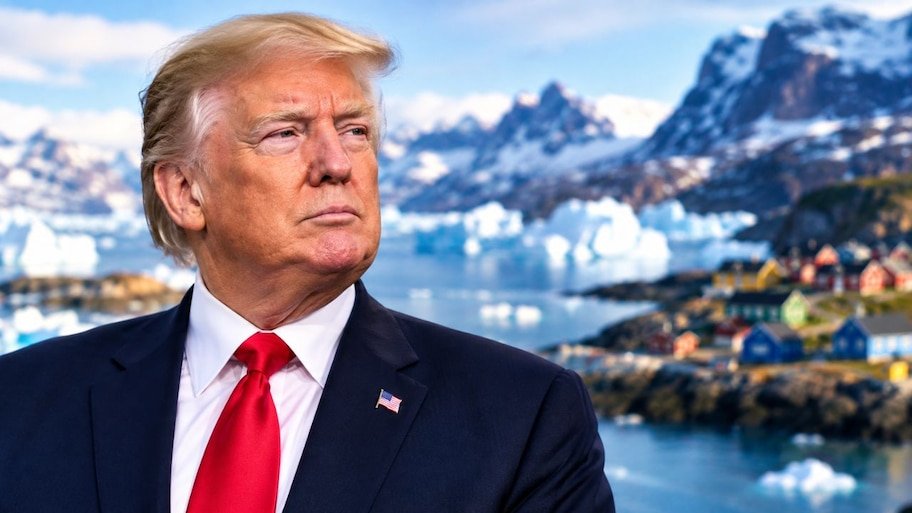
The war for supremacy in the icy Arctic region between global superpowers has now reached its most decisive and aggressive turn. Taking a major diplomatic and strategic step, US President Donald Trump has announced a historic three-tier security deal with Denmark and the autonomous region Greenland. Under this agreement, Washington will have permanent authority over Greenland’s security, basing and strategic needs.
Trump has called it an ‘infinite life agreement’ with no expiration date. This new agreement has created a huge stir in the power corridors of Vladimir Putin in Moscow and Xi Jinping in Beijing, because the direct and primary objective of this agreement is to completely oust Russia and China from the vast icy corridor of the Arctic.
The formal outline of this agreement is going to be signed on the sidelines of the United Nations General Assembly (UNGA). According to the key provisions of the agreement, any non-NATO country will be strictly prohibited from building a military base, establishing a military presence or investing in sensitive infrastructure on Greenland’s land, waters or airspace. America has not only got permanent overflight and basing rights here, but it will also be able to establish new military establishments as per its need in future.
Danish Prime Minister Mette Frederiksen and Greenland Prime Minister Jens-Fredrik Nielsen have made it clear that the agreement respects Greenland’s sovereignty and the right of its citizens to self-determination, but at the same time protects NATO and the shared security of the North Atlantic region. The US already operates its strategic ‘Pitufik Space Base’ (formerly Thule Air Base) in northern Greenland. Now after this agreement, America is moving towards installing additional military bases and state-of-the-art radar systems in Southern Greenland.
For Russia, this US control of Greenland is a direct attack on its national security and nuclear deterrence. The shortest air route for intercontinental ballistic missiles (ICBMs) between Russia and North America passes over the North Pole and the Arctic. Greenland is located exactly in the center of this missile trajectory.
America’s proposed ‘Golden Dome’ missile defense system is completely dependent on this geographical location of Greenland. Advanced early-warning radar, space-tracking sensors and interceptor missiles deployed in Greenland will allow Russian hypersonic and ballistic weapons to be tracked and destroyed in the early stages of flight. Additionally, the traditional ‘GIUK gap’ (Greenland-Iceland-UK) of entry into the Atlantic Ocean for nuclear submarines of the Russian Navy’s Northern Fleet will now be completely covered by US and NATO surveillance, bringing an almost complete halt to stealth patrolling by Russian submarines.
China may not be a direct coastal country of the Arctic, but it has declared itself a ‘Near-Arctic State’ a decade ago. China wanted to establish its dominance over the melting Arctic sea routes through its ambitious ‘Polar Silk Road’ project, which would have shortened its trade route to Europe by weeks. For this, Beijing has been trying to expand airports, establish research centers and invest heavily in mining projects in Greenland for the last several years.
This masterstroke of Trump has completely put a stop to all these plans of China. According to the terms of the agreement, no Chinese company will be able to invest even a single dollar in Greenland’s ports, airstrips or strategic areas without explicit US approval. Additionally, Greenland holds the world’s largest buried reserves of rare earth elements and critical minerals, which are essential for electric vehicles, semiconductors, and modern weapons systems. China currently monopolizes the global rare earth supply chain, but Greenland coming under the US security umbrella brings Western countries closer to ending their dependence on China entirely.
This restructuring of the balance of power in the Arctic is also extremely relevant from the point of view of India’s strategic and economic interests. India’s official ‘Arctic Policy’ focuses on continued research in the region, study of climate change and sustainability of global sea routes. New Delhi, which balances energy trade with Russia and security partnerships with the West, is keeping a close eye on increasing militarization in the region.
If the Arctic Northern Sea Route becomes increasingly stressed, future alternative trade corridors and energy flows could be adversely affected. However, any move to break China’s global monopoly on rare earth minerals could prove beneficial in the long run for India’s emerging high-tech manufacturing, electronics and defense sectors in terms of supply chain security.
Due to the rapid melting of polar ice due to climate change, the Arctic region is no longer just the subject of research by scientists, but it has also become the most sensitive arena of the new Cold War (Cold War 2.0). This race to gain control over untapped oil, natural gas, strategic minerals and the shortest maritime shipping routes may become more intense in the coming days.
With the Trump administration fully including Greenland in its security perimeter, America has made it clear that it will not tolerate even the slightest presence of any opposing superpower in the Western Hemisphere and the North Atlantic. The joint response of Russia and China will now depend on the extent to which they escalate their naval and diplomatic challenge in Arctic Council forums and in international waters.