 look news india

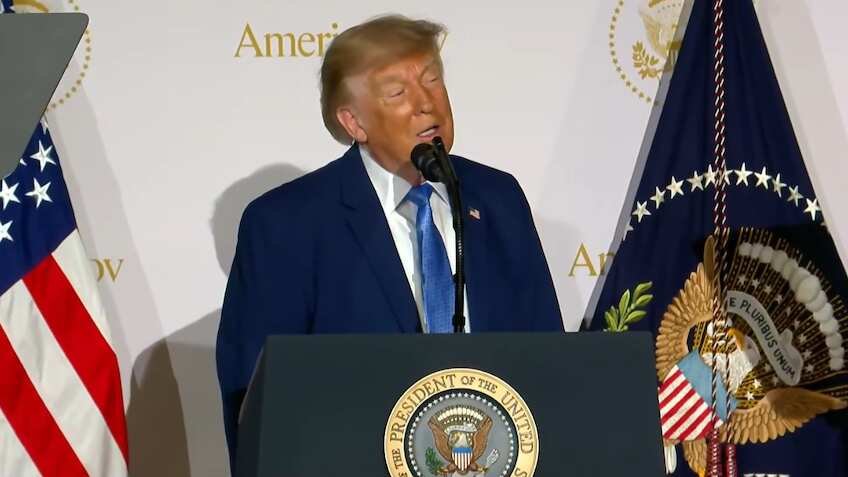
Amidst the race for Artificial Intelligence (AI) in the United States, dominance over global technology and related policy discussions, Donald Trump has given a big and popular statement. There is currently a heated debate going on about the future of AI among the top tech giants of Silicon Valley, investors and global think tanks. Meanwhile, Trump said that the term ‘Artificial Intelligence’ is unable to fully define the true potential, scope and power of this emerging technology. He believes that it should now be simply called ‘Superintelligence’. Describing this technology as an epochal turning point in the history of human civilization, Trump has compared it with the Industrial Revolution of the 18th century and the Internet revolution of the 20th century. He claims that in the coming times, this technology will prove to be more powerful and far-reaching than these two historical changes.
In his address and interview, Trump explained that when the Industrial Revolution came to the world with the advent of steam engines, factories and electricity, it completely changed human labor and methods of production. Similarly, the Internet revolution in the 1990s reshaped the entire landscape of information exchange and communication. But AI is not just limited to making manual labor or communication easier, it is also surpassing the human brain’s ability to think, take decisions, solve complex problems and give rise to new technologies. According to Trump, when machines start doing analysis many times faster than human intelligence, it will change every system, economy and geopolitical equation of the world. This is why it should be seen as ‘superintelligence’ and not just a ‘tool’ or general intelligence.
Behind this statement of Trump is also hidden a deep geopolitical aspect related to global technological dominance and national security. There is currently a new kind of ‘Cold War’ going on between the United States and China over advanced semiconductor chips, quantum computing, Large Language Models (LLMs), and supercomputing. Trump has repeatedly stressed that America cannot remain second in the race for superintelligence at any cost. If China or any other rival country gains ground in this region, it will have a direct impact on global financial systems, defense technologies and strategic autonomy. Trump has appealed to American companies and scientists to continue leading the world in the creation and leadership of superintelligence.
With the development of superintelligence, a big practical challenge of energy crisis is also emerging. To train and operate sophisticated AI models, they require huge data centers that consume billions of kilowatts of electricity and millions of gallons of water. Trump also expressed concern on this topic, saying that if America has to remain the global hub of superintelligence, then the country will have to double or triple its power generation capacity. For this, he has advocated for immediate approval of the use of Small Modular Reactors (SMR) and Advanced Nuclear Energy along with conventional energy sources. Tech companies like Microsoft, Google and Amazon are also signing deals with nuclear power plants to provide 24-hour power to their AI data centres.
On one hand, while Trump and many technical leaders are considering superintelligence as the biggest engine of economic growth, on the other hand, there are deep concerns among policy makers and sociologists around the world about its serious dangers. The rapid advent of AGI (Artificial General Intelligence) and superintelligence is expected to cause massive disruption in white-collar jobs like software engineering, finance, legal, medical and content creation. Apart from this, there is a demand to make strict rules of ‘AI Safety’ due to the threat of deepfakes, cyber attacks, autonomous weapons and AI systems going beyond human control. Critics say that before promoting uncontrolled superintelligence, it is extremely important to prepare its moral, social and legal security circle.
If the US formally opens up huge investment and tax exemption avenues by re-branding AI as superintelligence in its national policies and technology announcements, it will give a fresh boost to AI tech stocks (Nvidia, Microsoft, Alphabet, Meta, OpenAI) on Wall Street and global stock markets. Along with this, it will also have a deep impact on major IT and software service exporting countries like India. India will also have to move away from traditional IT outsourcing and speed up the development of its own indigenous large language models, supercomputing clusters and superintelligence infrastructure so that it can establish its strong presence in the race of this great invention of the future.