 look news india

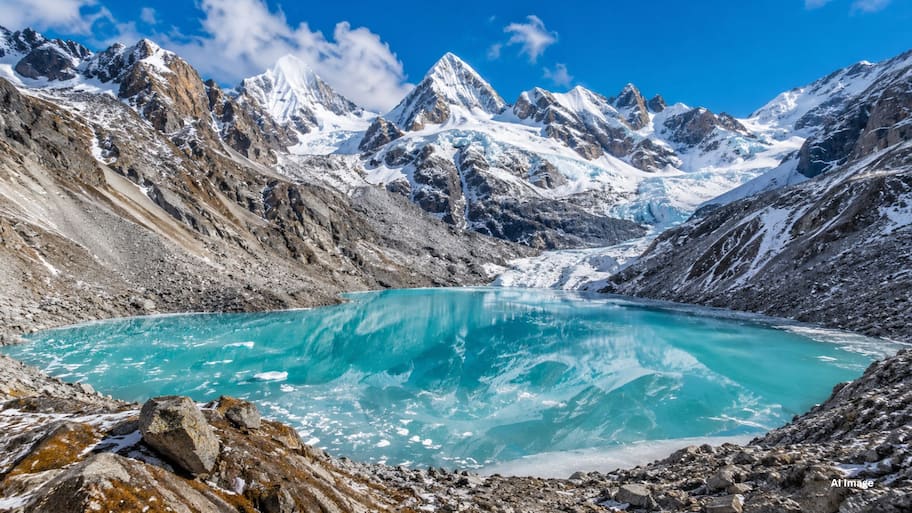
Sikkim, which is considered one of the seven states of India, can be hit by a disaster at any time, just like Nepal. 40 glacial lakes have been identified in Sikkim, which may be at risk of floods. Of these, 16 lakes fall in ‘extremely dangerous category ‘A’. If water pressure increases or an earthquake occurs, the lake may burst suddenly and engulf the areas below.
Concerns increased after the floods in Nepal.
It is important to mention that this information received from Sikkim has come out at a time when there was a sudden flood in the neighboring country Nepal due to the breaking of a glacier near the Nepal-Tibet border on August 26. More than 1200 people lost their lives in this incident and many people are missing. Although this flood in Nepal was not like a glacier explosion (Global Land Fire), but it has increased concerns about the increasing danger in the Himalayas.
What is a Glacier Lake (GLOF)?
Glacier lakes are formed when a glacier melts and the melt water accumulates beneath the surface of the glacier. A glacier lake outburst flood (GLOF) is an event in which a lake bursts suddenly for any reason. This may be due to accumulation of excess water or natural events such as earthquakes. This is also possible due to human activities.
In 2023, there was a massive disaster in Sikkim.
According to PTI, a glacial lake broke in Sikkim in October 2023. At least 60 people lost their lives in this incident. There was widespread devastation in Mangan, Gangtok, Pakyong and Namchi districts. The flood also damaged the Chungthang Dam, which was part of a larger hydroelectric project.
Speaking at a media workshop organized on gloff risk reduction in Sikkim on Thursday, Principal Secretary Sandeep Tambe said remote sensing and satellite imagery were being used to monitor changes in glaciers.
16 districts of Sikkim Himalaya are dangerous.
He said that out of the 40 high-risk districts identified, 16 have been classified as extremely dangerous (A-highest risk), 2 as more dangerous (B-high risk) and 9 as moderate or low risk (C-less than moderate risk). The category of the remaining 13 districts has not been decided yet.
Sikkim prepared the country’s first risk protocol to deal with the risk of glacial outburst (GLOF). Used to be
. The purpose of this protocol is to develop a scientific protocol to predict GLOF, so that its risk can be reduced.
According to the Sikkim government, this protocol being prepared can serve as a model for the Himalayas or other regions.
Tambe said that the same strategy cannot be adopted for all districts. Therefore, there are separate proposals for the Lhonak Complex, Shako Che Lake and the Gurudongmar Complex.
This lake is the most dangerous.
Sikkim government has declared Shako Cho lake as the most dangerous lake in terms of floods caused by breaking of glaciers. That is, this lake is very fragile and there is a danger of it breaking at any time. A detailed report in this regard has been sent to the National Defense Force (NDRF) and a preliminary project report has also been submitted to the Ministry of Jal Shakti.
Early warning proposal
According to DG Shrestha, Principal Secretary, Department of Science and Technology, Sikkim, on Thursday, the Union Home Secretary reviewed the preparedness to deal with these hazards and avalanche-related risks with the officials of the Himalayan states and union territories.
Chief Secretaries of Uttarakhand, Himachal Pradesh, Sikkim, Arunachal Pradesh and Jammu and Kashmir along with State Disaster Management Officers, officials of Home Ministry, ADAA, Central Water Commission, Meteorological Department and Defense Geo-Information Research Establishment were also present in the meeting.
Floods in Nepal increased concerns.
On August 26, the collapse of a glacier on the Nepal-Tibet border caused devastating floods. Hundreds of people died and thousands are still missing. However, it is being said that this devastation in Nepal is not related to glacier landslide (Global Land Fire). But this unexpected tragedy in Nepal has exposed the major changes taking place due to the activities taking place in the Himalayas. Due to these activities, glaciers are shifting from their place, new lakes are being formed and the size of existing lakes is increasing.