 look news india

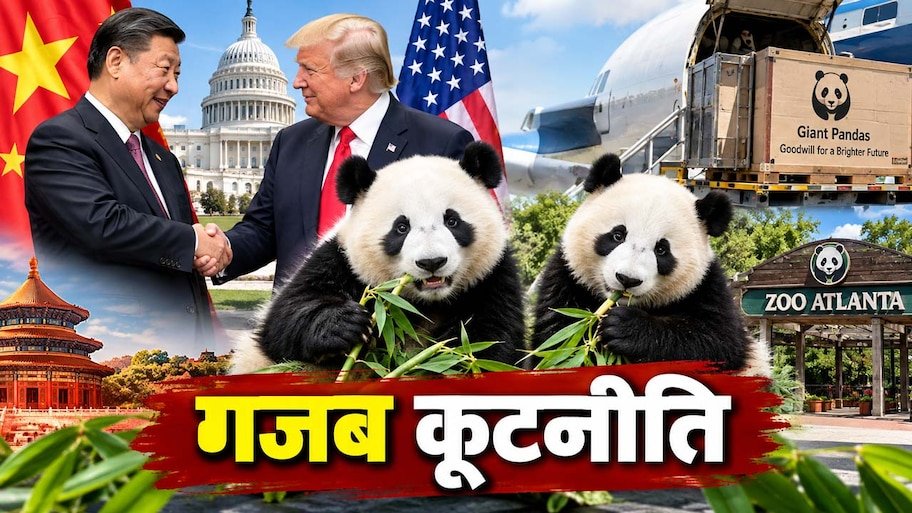
Beijing. In the world of international diplomacy, where countries resort to missile power, trade sanctions, economic packages and strategic alliances to pursue their interests, China has a ‘secret weapon’ in front of which even big superpower countries bow down. This weapon is neither a lethal missile nor a high-tech defense system; This is the national symbol of China – the chubby and innocent Giant Panda that chews bamboo shoots.
In global geopolitics it is officially called ‘Panda Diplomacy’. From the height of the Cold War till today, China has used this animal very well to improve its deteriorating relations with the world’s most powerful countries—be it the US, the Soviet Union, the UK, France or Japan, to secure new trade agreements and to flex its ‘soft power’ on the global stage. Let us understand how this herbivorous creature that lives peacefully in the forests became the most expensive and effective pawn of global diplomacy.
The gift of live pandas in diplomacy has its roots in centuries-old Tang Dynasty stories, but its formal and organized use in modern geopolitics was pioneered by Mao Zedong, founder of the People’s Republic of China.
-
Gift to the Soviet Union in 1957: After the formation of Communist China in 1949, Beijing was in dire need of international diplomatic recognition. In 1957, on the 40th anniversary of the Bolshevik Revolution in the Soviet Union, Mao gifted a giant panda named ‘Ping-Ping’ to the Moscow Zoo. Two years later in 1959, ‘Aan-Aan’ was also sent.
-
Means of strengthening the communist camp: This was not just an exchange of animals, but a message of how close Beijing and Moscow are to each other ideologically. After this, China also gifted pandas to close allies like North Korea.
The most dramatic and influential turning point in the history of Panda diplomacy came in February 1972. us President Richard Nixon Made a historic visit to Communist China amid Cold War tensions. During this visit, the then Chinese Prime Minister Chou En-lai offered American First Lady Pat Nixon a gift of two pandas during their conversation.
In April 1972, when two pandas named ‘Ling-Ling’ and ‘Hsing-Hsing’ arrived at the National Zoo in Washington DC, a long line of over 20,000 American citizens formed to see them on their first day. More than 10 lakh people saw these pandas in the first year itself. Within a few months, these innocent animals removed the hatred and fear of China in the hearts of the American people. In response, America sent two musk oxen to China. After this historical incident, the world understood that Panda is not just an animal, but the biggest tool to change global public perception.
Till the 1980s, China used to give pandas as completely free gifts, but in view of the economic reforms started in the country (era of Deng Xiaoping) and the declining population of pandas, in 1984, China made a major change in its panda policy. Now pandas are not given as ‘gift’ but on ‘lease’:
-
Huge rent of 1 million dollars annually: Foreign zoos have to pay around $1 million (about Rs 8.3 crore) per year to China in rent for a panda pair. This lease is usually for 10 to 15 years.
-
Strict medical and maintenance conditions: To house pandas, foreign zoos have to spend millions of dollars building special indoor weather-controlled enclosures and spend heavily on supplies of fresh bamboo every week.
-
China has ownership rights over children born abroad: The rules under the contract are extremely strict—if a baby panda is born in a foreign zoo, citizenship and ownership of that baby will remain solely with China. As soon as the cub turns 4 years old, it is mandatory to send it back to the breeding facility in China.
-
Heavy penalty for death: If a panda dies in a foreign zoo due to lack of proper care, that country has to pay a fine and explanation of up to $5 lakh to China.
A study conducted by researchers at Oxford University revealed that China leases pandas only to those countries with which it has a major strategic or trade agreement:
| Country | Year | Panda’s lease | Background / Secret Business Advantage |
| Australia | 2009 | wang wang and funi | Australian uranium supplies to China and the Free Trade Agreement (FTA) |
| Canada | 2013 | er shun and da mao | Multi-billion dollar oil and gas trans-Pacific investment agreement |
| France | 2012 | Huan Huan and Yuan Ji | Multi-billion euro deal with French nuclear power company Areva |
| malaysia | 2014 | Fu Wa and Feng Yi | Strengthening diplomatic ties with Malaysia amid South China Sea dispute |
Just as China sends pandas to please its friends, when a country crosses China’s red lines, Beijing expresses its displeasure by calling back its pandas:
-
When tension increased with America: When tensions between the two countries increased over the US-China trade war and the issue of Taiwan, China refused to renew the lease agreements of many zoos in America and called the pandas back to Beijing. When the pandas departed from American zoos, it was considered a clear diplomatic sign of deteriorating relations between the two countries.
-
Controversy between Dalai Lama and European countries: Around 2010, when leaders of some Western countries met the Tibetan religious leader Dalai Lama, China either indefinitely postponed or threatened to cancel Panda agreements with those countries.
China has beautifully created a confluence of biology and soft-power diplomacy that is unmatched in any other country in the world. This innocent bamboo-chewing creature makes deals worth billions of dollars behind the scenes and is seen to be at the forefront of changing China’s image from an aggressive military superpower to a friendly country on the international stage.