 look news india

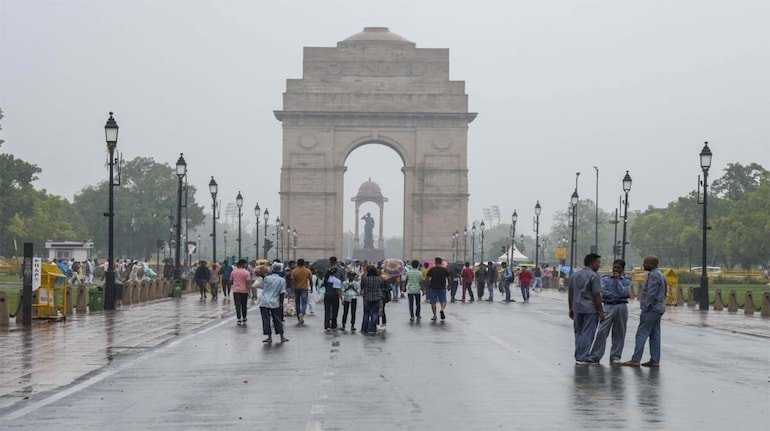
While every year in the middle of October, the climate of Delhi starts getting filled with stubble smoke and poisonous smog, on Thursday, the showers of relief from the sky have given a new lease of life to the entire national capital. The air of Delhi, which was suffocating due to dust, smoke and slow winds for the last several days, has suddenly started looking clean and transparent. According to the latest bulletin on the official Sameer app of the Central Pollution Control Board (CPCB), Delhi’s overall air quality index (AQI) has dropped straight to 149 from the figure of 181 recorded a day earlier. The air quality slipping from the threshold of ‘Poor’ to satisfactory ‘Moderate’ category is no less than a big boon for the people of Delhi. The microscopic dust particles floating in the atmosphere i.e. PM 2.5 (PM 2.5) and PM 10 (PM 10) mixed with the rain drops and settled on the ground, due to which the common citizens, especially the elderly and children going out for morning walks, have got a huge relief from the irritation in the eyes and severe difficulty in breathing in the morning and evening. The view around India Gate, Dutta Path, Connaught Place, Chanakyapuri and Shanti Path, which used to be covered in fog till yesterday, is completely washed away today and appears clean and green.
The effect of rain was not limited only to the purity of the air, but it had also completely disappeared the scorching heat and sticky humidity that had been troubling us during the day for the past several days. According to the India Meteorological Department (IMD), the Safdarjung weather station, the primary weather station in the national capital, as well as the weather stations at Palam, Lodhi Road, Ridge and Ayanagar have recorded a sharp drop of 3 to 5 degrees Celsius in the maximum temperatures above normal. The maximum temperature at Safdarjung Weather Station on Thursday fell much below normal to around 29 to 30 degrees Celsius, which added a pleasant coolness to the air even in the afternoon. Although the night minimum temperature is still slightly above normal i.e. around 23.3 degrees Celsius, this sudden drop in day temperature has given a feeling of the formal onset of ‘pink cold’ in Delhi ahead of time. The cold winds with a speed of 15 to 25 kilometers per hour throughout the day converted the moisture present in the atmosphere into a pleasant feeling, due to which people were seen getting relief from ACs and coolers on the streets of Delhi even in the afternoon.
Usually in the second fortnight of October, when the wind speed slows down and the nights become cool, ‘thermal inversion’ (temperature reversal) starts in Delhi-NCR, due to which the pollution remains trapped near the ground. To deal with this situation, the Commission for Air Quality Management (CAQM) is forced to implement a stringent Graded Response Action Plan (GRAP) every year, which includes emergency measures such as ban on generators, ban on construction work and water sprinkling. This unseasonal rain on Thursday has given a huge relief to the environmental policy-makers and the Delhi government. The rainfall has resulted in a natural ‘washout’ of particulate matter from the atmosphere, resulting in air levels currently remaining well below the threshold for severe GRAPE stages (Stage 2 or 3). Environmental experts say that if this rain had not occurred, the AQI would have crossed 200 to 250 due to local dust and vehicle emissions. However, experts have also cautioned that this natural bounty of rain is a temporary relief, and unless the wind speed remains strong or local pollution sources are continuously controlled, this relief is not going to last for very long.
The scope of this positive change in rain and wind was not limited only to the administrative border of Delhi, but the environmental picture in all the satellite cities of the National Capital Region (NCR) has also changed in an instant. Recently, in Gautam Buddha Nagar (Noida and Greater Noida) and Ghaziabad of Uttar Pradesh, AQI was being recorded above 190 to 210, which has improved after the rains to the ‘moderate’ range of 130 to 150. In Haryana’s Millennium City Gurugram, Faridabad, Ballabhgarh and Sonipat, the dust present in the air has completely settled down with heavy showers. In Gurugram’s concrete jungles like Cyber Hub and Golf Course Road, where carbon monoxide and nitrogen dioxide levels were rising due to heavy traffic, the air felt fresh after the rain. However, the flip side of this rain was that there was waterlogging and traffic jams at busy intersections like Dhaula Kuan, ITO, Ashram Chowk, Outer Ring Road and Sarai Kale Khan in Delhi, but in front of this unmatched purity in the air, people happily accepted the inconvenience of the jam.
Now the biggest question that arises is whether this improved AQI of 149 will remain intact in the coming days also? According to agriculture and satellite data, paddy harvesting is in its final stages in the fields of Punjab, Haryana and western Uttar Pradesh and incidents of stubble burning in the fields are gradually gaining momentum. As soon as north-westerly winds become active, they can drag the fine smoke of stubble into the plain bowl of Delhi. Moreover, the upcoming Diwali festival is round the corner, in which the emissions graph rises rapidly due to smoke from firecrackers and increased market activity. Meteorologists analyze that after rain, when there is more moisture in the ground and the temperature drops rapidly, the possibility of formation of light ‘radiation fog’ (mist) increases in the morning in the coming days. If the wind speed drops below 10 km per hour in the coming days, this moisture can bind the dust and smoke particles and form smog again. Therefore, this weather will be a respite for the people of Delhi for the next one week, but after that the real test of the real pollution crisis of winter will begin.
According to the latest weather bulletin of the India Meteorological Department (IMD), the influence of the active Western Disturbance over North India is now slowly moving forward. The sky over Delhi and NCR is likely to remain partly cloudy during the next 24 to 48 hours, but chances of heavy rain are now less. On Friday and Saturday, the maximum temperature in Delhi is expected to be around 31 to 32 degrees Celsius and the minimum temperature will be around 20 to 22 degrees Celsius. There will be light mist and cold winds in the morning, due to which morning walkers will feel a slight shiver. From the health point of view, the Meteorological Department has advised that since there is light sunshine during the day and cold winds in the morning and evening, people should remain alert during this change in weather to avoid seasonal viral, cough, cold and throat infection. Overall, the rains have given Delhi a much-awaited ‘green window’, providing a rare and pleasant opportunity to the residents of the capital to breathe freely and peacefully amid the festive preparations.