 look news india

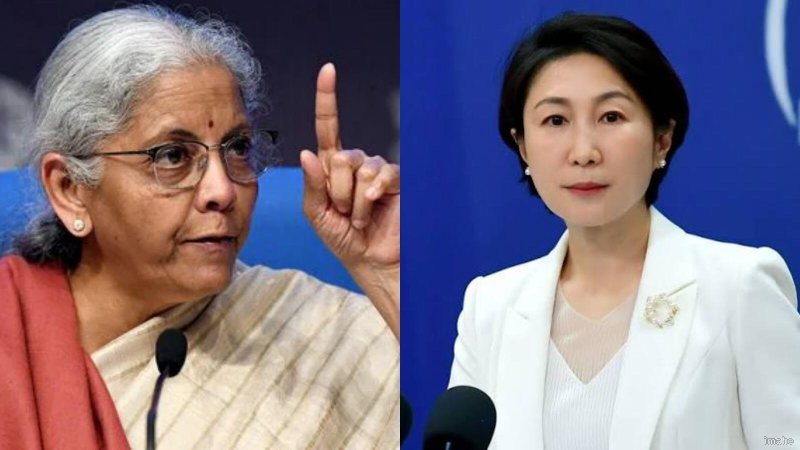
The trade imbalance between India and China has once again come into the center of discussion on international forums. India’s Finance Minister Nirmala Sitharaman expressed her views openly in a special dialogue program with the think-tank ‘Atlantic Council’ during the annual meetings of the International Monetary Fund (IMF) and the World Bank in Bangkok. He said in clear words that the trade deficit between India and China is not only extremely large, but it is also continuously increasing unevenly with time.
The Finance Minister stressed that the biggest obstacle to trade between the two countries is the ‘Non-Tariff Barriers’ erected by China. When Indian goods try to enter Chinese markets, they face strict phytosanitary regulations, complex approval processes and administrative hurdles. This direct and sharp statement of Sitharaman created a stir in the international diplomatic circles, because this is not the first time that India has raised this issue, but this time the tone was quite strict.
Sitharaman also underlined that India has never taken the aggressive path of hastily imposing countervailing duties (CVD) or retaliatory punitive tariffs to correct this imbalance. India has always believed in the policy of finding solutions to problems through dialogue, negotiation and established mechanisms, even if the process takes a long time.
#1 Trade deficit crosses 100 billion dollars: What do China’s official figures say?
According to data released by China Customs, the trade deficit between India and China has historically crossed the $100 billion mark. According to reports, the total bilateral trade between the two countries reached $144.45 billion within the first nine months of the current financial year. In this, exports from China to India stood at 125.19 billion dollars, whereas India could export only 19.26 billion dollars worth of goods to China.
This huge difference clearly shows that the penetration of Chinese goods in the Indian market is very deep, while Indian products have to struggle hard to enter the Chinese market. Although India’s exports to China have also increased in percentage terms, China has the upper hand in terms of total value. Indian industries are largely dependent on China for electronics, active pharmaceutical ingredients (APIs), machinery and industrial raw materials.
Trade experts believe that if this imbalance is not controlled in time, it could pose serious challenges to India’s foreign exchange position and domestic manufacturing sector. This is why the central government is not only promoting domestic production in India through ‘Make in India’ and PLI schemes, but is also putting constant pressure on China to open its market.
#1 Why is China closing its doors to Indian pharma, IT and agriculture sectors?
India has long demanded that China open its market to sectors in which India is globally competitive and strong. This mainly includes generic medicines, information technology (IT services), rice, vegetables, beef and other agricultural products. India’s generic medicines are known all over the world for their quality and low prices, but the process of their registration in China is so complex and lengthy that it becomes extremely difficult for Indian companies to do business there.
Finance Minister Nirmala Sitharaman expressed deep regret that despite many years of continuous talks and bilateral meetings, no significant progress has been made in these areas. China keeps out Indian products using non-tariff measures in the name of security and standard checks, while on the other hand it continues to supply its manufactured goods to the Indian market without any major hindrance.
This policy is creating a feeling of disappointment among Indian exporters. India argues that if economic relations between the two countries are to be made fair and sustainable, then China will have to provide a level playing field to Indian goods and services in its market.
#1 Foreign Ministry’s response: What clarification did Beijing give on Sitharaman’s allegations?
After Nirmala Sitharaman’s strong stance and statements, the official response of China’s Foreign Ministry has also come to the fore. Responding, Chinese Foreign Ministry spokesperson said that China is fully prepared to work with India to resolve each other’s economic and trade concerns in a balanced and amicable manner. Beijing says it wants to promote the continued and stable development of trade relations between the two countries.
However, Chinese officials refrained from providing any direct technical answers on specific non-tariff barriers, saying that detailed and technical questions related to trade should be contacted to the relevant Chinese commercial authorities. Diplomatic experts believe that this stance of China is the result of India’s growing economic condition and international pressure.
Beijing knows that India is one of the fastest growing major economies in the world and losing the Indian market can be a major blow to any country. In such a situation, instead of limiting itself to mere statements, China is now indicating to start a new round of trade talks with India.
#1 Road to the future: India’s self-reliance and transformation of global supply chains
This turn in India-China trade relations is not just an issue of two countries, but it is part of the restructuring of the global supply chain. The Indian government has taken several tough and strategic steps in the last few years to reduce its economic dependence on China. From cracking down on Chinese investment in sensitive sectors to banning several Chinese apps and accelerating the Atmanirbhar Bharat campaign, India has adopted a multi-pronged approach.
Along with this, India is busy finalizing or rapidly working on Free Trade Agreements (FTAs) with other major economic centers of the world such as the US, EU, UK and UAE. Its main objective is to diversify the sources of trade so that there is no excessive dependence on any one country. If China does not remove non-tariff barriers, addressing India’s concerns, India may make more drastic changes in its import strategies, which will have a direct impact on future bilateral trade.