 look news india

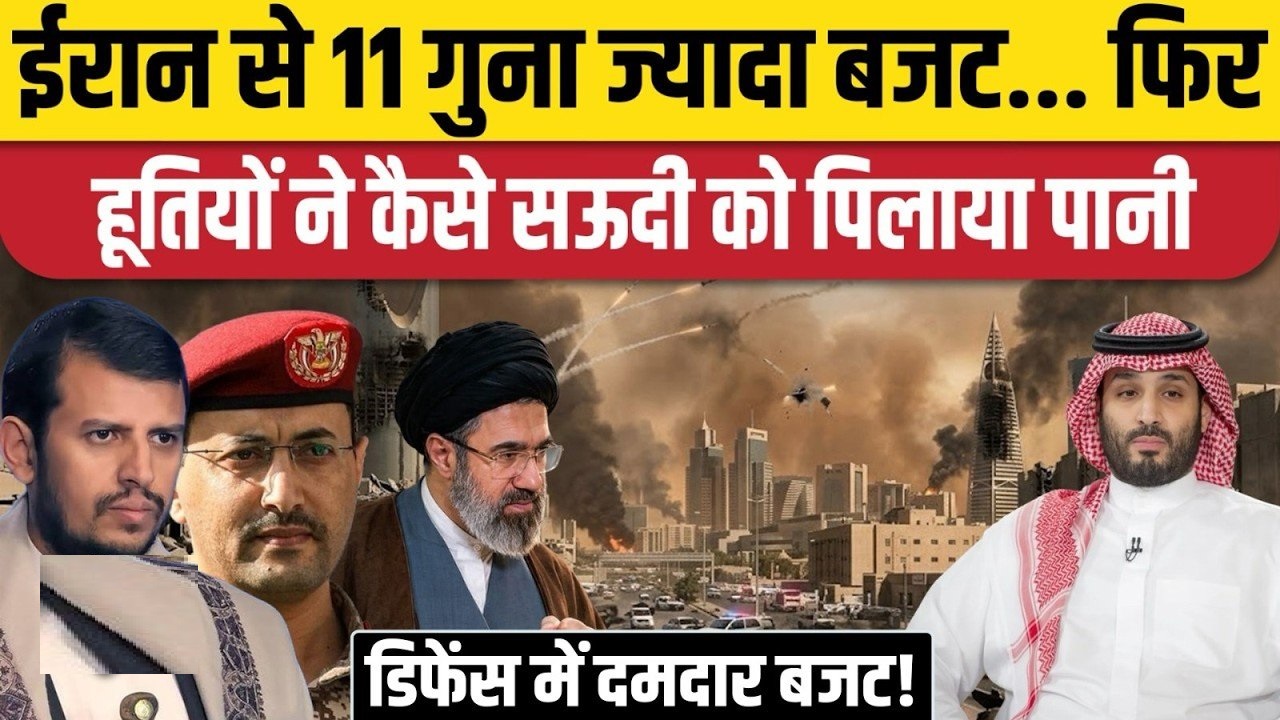
The rivalry between Saudi Arabia and Iran has been at the center of the balance of power in Middle East geopolitics for decades. If we talk about military expenditure and state-of-the-art weapons, Saudi Arabia ranks among the world’s largest defense buyers. According to Stockholm International Peace Research Institute (SIPRI) data, Saudi Arabia’s annual military expenditure ranges from 70 to 83 billion dollars, while Iran’s official defense budget, which is facing international sanctions, is limited to only 7 to 8 billion dollars. That means, on paper, Saudi Arabia’s military budget is about 11 times more than Iran’s. Yet Saudi Arabia faces serious strategic challenges when it comes to the war against Iran-backed Houthi rebels in Yemen and cross-border attacks.
Saudi Arabia has been dependent for its security mainly on modern weapons purchased from Western countries, especially America, France and Britain. The Saudi Air Force has advanced fighter aircraft like F-15SA, Eurofighter Typhoon and American Patriot (Patriot PAC-3) and THAAD missile defense systems on the ground.
Iran, on the other hand, has been dealing with tough US and international sanctions, financial limitations and an aging air force for decades. Despite this huge economic and technological disparity on the battlefield, the Houthi rebels’ precision targeting of Saudi Arabia’s oil refinery facilities (such as Aramco), airports and military bases has forced defense experts to wonder whether modern wars can be won with huge defense budgets alone.
The biggest reason behind this military disparity is ‘Asymmetric Warfare’ i.e. asymmetric war strategy.
-
Iran’s indigenous model: Unable to purchase expensive conventional fighter aircraft, Iran focused its efforts on developing low-cost ballistic missiles, cruise missiles and ‘kamikaze’ (suicide) drones (such as the Shahab, Quds and Samad series).
-
Technology transfer to Houthis: Iran delivered this technology and parts to Yemen’s Houthi rebels, who assembled them in local workshops and turned them into strategic weapons against Saudi Arabia.
-
The destructive game of cost: The manufacturing cost of the drone with which Houthi rebels attack is only 15,000 to 20,000 dollars (about Rs 15 to 20 lakh). At the same time, to destroy that one drone in the air, Saudi Arabia has to fire an American Patriot missile, whose interceptor rocket costs 30 lakh to 40 lakh dollars (about Rs 25 to 35 crore).
-
Financially losing deal: Spending $4 million worth of weapons to shoot down a $20,000 drone cannot be sustainable for any country’s treasury in a long-lasting war.
Yemen’s geography is considered the biggest nightmare for any conventional or modern army.
-
Guerrilla Tactics: Houthi rebels hide in caves, narrow valleys and ravines in Yemen’s northern mountainous regions (such as Saada and Sanaa). They do not live in a barrack or cantonment like the modern army, rather they are divided into small squads and fire missiles from mobile launchers and disappear immediately.
-
Limitations of high-tech weapons: Billion-dollar stealth fighter jets and satellite-guided missiles are of little effect against targets hidden within solid rocks and deep caves. The Saudi-led coalition launched thousands of airstrikes, but they were unable to completely eliminate the Houthis’ missile launching capability.
The mainstay of Saudi Arabia’s economy is its oil industry and infrastructure. Riyadh is focusing on international investment, tourism and large infrastructure projects (such as Neom City) under the country’s Vision 2030.
-
Saudi has a lot to lose: In a rich country like Saudi Arabia, if even a single drone falls on a refinery or airport, it creates panic in the global oil market. In 2019, drone-missile attacks on Saudi Aramco’s Abqaiq and Khurais plants halted 5 percent of the world’s oil supply in one fell swoop.
-
The Houthis have nothing to lose: In war-torn Yemen and a humanitarian crisis, the Houthis did not have any major infrastructure or economic assets that they feared being destroyed. This psychological and economic advantage maintained the Houthis’ advantage.
Iran adopted proxy strategy in this entire conflict through ‘Axis of Resistance’. Iran has never fought a direct war with Saudi Arabia, thereby avoiding Western sanctions and the risk of direct military retaliation.
By providing arms, training and intelligence to Yemen’s Houthis, Lebanon’s Hezbollah and militia groups in Iraq and Syria, Tehran cornered its rivals on their own borders. Saudi Arabia had to deploy billions of dollars of military and air defense to protect its 1,400 kilometer long southern border, while Iran had to spend only a small part of its annual budget on the entire operation.
The Yemen conflict and Houthi attacks sent a clear message to global military analysts that 21st century wars cannot be won with the most expensive fighter jets, tanks and huge defense budgets alone. The indigenous stockpile of cheap unmanned drones (UAVs), hypersonic and cruise missiles and asymmetric strategies have exposed the vulnerabilities of modern air defense systems. This was the reason why Saudi Arabia eventually started giving priority to the options of diplomatic routes, ceasefire and regional stability instead of military confrontation.