 look news india

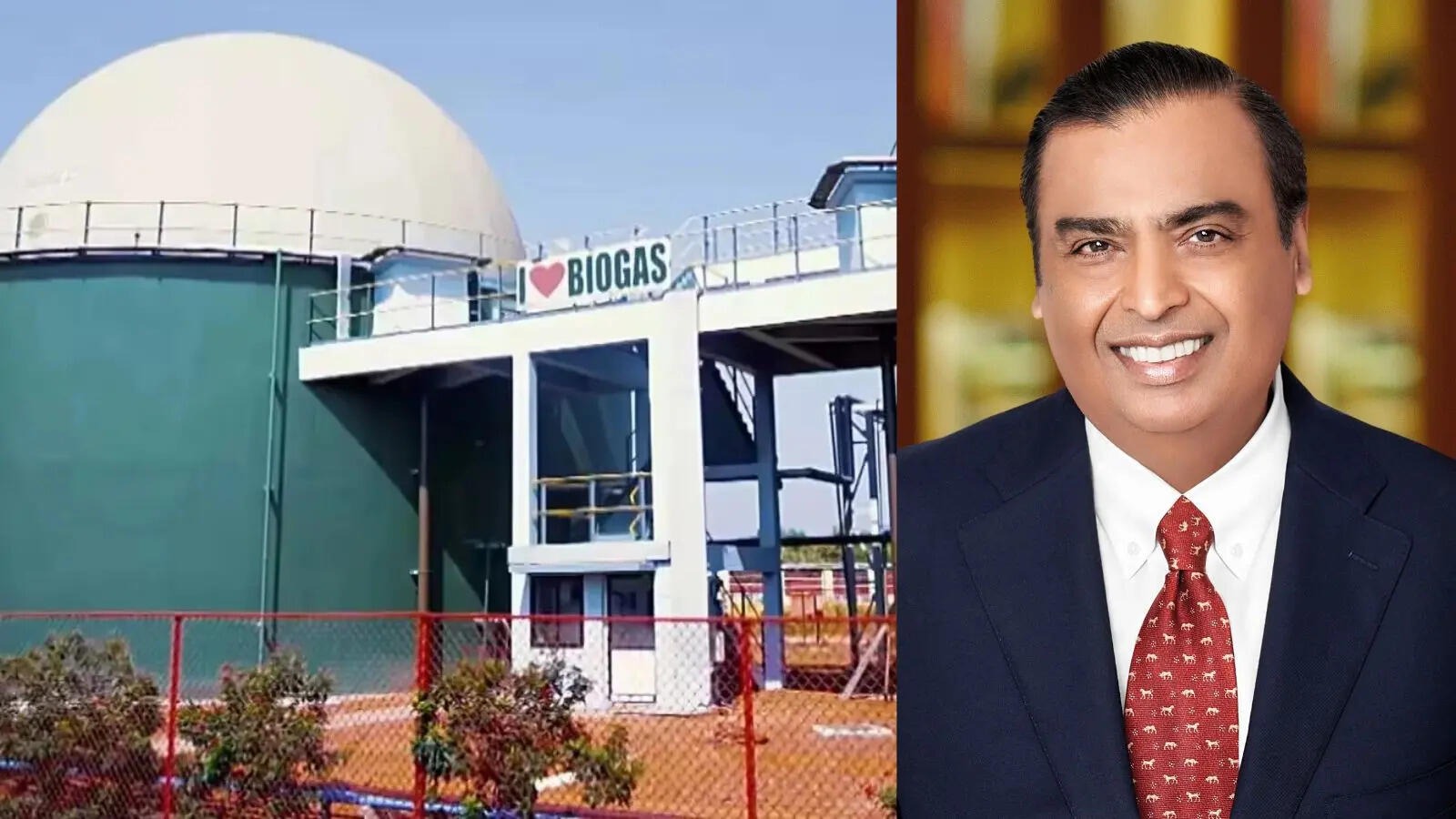
A huge step has been taken towards the expansion of clean energy in the country and a permanent solution to the problem of stubble burning that troubles North India every winter. Industrialist Mukesh Ambani-led Reliance Industries Limited (RIL) is going to produce compressed biogas (CBG) on a large scale from straw, cow dung and other agricultural waste. For this, the company will invest about Rs 15,000 crore in setting up 100 new biogas plants across the country. On one hand, this ambitious green energy project is expected to reduce the air pollution caused by burning of stubble in the fields, while on the other hand it will also open new avenues for rural economy and additional income for farmers.
According to energy and industrial sector information, Reliance Industries is rapidly increasing compressed biogas (CBG) production as part of its net-zero carbon target and clean fuel strategy. Under this scheme, 100 modern biogas plants will be established in various agricultural states of the country, on which a capital of about Rs 15,000 crore will be spent. In these plants, high quality biogas will be produced using paddy straw, sugarcane bagasse (pressmud), animal dung and other organic agricultural residues as raw materials.
This biogas can be purified and compressed and used as vehicle fuel, industrial use and in domestic and commercial gas networks. It is a clean and renewable alternative to natural gas (CNG), which will also help in reducing the country’s dependence on imported crude oil and natural gas.
Till now, disposal of stubble after harvesting of paddy remained a big challenge for the farmers in many states of North India. Due to lack of time and resources, many farmers were forced to burn stubble in the fields, due to which the air from Delhi-NCR to the entire North India became poisonous. With the start of these 100 new biogas plants of Reliance, stubble and cow dung will no longer become waste or burden, but a valuable raw material.
A complete supply chain of collection, sorting and transportation of stubble, agricultural residue and cow dung will be developed for biogas plants in villages. This will provide an opportunity to farmers and livestock farmers to earn additional income by selling their agricultural waste and cow dung. With this, thousands of new direct and indirect employment opportunities will be created for local youth in construction, operation, maintenance and logistics of the plants. Not only this, after the production of biogas, the organic residue (fermented organic manure) coming out of the plant will come back in the form of high quality organic fertilizer to increase the fertility of the fields, which will also reduce the dependence on chemical fertilizers.
North India is considered to be the most important center for agricultural waste based biogas projects in India. Paddy, sugarcane and animal husbandry are grown extensively in agriculture-dominated districts of Uttar Pradesh such as Lucknow, Barabanki, Sitapur, Lakhimpur Kheri, Bareilly, Moradabad, Meerut, Saharanpur, Gorakhpur and Varanasi, as well as in Punjab, Haryana, Madhya Pradesh and Maharashtra. Establishment of such plants in these areas will provide a big boost to both stubble management and clean energy production.
Compressed biogas is also being promoted under the ‘SATAT’ (Sustainable Alternative Towards Affordable Transportation) scheme of the Central Government. In such a situation, this investment of Rs 15,000 crore by Reliance Industries is being considered a big step by the private sector to strengthen the circular economy. Overall, this campaign to make biogas from stubble and cowdung has the potential to bring positive change simultaneously on all three fronts – environmental protection, energy self-reliance and farmer welfare.