 look news india

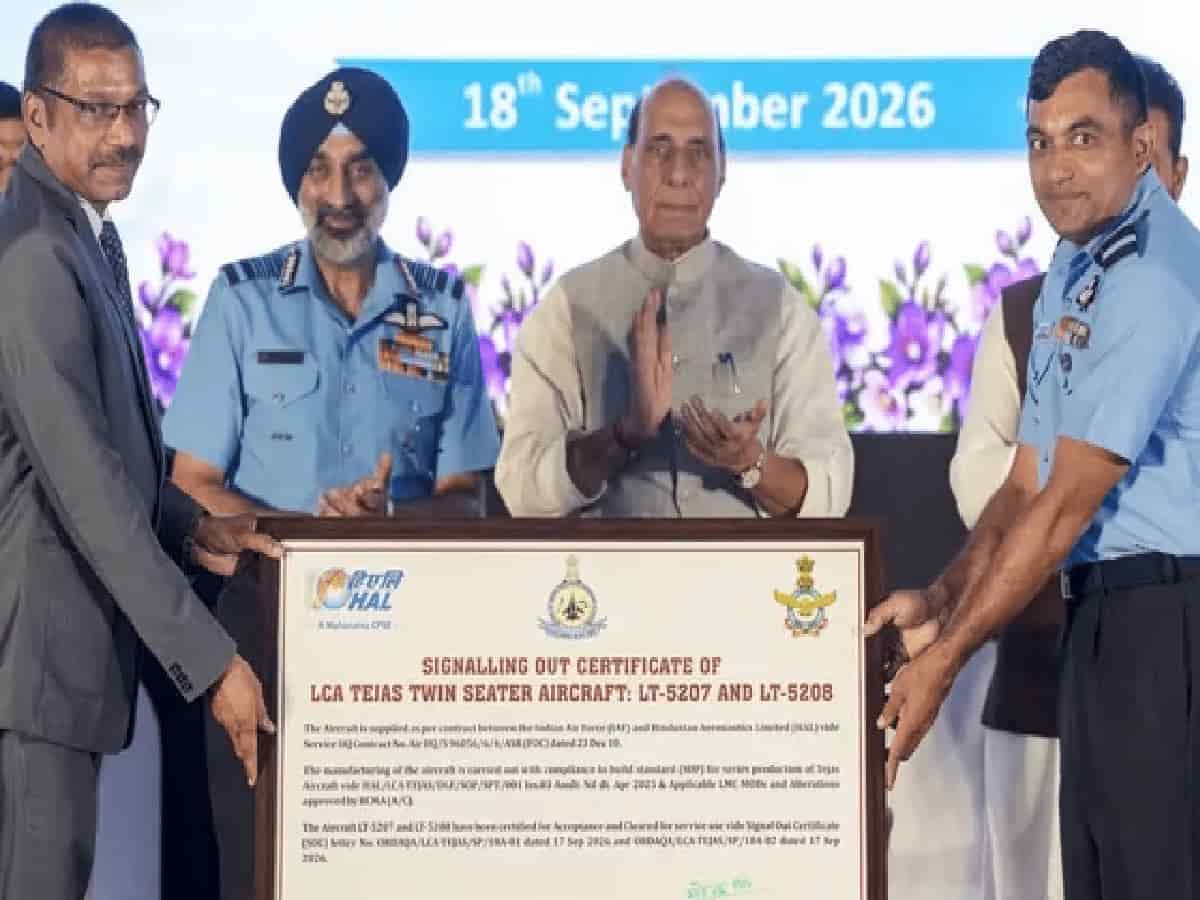
Friday was a historic day in the direction of making the country’s defense preparedness self-reliant, when three major indigenous aviation platforms were formally handed over from a single platform from the largest aircraft complex of Hindustan Aeronautics Limited (HAL), Bengaluru. On this important occasion, Defense Minister Rajnath Singh, Civil Aviation Minister K. Rammohan Naidu and Indian Air Force Chief Air Chief Marshal AP Singh were specially present. During the ceremony, while on one hand India’s growing technological prowess in the field of indigenous defense manufacturing was praised, on the other hand the Defense Minister also held a mirror to the defense manufacturers and policy makers of the country regarding the extraordinary delays being faced in various indigenous projects.
Defense Minister Rajnath Singh, while speaking openly on the ill effects of delays in projects, said that violation of deadlines in any strategic project directly leads to double losses. The first disadvantage is that the estimated cost of the project increases exponentially, which puts additional financial burden on the government exchequer. The second and much more serious danger is that in this age of modern warfare, technology changes very rapidly, and in extreme time-consuming situations, the defense product or technology in question becomes obsolete even before it enters service. He said in clear words that all defense undertakings and research institutes will now have to move beyond ambitious slogans and set real and practical deadlines, so that the armies can get modern weapons on time.
This strong comment of the Defense Minister has come at a time when the supply of 180 Tejas MK1A fighter aircraft given to HAL to strengthen the Indian Air Force fleet is far behind schedule. These include huge deals totaling more than Rs 1.1 lakh crore signed for 83 jets contracted in 2021 and 97 additional fighters in 2025. The project is facing delays due to technical challenges of advanced missile and radar integration. This delay is having a direct impact on the operational preparedness of the Indian Air Force. At present, the Indian Air Force has only 29 squadrons active against the sanctioned strength of 42.5 squadrons, due to which the strategic pressure on the front is increasing.
Amidst the concerns, the ceremony also wrote a new glorious chapter for the Indian aerospace sector. HAL CMD Ravi K. It said that its test pilots and engineers completed the testing of these aviation platforms in extremely complex and adverse conditions and got them operationally certified. In this joint ceremony, two FOC LCA MK1 trainer aircraft and three HTT-40 basic trainer aircraft were handed over to the Indian Air Force. Along with this, the keys of four indigenous Dhruv NG (New Generation) civil helicopters, which are a fully civilian-certified upgraded version of the military-use Advanced Light Helicopter (ALH), were also handed over to modernize the fleet of Pawan Hans Limited.
With the delivery of two FOC trainer aircraft to the Air Force during the ceremony, HAL completed 100 per cent delivery of all 40 LCA Mk1 jets sanctioned under two separate contracts in 2006 and 2010. Parallel to this, the first batch of HTT-40 basic trainer aircraft, officially named ‘Ankur’, was handed over to the Air Force under the historic deal for 70 aircraft signed with the Ministry of Defence. For decades, there was dependence on foreign imported basic trainer aircraft for basic training of Indian cadets, which has been completely eliminated by HTT-40. This new indigenous trainer aircraft will not only provide world-class training to the future fighter pilots of the Indian Air Force, but will also become a powerful medium for defense exports to friendly countries at the international level.
The Defense Minister gave a message to the young scientists, aerospace engineers, designers and technicians present at the ceremony to work with new energy. He said that there are no sudden miracles in the aerospace industry, it is a continuous, scientific and disciplined growth process. He appealed to the scientists to take the risk of designing today the technologies of tomorrow which do not currently exist in the world. India can attain a top position in the global aerospace scenario only if a common and strong aviation ecosystem is developed in the country to meet both civil and military needs.