 look news india

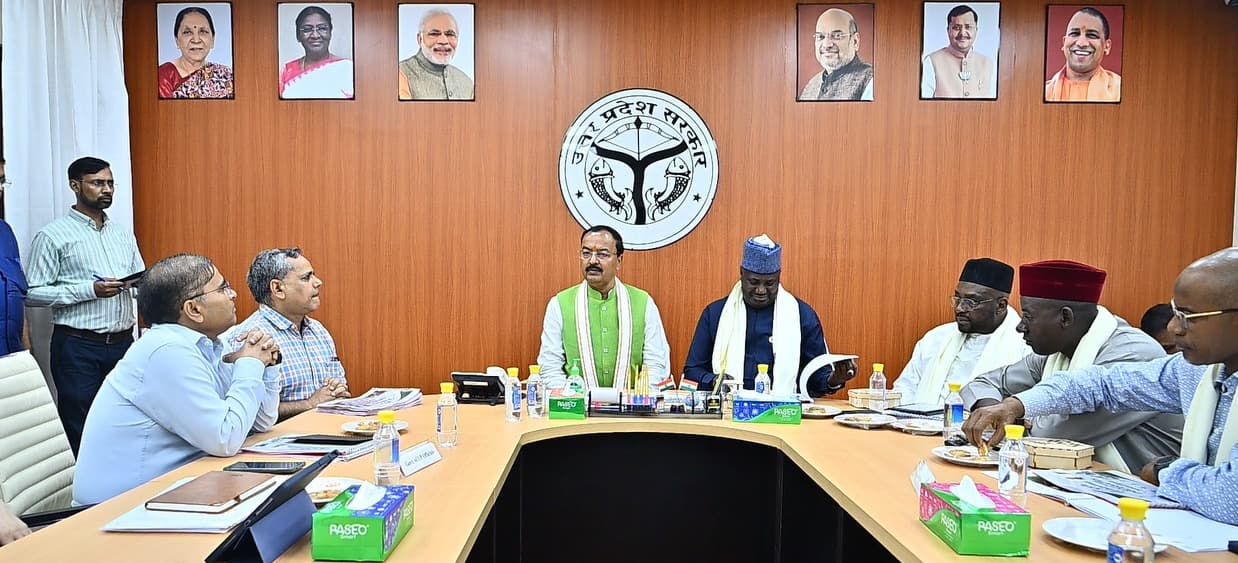
Keshav Prasad Maurya today held an important meeting with the Minister of State for Agriculture and Food Security of the Federal Republic of Nigeria and Head of the delegation, Senator Dr. Aliyu Sabi Abdullahi (CON) and his respected delegation at his official residence, 7 Kalidas Road, Lucknow. While giving information about the achievements of Pradhan Mantri Gram Sadak Yojana, Principal Secretary of Rural Development Department, Saurabh Babu said that this is an ambitious scheme and the first phase of Pradhan Mantri Gram Sadak Yojana was launched on the ground. Through the scheme, the work of connecting villages with perennial and quality road connectivity was continuously taken forward, the target of 50,000 kilometers was achieved in Phase-2. After this, Phase-3 of Pradhan Mantri Gram Sadak Yojana started, under which construction work of about 1.25 lakh kilometers of roads was done in the state. After this, a target has been set to develop about 62,500 kilometers of routes under Phase-4. A total of 21,124 routes have been approved from Phase-1 to Phase-4 of the Pradhan Mantri Gram Sadak Yojana, whose total length is 77,418.69 kilometers. These projects also include 17 bridges and a total cost of Rs 33,359.15 crore has been sanctioned for these works. So far, the construction work of about 21,040 kilometers of roads has been completed, which is about 99.60 percent of the total sanctioned work.
Chief Executive Officer, Uttar Pradesh Rural Road Development Agency, Shiv Sahay Awasthi informed the delegation about the modern technologies being adopted in rural road construction in the state. He said that at present, special emphasis is being laid on making road construction more sustainable, quality, cost-effective and environment-friendly. Giving information about FDR technology, he said that through this technology, the road is made strong and durable by reusing the existing road material in a scientific manner. This reduces the need for construction materials, reduces transportation costs, and construction work can be completed more quickly. Along with this, environmental protection is also being given priority in road construction by adopting technologies that reduce carbon footprint.
The Nigerian delegation showed special interest in these modern technologies being adopted for rural road construction in Uttar Pradesh and through these, obtained information regarding connectivity in rural areas, agricultural marketing and boost to the rural economy.