 look news india

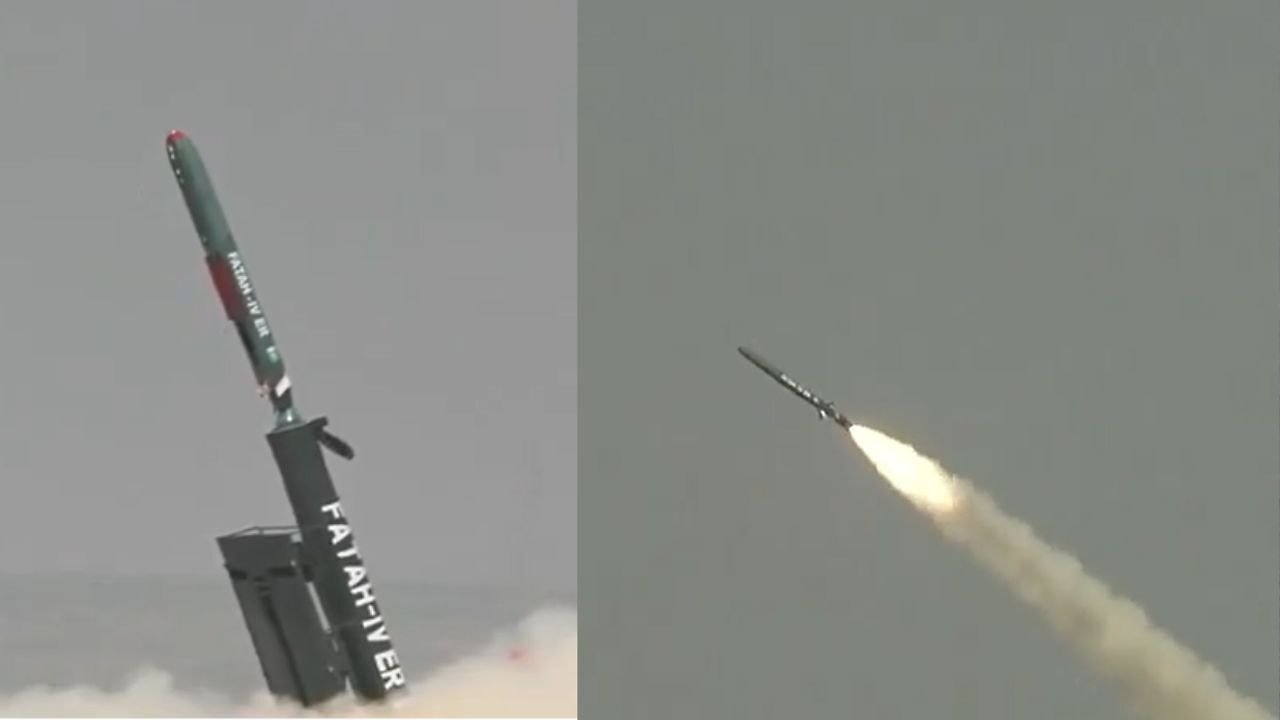
Neighboring Pakistan has successfully test-fired an extended range upgraded version of the indigenously developed Fatah-IV ground-launched cruise missile, giving its missile arsenal and long-range precision strike capability a boost. According to an official statement issued by the Inter-Services Public Relations (ISPR), the media wing of the Pakistan Army, the test was successfully conducted on Tuesday from an undisclosed test site in the country. During the test, comprehensive verification of all technical parameters related to various sub-systems of the missile, navigation accuracy and survivability to evade enemy air defenses was carried out. Seeing this successful test, senior officers, scientists and engineers of Pakistani Army and Strategic Command were present on the spot.
Immediately after the successful flight test of Fateh-4, Pakistan President Asif Ali Zardari, Prime Minister Shehbaz Sharif and Pakistan Army Chief General Asim Munir, along with the chiefs of the three armies, congratulated all the scientists, engineers and military personnel associated with this mission. Prime Minister Shehbaz Sharif said that this successful test has once again proved the country’s technological self-reliance and unwavering commitment to safeguard national security. Army Chief Asim Munir termed this achievement as a milestone in the direction of strengthening Pakistan’s conventional deterrence capability. Pakistan’s defense experts claim that with the induction of this missile, the Army’s rocket force will get a big advantage in accurately targeting deep strategic targets across the border.
The Fatah (F-Series) missile system of the Pakistani Army has evolved from traditional artillery rockets to modern cruise and guided weapons. The key technical features of the Fatah-4 ground-launched cruise missile are as follows:
-
Extended range: Earlier, training trials of Fatah-4 were conducted at a range of 750 kilometers, while the range of this new extended version has been further increased, making it capable of directly targeting enemy internal military bases, radar stations and command centers.
-
Advanced Avionics and Navigation: According to the Army, the missile is equipped with a hybrid model of state-of-the-art avionics, satellite navigation (GNSS) and inertial navigation system (INS), which ensures ‘pin-point accuracy’ even in GPS jamming environments.
-
Terrain Hugging and Low-Altitude Flight: Being a state-of-the-art cruise missile, Fatah-4 flies at very low altitude above the ground, parallel to the surface of mountains and valleys (Terrain Hugging), making it extremely challenging for conventional radar and missile defense systems to pre-track and intercept it.
-
Lethal Warhead Capability: It is fully capable of carrying conventional explosive and strategic payloads, which can cause heavy damage to bunkers, airstrips and dense military structures.
Pakistan has been working rapidly on its ‘Fatah’ missile series for the last few years. This journey, which started with the testing of Fatah-1 (140 km range) in the year 2021, is now moving towards Fatah-4 and further towards Fatah-5, passing through Fatah-2 (400 km range). The main objective of this new successful test of Fatah-4 is to achieve the capability of quick deployment through mobile launcher trucks on the border and retaliatory strike immediately after the first attack. Strategic analysts believe that in view of the deployment of modern air defense systems in the South Asian subcontinent, Pakistan is continuously changing the range and radar evasion technology of its stand-off weapons.
This latest test of Fatah-4 has created a stir in the military and diplomatic circles of South Asia. Although Pakistan is calling it a legitimate effort to maintain its self-defense and strategic balance, but according to experts, the deployment of long-range cruise missiles near the border could make the regional security scenario sensitive. Although India’s modern multi-layered air defense systems like S-400 Triumf and indigenous Akash-MRSAM are capable of destroying low-flying targets, such tests indicate further acceleration of the pace of missile technological race and modernization between the two countries.