 look news india

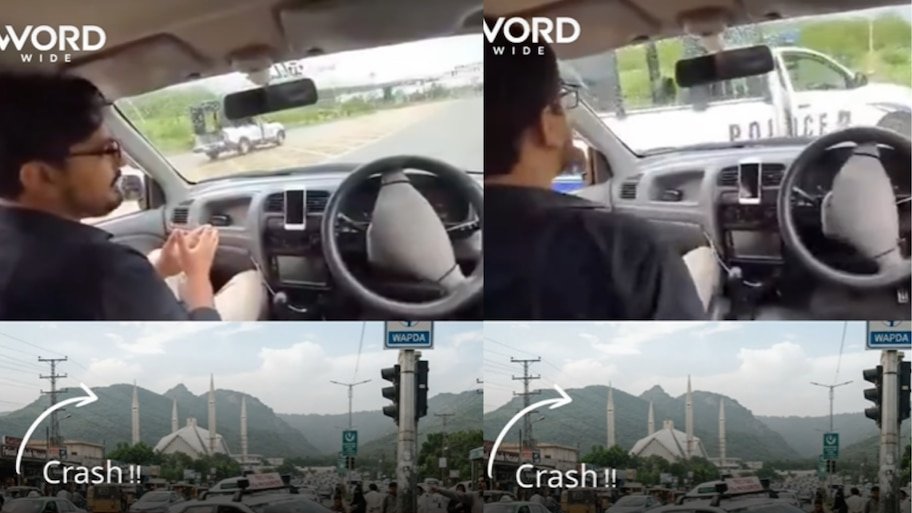
The public demonstration of a ‘driverless’ (remotely controlled) car prepared with indigenous technology in Pakistan’s capital Islamabad turned into a huge embarrassment when during the trial, the car suddenly went out of control and collided directly with a police van parked on the roadside. The video of this strange accident that happened at the sensitive and high-security D-Chowk located near the Parliament House has gone viral on social media. While on one hand there has been a flood of memes and satire on social media, on the other hand, serious safety questions have arisen regarding the trial of autonomous vehicles on public roads without adequate testing and safety standards.
The video of the incident was being shot by local journalist Mohammad Aliza, who was recording a live demo of this innovation while sitting on the front passenger seat. There was no driver present at the steering wheel and the vehicle was moving slowly. As soon as the journalist says in the video that “There is no dearth of talent in Pakistan”At that very moment, instead of turning to the right, the steering of the car suddenly turned to the left and the car collided directly with the Islamabad Police van parked in front. In a panic, the journalist tried to stop the car by pulling the handbrake, but by then the car had collided with the police van.
Different aspects have emerged regarding the reasons for this collision:
-
Internet and Satellite Disconnection: According to journalist Alija, this vehicle was being controlled remotely through internet and satellite signals. During the trial, there was a sudden disruption in internet connectivity, due to which the external control broke and the vehicle went out of control.
-
Argument for pressing the wrong button: Abbottabad resident and computer engineering student Ahsan Zafar Abbasi, who modified this car, says that when an attempt was made to turn the car during video recording, the left control was pressed instead of the right, due to which the car went straight in the direction of the police van.
After the video went viral, Islamabad Police swung into action and investigated the matter. SP City Zone Ayaz Hussain along with student Ahsan Zafar issued an official statement clarifying that no criminal intent or illegal offense has been found in this case. The police termed it a “genuine mistake” while testing the new invention and asked not to discourage technological innovation by the youth. Fortunately, the speed of the vehicle was slow, due to which no one was injured.
This incident has exposed the huge difference between the self-driving technology being developed globally and this indigenous model. Autonomous vehicles from Tesla, Waymo or other global companies make decisions in real-time using on-board sensors, LiDAR, radar, cameras and AI computing chips, rather than relying on an internet connection. Even if the signal goes off, the ‘fail-safe’ and automatic emergency braking (AEB) systems get activated. Conversely, a vehicle relying on the Internet and remote control to go out of control as soon as the signal was lost proves that adequate safety protocols and backup systems were not in place.
Experts and the journalist himself have warned that a major accident was averted due to less traffic at D-Chowk, but if the same technical glitch had happened in a busy market or highway, it could have proved fatal. People on social media are appreciating the efforts of innovation but are also advising that instead of testing it on public roads by risking human lives, its reliability should be proved first in a safe track or lab.